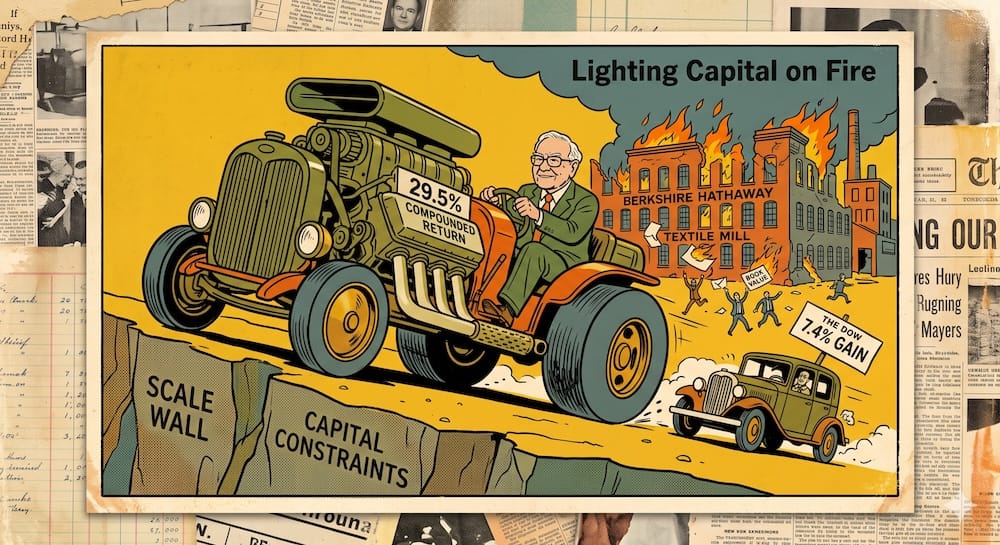
Benjamin Graham now functions as both an investor and a Rorschach test.
To one group, he is proof that disciplined investors can still uncover mispriced securities using conservative arithmetic. To another, he represents a fossilized version of capitalism built around factories, inventories, railroads, and balance sheets that modern companies have outgrown. Somewhere along the way, “Graham investing” was flattened into buying low price-to-book stocks, and the recent performance of that category became a public referendum on whether a man born in 1894 still understands markets.
That debate is tidy, measurable, and mostly wrong.
The real question is which parts of Graham’s system depended on the market he inhabited and which parts addressed permanent weaknesses in how investors make decisions. His original screens emerged from particular accounting rules, interest rates, disclosure systems, and opportunity sets. Several have weakened badly. Others need extensive reinterpretation. A few now survive mainly among tiny, distressed, illiquid securities where a beautiful backtest can become an ugly lived experience.
Graham’s deeper mechanism remains much harder to bury. He demanded that price be judged against independently appraised value, that uncertain futures receive limited credit, that analytical errors be expected, and that investors protect themselves before fantasizing about upside.
Modern markets have made those demands more difficult to satisfy. They have not made them obsolete.
My verdict is that classic value still works as a decision architecture. It fails when investors mistake Graham’s old measurements for the architecture itself.
A formula gives the comfort of an answer. Graham’s actual discipline imposes a burden of proof.
Low Price-to-Book Is a Very Small Graham Costume
The easiest way to declare Graham dead is to define him narrowly enough that one disappointing metric can kill him.
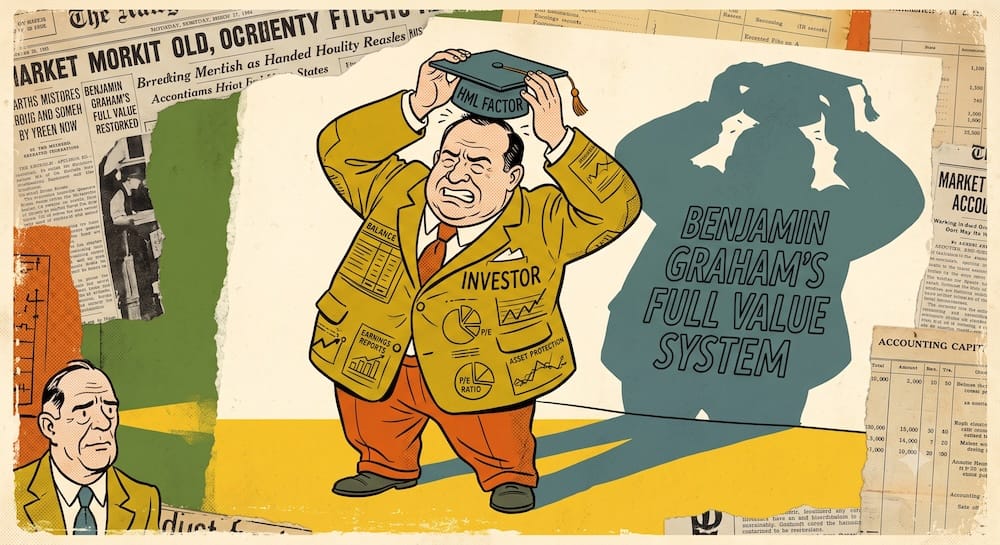
Modern academic finance often measures value using book-to-market. Eugene Fama and Kenneth French’s HML factor compares portfolios of high book-to-market stocks with low book-to-market stocks. In their later five-factor model, which added profitability and investment, HML became redundant in the 1963–2013 US sample.
That finding presents a genuine problem for anyone claiming that book-to-market alone captures an independent and permanent value premium.
It does far less damage to Graham’s full system.
Graham considered earnings, financial strength, asset protection, diversification, market price, and the reliability of the assumptions supporting valuation. His work ranged from detailed security analysis to diversified groups selected through statistical criteria. He did not hand investors one ratio and tell them to close the filing.
Calling HML “Graham investing” solves several institutional problems at once. Academics receive a definition that can be measured across decades. Consultants receive a style category. Fund companies receive a product label. Financial media receive a scoreboard showing whether value defeated growth this quarter, as though two philosophical armies met at dawn and settled the matter before the closing bell.
The full Graham process is less commercially convenient. It demands judgment about liabilities, asset quality, normalized earnings, accounting treatment, and the durability of a company’s economics. Those decisions resist clean packaging. Remove them and “value” becomes wonderfully scalable.
It also becomes much thinner.
A low price-to-book ratio may identify a financially sound business temporarily neglected by the market. It may identify obsolete assets, deteriorating economics, aggressive acquisition accounting, or a company earning miserable returns on the capital shown in its accounts. The ratio does not explain which situation the investor has found. It simply reports that the market price is low relative to a bookkeeping figure.
I understand why the simplification is seductive. A clean category feels impartial. It gives the impression that discretion has been removed and discipline has taken over. I am susceptible to that comfort myself. A formula with two decimal places can look more honest than a human judgment even when the formula is measuring the wrong thing with magnificent precision.
Weak performance from low price-to-book portfolios therefore tells us something real about that metric, that construction method, and that period. It cannot carry the weight of a verdict on Graham’s entire approach.
Classic value becomes intellectually useless when every cheap ratio is treated as Graham and every disappointing cheap ratio is used to prosecute him.
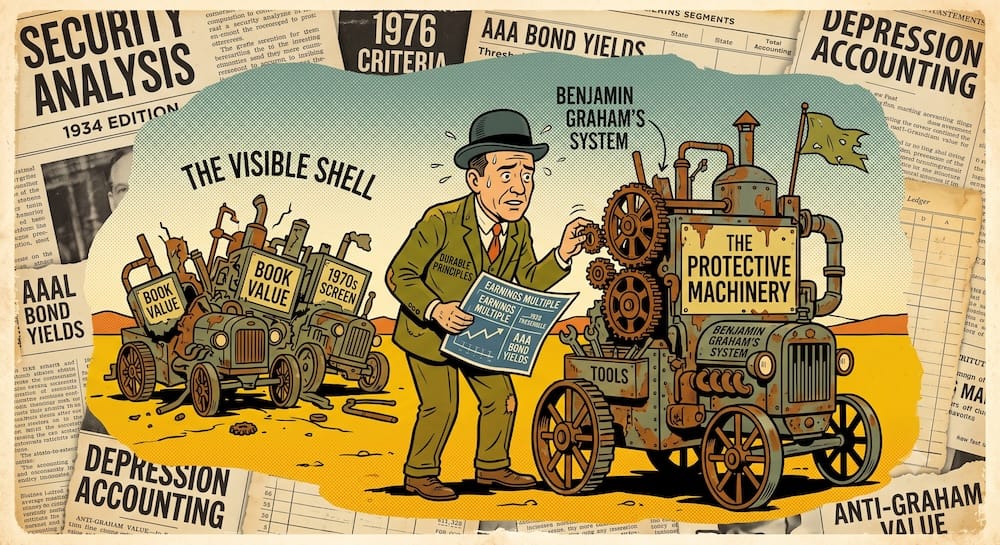
Graham Built Principles and Tools; Followers Keep Confusing Them
Graham and David Dodd defined an investment operation in the 1934 edition of Security Analysis as one that, after thorough analysis, promises safety of principal and a satisfactory return. Anything failing those requirements was speculative.
The sequence matters.
Analysis must establish protection and prospective return. Cheapness does not award itself a certificate of safety. A security can trade at a low multiple because the market is emotional, because the accounting is misleading, or because the business is genuinely dreadful.
More than four decades later, Graham told the Financial Analysts Research Foundation that successful investing required “the right general principles and the character to stick to them.” By then, he had also become sceptical that analysts could consistently identify individual companies destined for superior long-term performance. His preference had shifted toward diversified groups purchased through relatively simple undervaluation criteria.
That evolution reveals two layers inside his system.
The layer that still travels
The durable layer consists of decision constraints:
- Market price must be compared with an independently reasoned estimate of value.
- Valuation should rest on evidence strong enough to survive disappointment.
- Protection against loss deserves priority because analytical errors are inevitable.
- Diversification can compensate for uncertainty across individually fragile bargains.
- Popular enthusiasm does not cancel the investor’s obligation to appraise the security.
None of those principles requires Depression-era accounting. They remain coherent wherever uncertain businesses trade at fluctuating prices.
The layer tied to Graham’s conditions
The second layer contains his implementations: earnings-yield thresholds, discounts to working capital, financial-strength tests, balance-sheet rules, and numerical buying limits.
Even Graham’s simplified 1976 criteria incorporated the environment around them. He linked acceptable earnings multiples to prevailing AAA bond yields, suggesting maximum multiples in the range of roughly seven to ten. The threshold changed as the return available from high-grade bonds changed.
Graham adjusted his numbers because the relationship mattered more than the number.
Many followers reverse that hierarchy. They preserve the number and forget the relationship. A screen survives because it is visible, easy to copy, and blessed by history. The economic purpose quietly disappears.
I give Graham considerable credit for refusing to worship his own equipment. His methods evolved because he understood that a tool earns its place by enforcing a principle. Once the tool stops doing that job, loyalty becomes theatre.
This is where classic value can become strangely anti-Graham. Investors keep a fixed multiple during a radically different interest-rate environment, treat stated book value as economic value, or concentrate heavily in one distressed company because it passes a screen designed for diversified portfolios.
The visible shell remains. The protective machinery has been removed.
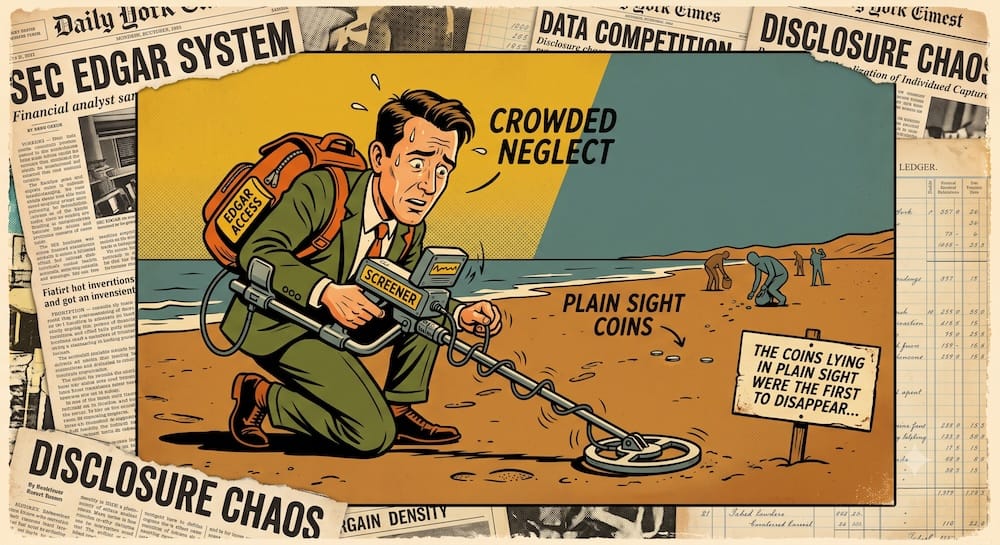
Graham Had More Bargains to Work With
Some of Graham’s success came from the quality of his reasoning. Some came from the astonishing supply of securities available to that reasoning.
In his 1932 Forbes series, “Is American Business Worth More Dead Than Alive?”, Graham reported that more than 40% of New York Stock Exchange companies traded below net working capital. Some sold for less than the cash shown on their balance sheets.
That opportunity set scarcely resembles the modern large-cap market.
The Depression created forced liquidation, shattered confidence, corporate distress, and prices detached from ordinary expectations of going-concern value. Graham did not manufacture those conditions. He developed a method capable of exploiting them with unusually conservative arithmetic.
The distinction between method quality and opportunity supply often gets blurred. Investors look at Graham finding obvious asset discounts and assume that superior analysis produced the entire advantage. Yet analysis had an enormous amount of raw material. The market offered widespread discounts that allowed current assets and liabilities to do much of the intellectual work.
Modern disclosure and data systems changed that environment. The US Securities and Exchange Commission’s EDGAR system eventually made filings freely available in real time, generally within minutes of submission. Screeners and financial databases turned a laborious information-gathering process into an automated search.
The information advantage did not vanish completely. It became more competitive and migrated toward harder questions.
Thousands of analysts can now identify a company trading below book value. Far fewer can determine whether the book value is economically meaningful, whether the liabilities are fully captured, whether the assets can earn adequate returns, or whether management will destroy the apparent discount before shareholders receive it.
Saying markets “became more efficient” makes the transition sound almost natural. What happened was more concrete. More professionals gained access to the same filings, similar databases, overlapping screens, and enormous incentives to locate the same visible bargains. Easy numerical neglect became crowded.
The beach may still contain valuables. The coins lying in plain sight were the first to disappear once everyone received a metal detector.
Graham’s original bargain density was an enabling condition. It should never be mistaken for a natural law. His logic can remain sound after the supply of obvious candidates contracts, although the expected results from copying his screens cannot simply be carried forward unchanged.
A method can survive the disappearance of its easiest opportunities. It becomes harder to practise, easier to misuse, and less forgiving of shortcuts.
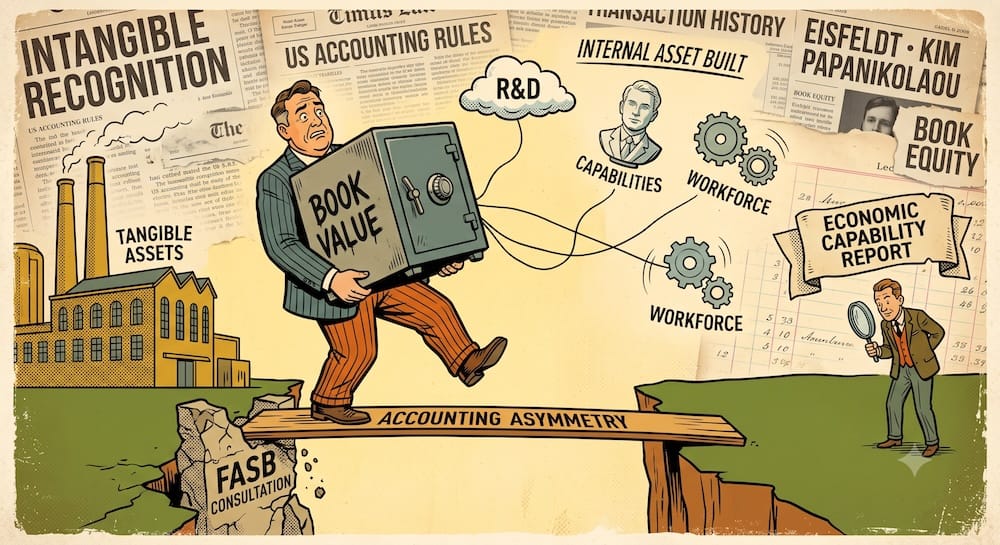
Book Value Can Now Misclassify Strength and Weakness
Book value once carried more intuitive economic meaning because corporate assets were more often tangible, recorded, and visible: factories, machinery, inventory, receivables, land, and cash.
Modern companies have made that picture much messier.
Under US accounting rules, many internally generated intangible investments are expensed. Research and development, internally developed brands, workforce capabilities, and other expenditures may reduce reported earnings without creating a corresponding balance-sheet asset. Economically similar resources acquired through a corporate purchase may be recognized.
The Financial Accounting Standards Board’s 2024 consultation on intangible recognition describes this asymmetry. Accounting treatment can depend partly on whether a company built an asset internally or bought it from someone else.
That is a serious limitation.
Two companies can possess comparable productive capabilities while reporting very different book values because one developed them and the other acquired them. The ratio may reflect transaction history almost as much as underlying economics.
Andrea Eisfeldt, Edward Kim, and Dimitris Papanikolaou examined this issue in “Intangible Value”. Their intangible-adjusted value measure sorted firms more effectively on several characteristics, including productivity, profitability, and financial soundness, and it produced stronger returns in their sample.
Their work supports the case that traditional book equity can omit economically meaningful investment.
It does not make intangible reconstruction objective.
A company’s research spending is visible. The eventual payoff is not. Some research creates durable intellectual property. Some leads nowhere. Spending on workers may create organizational capability, although employees can leave. Advertising may build a valuable brand or produce an expensive campaign that vanishes from public memory within weeks.
Accounting scholars Richard Barker, Andrew Lennard, Stephen Penman, and Alfred Wagenhofer Teixeira have highlighted the uncertainty involved in estimating useful lives, future revenues, amortization, and impairment for intangible assets. Expensing can understate investment. Capitalization can create an impressive-looking asset from assumptions nobody can verify.
This leaves the investor with an uncomfortable choice. Reported book value may omit real economic resources. Adjusted book value may smuggle speculation into the balance sheet.
My answer is to treat the adjustment as useful and uncertain at the same time. That sounds obvious. In practice, investors have a remarkable talent for performing the first half and forgetting the second.
An analyst capitalizes R&D, estimates a useful life, adjusts earnings, and raises calculated value. The uncertainty of the reconstruction should demand a larger discount. Instead, the adjustment often becomes a licence to pay more because the business now appears “asset-rich” under a private accounting system designed by the person hoping to buy it.
The other side deserves equal attention. Tangible assets are not automatically valuable because they can be photographed. A factory may produce unwanted goods. Inventory may require severe discounting. Receivables may prove uncollectible. Machinery can remain physically intact after its commercial usefulness has died.
Book value has therefore become less comparable, while its components still require scepticism. It has not become universally meaningless.
Fama and French’s finding that profitability and investment add explanatory information beyond book-to-market reinforces the same point. A valuation ratio needs context from the economics producing it.
A bad business can become statistically cheaper every year. That does not mean value is accumulating. Sometimes the denominator is documenting the wreckage.

Net-Nets Still Make Sense—and Barely Solve the Modern Problem
Graham’s net-current-asset-value method is the cleanest test of whether a valid idea can lose practical reach.
The method values current assets conservatively, subtracts all liabilities, and demands a substantial discount. Fixed assets and future growth receive little or no credit. The investor attempts to buy a claim for less than a severe estimate of realizable net assets.
Historical studies found strong results. Henry Oppenheimer examined US securities meeting Graham’s NCAV criterion from 1970 through 1982 and reported substantial benchmark-relative performance. Ying Xiao and Glen Arnold later tested the strategy in London and also found strong historical portfolio results.
The London sample exposed the portability problem. It contained 74 qualifying companies in 1981 and 76 in 1982. By much of the late 1990s, the annual number had fallen into single digits.
The logic had not broken. The supply had.
That distinction matters because investors often discuss whether a strategy “works” as though effectiveness were a permanent substance sealed inside the formula. Actual results depend on how many opportunities exist, who else is pursuing them, how liquid the securities are, how the portfolio is constructed, and whether the apparent assets survive contact with reality.
Net-nets still appear. They are more likely to inhabit the market’s less hospitable neighbourhoods: microcaps, distressed companies, illiquid listings, foreign securities, and firms with serious governance or solvency concerns.
That migration creates a widening gap between a historical return series and an investable outcome.
Kewei Hou, Chen Xue, and Lu Zhang found in their broader anomaly-replication work that many reported effects weakened substantially when microcap influence was reduced using NYSE breakpoints and value-weighted portfolios. Their findings do not invalidate every NCAV study. They do show how tiny securities can dominate a result while presenting severe trading and capacity problems.
A spreadsheet can assign heroic returns to a portfolio whose real-world execution involves wide spreads, scarce liquidity, ugly governance, and the occasional company that appears to communicate with shareholders through smoke signals.
Diversification was part of Graham’s answer. Deep bargains were often weak companies. Some recovered. Some liquidated favourably. Some remained awful. Portfolio construction reduced the need to treat every security as a misunderstood masterpiece.
Followers frequently keep the cheapness and remove the diversification. They discover one distressed company, write an elaborate turnaround narrative, and call the position Graham-like because the multiple is low.
That version has inherited the danger and discarded the insurance.
Net-nets remain conceptually powerful because they reveal the original discipline in concentrated form: conservative assets, full liabilities, little credit for forecasts, and a severe purchase discount. They are less useful as proof that a broad modern strategy remains readily available.
The method survived. Its natural habitat shrank.
Faster Information Did Not Cure Forced Selling or Human Extrapolation
Graham accepted that information could become widely distributed. He rejected the assumption that widespread information must produce logically correct prices.
That distinction looks even more important now.
Markets process public data at extraordinary speed. Filings are searchable. Models update rapidly. Automated systems can react before a human investor has finished reading the headline.
Yet a market price is created by transactions, and transactions occur for reasons extending far beyond a calm reassessment of intrinsic value.
Joshua Coval and Erik Stafford documented how mutual funds experiencing extreme investor flows were forced to trade existing holdings, producing price pressure. Investors supplying liquidity against constrained funds earned significant returns in their sample.
The mechanism requires no grand theory of irrationality. A fund facing redemptions needs cash. It sells securities it owns. Some may be fairly valued. Some may be undervalued. The transaction reflects an institutional constraint as well as an opinion about the company.
That is a modern path through which price can separate from value.
Josef Lakonishok, Andrei Shleifer, and Robert Vishny offered another mechanism. Their work documented value-return patterns and argued that investor extrapolation explained the results better than higher fundamental risk in their tests. The broader dispute between behavioural and risk-based explanations remains unresolved.
I am comfortable leaving that dispute unresolved because the useful conclusion does not require a monopoly explanation. Investors extrapolate. Institutions face constraints. Leverage limits matter. Redemptions matter. Mandates matter. Career protection matters. None of these forces guarantees a bargain, yet each can move price without delivering a fresh insight into long-term business value.
The flattering description of an efficient market imagines collective intelligence continuously refining prices. Real markets also contain committees, benchmarks, liquidity needs, forced rebalancing, and managers who may prefer a conventional mistake to an unconventional career-ending position.
Graham was right that information availability and valuation accuracy are separate conditions.
He was also operating before the modern arms race in data, speed, computing, and professional analysis. Mispricing may survive, although the investor needs a much better explanation than “the ratio is low.”
Why does the gap exist? Which participant is constrained? What does the market appear to be extrapolating? Is the apparent discount large enough to survive errors in the appraisal? Can the investor endure the time required for the gap to close?
Recognizing a forced seller does not reveal when the selling will end. Identifying overreaction does not prove intrinsic value. A security can remain mispriced long enough to expose weaknesses in financing, temperament, or analysis.
Being early is occasionally indistinguishable from being wrong until after the investor’s patience, liquidity, or credibility has expired.
Modern markets preserve Graham’s premise under harsher operating conditions. Price and value can diverge. Exploiting the divergence requires more work, more restraint, and fewer assumptions disguised as insight.
Which Graham Tools Still Travel?
Graham’s methods become easier to assess once each one is tested against four questions: What economic purpose did it serve? How dependent was it on his historical setting? What distorts it now? Does it still enforce the principle it was designed to protect?
| Graham tool or principle | Original purpose | Modern complication | Current status |
|---|---|---|---|
| Price–value separation | Prevent the market quotation from replacing independent appraisal | Value remains uncertain and model-dependent | Structurally portable |
| Conservative evidence | Reduce reliance on optimistic forecasts | Intangible-heavy businesses require more estimation | Structurally portable, harder to execute |
| Diversification across fragile bargains | Limit damage from company-specific failure and analytical error | Illiquidity and trading costs can concentrate practical exposure | Structurally portable |
| Earnings yield | Relate earning power to price and available alternatives | Cyclical earnings, accounting choices, and changing rates distort fixed thresholds | Portable after adaptation |
| Book value | Anchor valuation to recorded net assets | Internally generated intangibles may be omitted; weak tangible assets may be overstated | Selectively portable |
| Financial-strength tests | Reduce insolvency and refinancing risk | Off-balance-sheet obligations and business-model differences require broader analysis | Portable after adaptation |
| Net-current-asset-value screens | Buy assets at a severe discount with minimal dependence on growth | Scarcity, illiquidity, governance, and distress limit the opportunity set | Narrow and historically contingent |
| Fixed numerical thresholds | Enforce price discipline | Rates, inflation, accounting, and industry economics change | Useful only when recalibrated |
The pattern is clear.
Graham’s broad constraints travel well. His measurements travel unevenly. The extraordinary abundance of his original opportunities does not travel at all.
I would preserve conservative appraisal before preserving any individual ratio. I would preserve the relationship between earnings yield and available alternatives before preserving a fixed multiple. I would preserve diversification across uncertain bargains before concentrating in one company merely because it has achieved an impressively low valuation statistic.
The hierarchy runs from principle to tool. Reverse it and the tool begins impersonating the principle.
That is how a useful screen becomes an ideology.
Modernizing Graham Can Become a Sophisticated Excuse to Pay More
Graham’s framework must be updated for intangible-intensive businesses. The danger lies in making the update so generous that his protective mechanism disappears.
Consider the adjustments available to a modern analyst. Capitalize research spending. Estimate a useful life. Amortize the reconstructed asset. Assign economic value to the brand. Normalize customer-acquisition spending. Project mature margins. Include network effects. Add optionality.
Each step can sound reasonable. Together they can produce a valuation resting on an impressive number of individually uncertain assumptions.
Complexity is persuasive because discretion becomes harder to see once it is distributed across fifty spreadsheet cells. I have to watch this tendency in my own reasoning. An elaborate model can feel disciplined simply because it took longer to build.
Graham’s scepticism toward long-range forecasting helps establish the boundary. In his 1976 interview, he contrasted relatively simple valuation criteria with attempts to identify the next great company or winning industry. He doubted that investors could make those forecasts reliably enough to profit consistently from them.
His warning should not be turned into a ban on every forecast. Even liquidation analysis contains expectations about collection values, liabilities, and timing. Every appraisal reaches into the future to some degree.
The decisive issue is dependency.
How much of the estimated value requires growth that has not occurred? How sensitive is the result to small changes in margins, useful lives, discount rates, or terminal assumptions? How much of the claimed asset base exists because the analyst converted uncertain expenditure into privately estimated capital?
A faithful modernization would adjust flawed accounting inputs and demand greater protection around the replacement estimates.
Investors often do the reverse.
They reconstruct intangibles, increase estimated value, and then accept a higher purchase price because the company appears to possess better economics. Uncertainty becomes the ingredient used to justify paying more.
The adaptation grows more sophisticated while the margin of safety grows thinner.
The modern value label can accommodate almost any conclusion once enough forward assumptions are introduced. A high-multiple company becomes cheap relative to its total addressable market. A loss-making business becomes cheap relative to mature margins. An acquisition-heavy firm becomes cheap after removing “non-recurring” charges that return annually with the reliability of a subscription service.
Those judgments may occasionally prove correct. They do not inherit Graham’s protection merely because the analyst mentions intrinsic value.
Graham deserves credit for making uncertainty expensive. When an investor lacks confidence in the assets, earnings, or future, that uncertainty should reduce the acceptable price.
Once uncertainty is used to increase calculated value, the process has crossed into another philosophy while keeping Graham’s name on the door.
Graham Still Works Best as a Burden of Proof
Classic value remains alive wherever market price can separate from conservatively appraised economic value.
That separation still occurs. Investors extrapolate. Funds sell under pressure. Accounting omits some productive assets and overstates others. Market participants possess more information than ever while continuing to operate under mandates, incentives, liquidity needs, and ordinary human limitations.
Several Graham tools have lost much of their original reach. Book value is less comparable across firms built around intangible investment. Net-nets are scarcer in major developed markets and increasingly concentrated among securities with serious practical risks. Fixed thresholds lose meaning when detached from interest rates, accounting conditions, and business economics.
Graham’s survival therefore cannot be established by proving that one old screen will outperform. The available evidence does not support that promise.
His survival rests on a harder standard.
Can value be defended independently of the quoted price? Does the appraisal rely on observable economics or an optimistic chain of future events? Has downside received the same analytical attention as upside? Is the apparent bargain robust enough to survive errors in the assumptions? Does the implementation preserve the diversification, liquidity, and patience the theory quietly requires?
I would use Graham to reject valuations that become attractive only after uncertainty has been resolved in the investor’s favour. I would not use him to pretend that every low ratio is a bargain or that every reconstructed intangible is an asset.
Modern markets did not invalidate classic value. They exposed which parts were portable and which parts were fortunate products of Graham’s time.
The formulas can expire. The burden of proof remains.
Does Benjamin Graham’s classic value investing still work in modern markets?
Yes, as a decision framework rather than a frozen set of formulas. Graham’s emphasis on separating price from value, demanding conservative evidence, protecting against analytical error, and limiting optimistic assumptions remains useful even when individual screens require adaptation.
Is Benjamin Graham investing the same as buying low price-to-book stocks?
No. Graham considered earnings, financial strength, asset protection, diversification, market price, and the reliability of valuation assumptions. A low price-to-book ratio is only one possible signal and can identify either genuine undervaluation or a deteriorating business.
Why are Benjamin Graham’s original bargains harder to find today?
Modern disclosure systems, financial databases, and automated screeners allow many investors to locate obvious statistical bargains quickly. Graham also operated during periods when unusually large numbers of companies traded below conservative measures of tangible asset value.
Has book value become useless for modern value investors?
No. Book value remains useful in some situations, but it is less comparable across companies because internally developed intangible investments may be expensed while acquired intangibles may be recognized. Tangible assets can also be overstated when their economic usefulness deteriorates.
Do Benjamin Graham’s net-net strategies still work?
The underlying logic remains coherent, but the opportunity set has narrowed. Modern net-nets are often concentrated among small, illiquid, distressed, foreign, or governance-challenged companies, creating a substantial gap between historical backtests and practical implementation.
What is the biggest danger when modernizing Benjamin Graham’s methods?
The danger is replacing imperfect accounting measures with estimates that depend on optimistic assumptions. Adjusting for intangible assets can improve analysis, but uncertainty should increase the required discount rather than become an excuse to justify a higher valuation.
This article is also available in Spanish. [Leé la versión en castellano: Benjamin Graham frente a los mercados modernos: ¿Sigue funcionando la inversión en valor clásica?]