The general investing public views Harry Browne’s Permanent Portfolio as a sleepy, “set-and-forget” cash substitute or a low-beta parking lot for retirees who are terrified of the stock market. They look at smooth, fifty-year backtests and assume holding it is a psychological free lunch.
But backtests are a clean map of a very messy road.
When you strip the strategy down to its bare metal, it reveals an elegant piece of engineering that most modern commentators completely misunderstand. They look at the 25/25/25/25 split and see a crude, childish simplification—a neat piece of geometric symmetry designed for people who don’t know how to run a regression analysis or optimize a covariance matrix. They assume that because the math is simple, the philosophy behind it must be simplistic.
They have it backward.
The core mechanism of Harry Browne’s framework is not arbitrary neatness. It is humility expressed as math. The point is not just that each asset maps to a particular macroeconomic season. The deeper, unyielding logic is that Browne flatly refused to forecast which season deserved more capital, so he gave each economic defense job equal structural authority.
I like this because it offends almost everyone inside the institutional finance ecosystem. It insults the Wall Street prognosticators who make their living pretending they know where the Federal Funds Rate will sit next quarter. It irritates the quantitative optimization crowd who spend their lives overfitting historical datasets to find the “perfect” fractional allocation. And it terrifies the average investor because it forces them to sit with a permanent, unhedged exposure to assets that look remarkably stupid for years at a time.
This article is not about Harry Browne’s political campaigns or his apocalyptic newsletter warnings. It is about the specific logic of equal-weight economic defense: why gold, cash, stocks, and long-term bonds each deserve identical 25% status inside a defensive system. It is an exploration of what happens to a portfolio when you stop trying to rank economic dangers based on a forecast, drop the illusion of control, and give every core market threat equal weight at the table.
Equal Weight Is the Point, Not a Formatting Choice
If you hang around online finance forums long enough, you will eventually encounter the optimization trap. Someone will pull up a spreadsheet, load forty years of macroeconomic data, run an efficient frontier calculation, and confidently announce that Browne was wrong. They will show you that a 31% stock allocation paired with 19% gold and 22% bonds would have yielded an extra 42 basis points of risk-adjusted return over some specific historical window.
Whenever I see those charts, I smile, because they are completely missing the philosophical spine of the strategy.
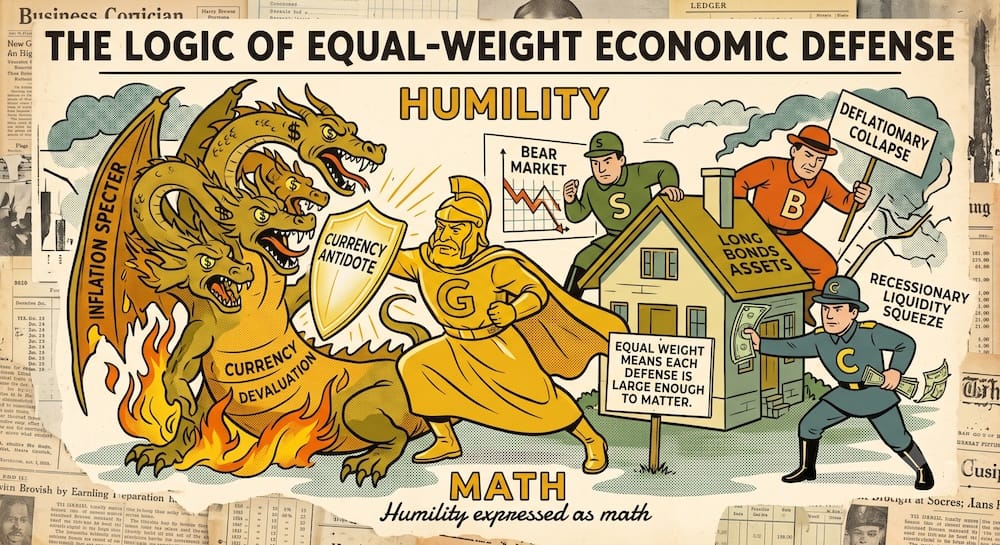
Browne’s equal weighting is an explicit anti-forecasting device. He does not give stocks more because growth usually wins over long cycles. He does not give gold more because inflation is a terrifying specter that destroys fiat purchasing power. He does not give bonds more because deflation can wipe out equities overnight. And he does not give cash less because its nominal yield feels boring or counterproductive during an expansion.
He gives each asset exactly 25% because each represents a fundamentally different kind of economic defense, and he refuses to pretend he knows which defense will matter next.
┌─────────────────────────────────────────────────────────────┐
│                 THE EQUAL-WEIGHT DEFENSE GRID               │
├──────────────────────────────┬──────────────────────────────┤
│       PROSPERITY DEFENSE     │       DEFLATION DEFENSE      │
│          25% STOCKS          │        25% LONG BONDS        │
├──────────────────────────────┼──────────────────────────────┤
│       INFLATION DEFENSE      │       RECESSION DEFENSE      │
│           25% GOLD           │           25% CASH           │
└──────────────────────────────┴──────────────────────────────┘
To understand why this equal authority matters, you have to look at the portfolio not as a collection of investment ideas, but as a team of specialized security guards. If you are building a defense system for a house, you don’t spend 80% of your budget on a state-of-the-art security system to stop robberies, 5% on fire insurance, 5% on flood defenses, and 10% on structural maintenance just because it hasn’t rained in a few months. A flood doesn’t care that you spent most of your money preparing for a burglary. When the water rises, your security cameras are useless.
In the economic matrix, the weather is always changing, and the shifts are rarely polite enough to announce themselves ahead of time. By assigning an identical 25% weight to each asset class, Browne creates a structure where the explosive gains of the asset in its proper season can be large enough to counterbalance the losses or dead weight of the assets currently out of season. If an investor dilutes any single sleeve down to a minor 5% or 10% “tilt,” it destroys that sleeve’s ability to protect the aggregate capital base when its specific nightmare scenario manifests. Equal weight means each defense is large enough to matter.
The Four Defense Jobs
To appreciate the elegance of this structure, we have to look at each sleeve not through the lens of maximizing returns, but through the lens of its explicit defense job. Each asset is assigned a specific threat to neutralize, and each carries a behavioral tax that an investor holding this structure must pay outside its designated season.
| Asset | Economic Defense Job | What It Protects Against | Why 25% Matters | Why It Looks Stupid Outside Its Season |
| Stocks | Productive growth capture | Missing out on systemic prosperity | Enough to participate in expansions without letting equity crashes dominate the whole structure | Appears wildly inefficient during valuation crashes or prolonged secular bear markets |
| Long-Term Bonds | Deflation shock insurance | Collapsing interest rates and credit contraction | Maximum duration exposure ensures small allocations generate significant capital gains in panics | Looks like financial madness during rising-rate regimes or runaway inflationary cycles |
| Gold | Monetary disorder shield | Systematic currency distrust and runaway CPI | Large enough to offset paper-asset destruction when confidence in central banking breaks | Generates zero yield, carries storage costs, and undergoes brutal multi-decade dry spells |
| Cash | Liquidity survival anchor | Forced selling, credit freezes, and panic | Provides structural liquidity and emergency funding when all markets lose liquidity | Suffers continuous purchasing power decay from inflation and creates deep bull-market regret |
When you lay out the chess pieces this way, you realize that the portfolio is designed to exploit the fact that these assets have wildly different personalities. They don’t move together, and they often perform best when their companions are suffering. Let’s look at how each sleeve operates inside this equal-weight defense grid.
Stocks: The Growth Sleeve Browne Refused to Worship
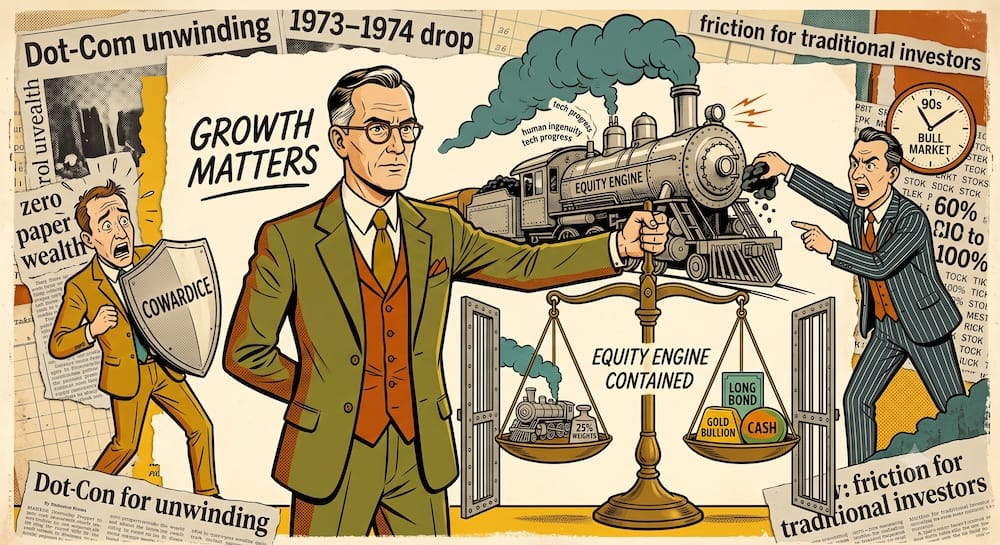
Let’s start with the asset class that causes the most friction for traditional investors: equities. Browne was not anti-capitalist, nor was he a perma-bear hiding in a bunker. He understood that corporate equities are an exceptional engine for capturing human ingenuity, technological progress, and compounding real wealth during periods of economic prosperity. Browne’s framework requires stock exposure because when the world is working, factories are running, and consumers are spending, equities drive capital expansion.
But he absolutely refused to worship them.
The traditional 60/40 portfolio and modern equity-maximalist frameworks are built on a singular, unstated assumption: that economic prosperity is the default state of human affairs, and all other macro regimes are brief, temporary interruptions to the long-term trend. Because of this narrative, investors willingly expose 60% to 100% of their capital to corporate equity risk, assuming they can simply ride out whatever drawdowns occur.
Browne’s allocation of 25% to stocks says something very different: “Growth matters, but growth is not the only weather.”
This 25% baseline is explicitly designed to keep the equity engine contained. It ensures that when prosperity arrives, the capital participates enough to maintain purchasing power and build real wealth. But because it is capped at a quarter of the allocation map, a catastrophic 50% equity crash—like the one experienced during the 1973–1974 drop or the 2000–2002 Dot-Com unwinding—only inflicts an isolated 12.5% hit on the aggregate portfolio architecture before accounting for the performance of the other sleeves.
I respect this approach because it manages to offend two entirely different camps at the same time. It annoys the hard-money doomsday preppers who think all paper equities are a scheme destined for zero, and it infuriates the equity maximalists who view any asset that isn’t a stock as an act of cowardice. During a roaring bull market like the late 1990s, holding just 25% in stocks feels like a self-inflicted wound. You lag the benchmarks, and the strategy looks completely out of step with the times. But that limitation is the price of admission for ensuring an equity bear market cannot break your financial security.
Long Bonds: Duration as Deflation Defense
If the stock sleeve represents economic optimism, the 25% allocation to long-term nominal Treasury bonds represents the ultimate insurance policy against economic despair. And this is where many modern retail allocators make their most dangerous alteration to Browne’s design: they swap out long-term bonds for intermediate-term bonds because they are terrified of duration risk.
That single change completely dismantles the portfolio’s defense mechanics.
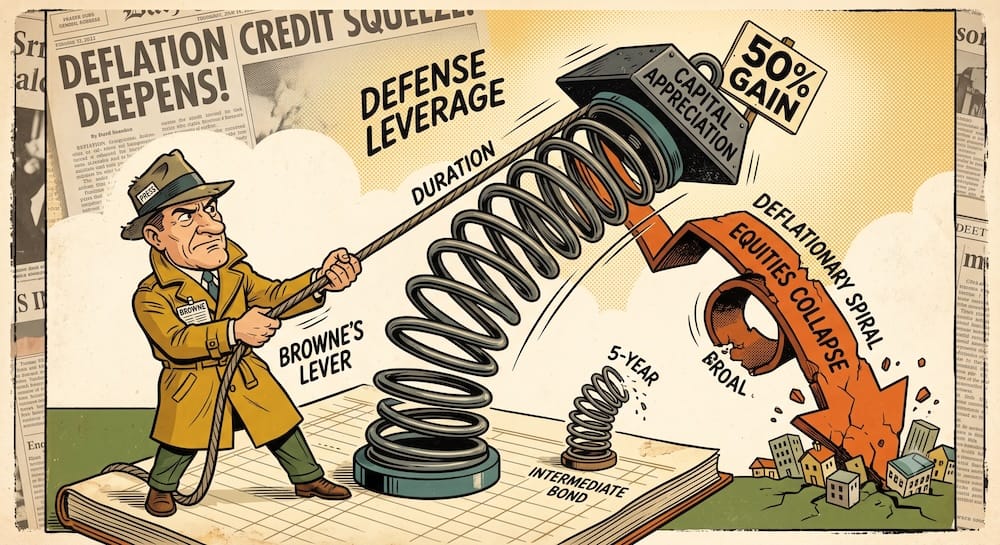
Browne’s choice of long-term bonds was entirely deliberate. This sleeve does not exist to collect yield or provide a steady stream of conservative income. Its job is to provide an explosive, high-duration capital gains surge during a sudden deflationary shock or a systemic credit contraction.
Consider a simplified approximation of fixed-income duration mechanics:
Price Change ≈ -Duration × Change in Yield
At a 25-year duration, a sharp 2% drop in yields translates to an approximate 50% capital gain, serving as an exceptional counterweight. If you shorten that duration to a 5-year intermediate bond, a 2% drop in yield provides only a modest 10% gain, which is entirely insufficient to act as a portfolio defibrillator when equities are shedding value.
When the economy enters a deflationary spiral, consumer prices fall, economic activity collapses, and interest rates plummet. In that specific climate, equities crater. To offset that destruction, the system needs an asset that can move with equal and opposite violence in the upward direction. Long bonds are one of the few asset classes designed for that role because their extreme sensitivity to changing interest rates delivers massive capital appreciation when yields collapse.
In isolation, holding 25% of your wealth in long-term Treasuries looks highly questionable during a rising interest rate regime, as investors were reminded during the structural shifts of the early 2020s. When rates climb, long bonds lose significant value. But inside Browne’s equal-weight system, the sleeve exists because when the deflationary nightmare manifests, it provides the necessary defensive leverage to swallow an equity collapse whole.
Gold: Monetary Insurance, Not Gold-Bug Religion
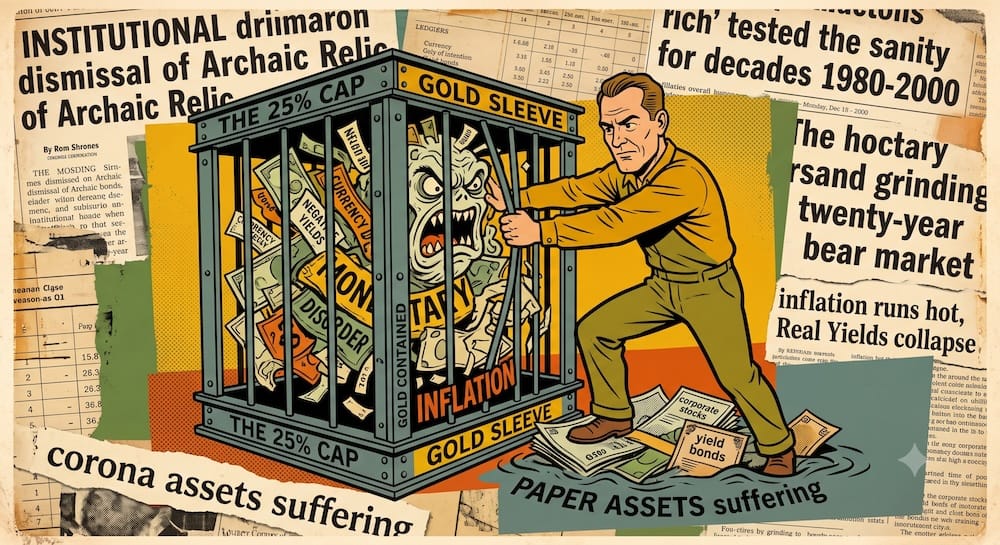
The third guard at the gate is gold, and it is undoubtedly the most controversial 25% slice in the entire layout. In mainstream institutional finance, gold is routinely dismissed as an archaic relic—a useless, non-yielding metal that produces no cash flow, pays no dividends, and has no place inside a modern asset allocation model.
Browne viewed gold through a lens stripped of both institutional dismissal and gold-bug fanaticism. He did not look at gold as a speculative vehicle to achieve riches, nor did he treat it as a religious token for an impending return to the gold standard. He treated it strictly as a functional economic defense unit designed to hedge against a singular, specific threat: monetary disorder, severe inflation, and systemic distrust in central banking.
The core dynamic of gold is tied closely to real interest rates (nominal rates minus inflation). When inflation runs hot and outpaces nominal interest rates, real yields collapse into negative territory. In that environment, paper currencies, nominal cash, and long-term bonds decay in real purchasing power. Gold serves as a classic currency proxy that cannot be diluted by central bank printing presses, frequently experiencing sharp upward volatility when confidence in paper currency breaks down.
The problem with gold—and the reason it requires an exact 25% weight—is that outside of those inflationary stress events, it can look completely useless for decades. Between 1980 and 2000, gold entered a grinding, twenty-year bear market that tested the sanity of anyone who held it. If you allocate only a minor fraction to gold as a small diversifier, its performance during an inflation shock will be a rounding error that fails to protect your total net worth. If you allocate too much to it out of fear, its long dry spells will completely paralyze your capital compounding.
Equal weighting keeps gold contained. It gives it enough structural authority to salvage the portfolio when paper assets are suffering, but caps it tightly enough to prevent an ideological obsession with hard assets from ruining your participation in periods of corporate prosperity.
Cash: The Most Insulted Sleeve
We come finally to cash—specifically, short-term sovereign Treasury bills. This is the sleeve that every optimization model mocks, every financial adviser tries to minimize, and every investor is tempted to ditch during an extended bull market. In an era dominated by discussions of inflation drag and purchasing power loss, maintaining a permanent 25% allocation to cash feels like an act of pure financial self-sabotage.
But inside Browne’s framework, cash is the unsung hero that holds the entire defensive system together.
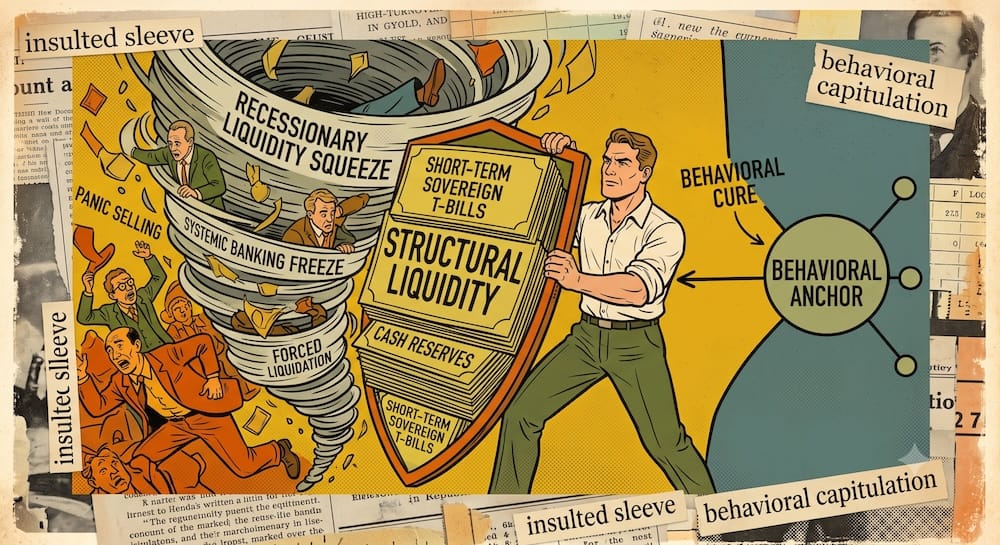
Cash does not exist here to generate a high return. Cash is there to protect against two devastating market conditions: acute recessionary liquidity squeezes and the behavioral failure of the investor.
During a true credit panic or a systemic banking freeze, correlations break down and everything can lose liquidity at once. Forced selling becomes the order of the day as institutions and individuals scramble for cash to clear obligations. In those moments, short-term sovereign bills provide a high-quality liquidity shelter. An investor is never forced to liquidate deeply discounted stocks or temporarily depressed gold positions to fund daily life because cash provides essential structural liquidity.
More importantly, cash is psychological ammunition. It is the stabilization mechanism that allows the rest of the portfolio to survive. When the markets are in chaos, looking at an account and seeing a substantial, unencumbered block of pure liquidity acts as a behavioral anchor. It prevents the panic that drives individuals to sell out at the absolute trough of a bear market.
During an expansion, sitting on 25% cash looks incredibly inefficient. It drags down your compounding rate and makes you look like an ultra-conservative hoarder while the equity indices are printing new highs. But cash earns its keep when liquidity vanishes and the financial system locks up, serving as the primary barrier between an investor and total behavioral capitulation.
Why Equal Weight Beats Forecast Weighting
Now that we have examined the four individual defense units, we can address the central architectural question: Why force them into a rigid, equal-weight split? Why not tilt the weights based on current market valuations, macroeconomic trends, or interest rate regimes?
To understand why Browne rejected any form of tactical variance, we have to look at the alternative weighting models that dominate the investment landscape and examine how they break down under real-world pressure.
| Weighting Logic | What It Tries To Do | Why Browne Rejects It | The Core Failure Mode |
| Market-Cap Weighting | Allocate capital based on the market size of individual assets | Lets the largest, most expensive markets dominate the portfolio layout | Automatically overweights late-stage prosperity narratives right before a crash |
| Return Optimization | Mathematically maximize historical risk-adjusted returns | Assumes that the specific parameters of a past regime will repeat exactly | Overfits the last cycle, leaving the portfolio defenseless against a novel macro shock |
| Tactical Macro Weighting | Dynamically tilt capital toward the forecasted economic regime | Requires the investor to accurately predict complex macro inflections ahead of time | The Forecasting Trap: Requires being right twice (the exit and the re-entry) |
| Risk Parity | Equalize the volatility contribution of each asset class | Requires complex estimation, continuous rebalancing, and often leverage | Increased model risk and implementation complexity that can fail in unexpected regimes |
| Equal Weight | Give every core economic defense unit identical status | Admits total ignorance of the future and treats all market dangers with equal gravity | High tracking error and permanent opportunity cost during long, single-regime cycles |
Let’s think about what happens when an investor adopts any of these alternative paths. Take return optimization. If you sat down in the year 2000 and ran a twenty-year mathematical optimization model, your spreadsheet would have instructed you to dump gold entirely and load up on large-cap U.S. equities, because the previous two decades had been an unmitigated disaster for hard assets and a paradise for stocks. By optimizing for the past, you would have built a portfolio perfectly engineered to be decimated by the subsequent 2000–2002 Dot-Com crash and the grinding “lost decade” for equities that followed.
Tactical macro weighting is even more seductive. It tells you that you can look at the current yield curve, evaluate inflation data, and shift your weights to prepare for the next phase. But as Browne frequently pointed out, to make tactical trading profitable, you have to be right twice: you have to get out of the correct asset at the right time, and you must re-enter the next asset before the market prices in the change.
Equal weighting is an explicit rejection of this game. It is not an optimized model; it is a structural acknowledgment that the future is unknowable. By giving every asset class 25% status, you are accepting that you do not know which danger will matter next, but you are ensuring broader resilience across regimes. No matter which door the monster walks through, an equal-weight defense unit is standing there waiting for it.
The Equal-Weight Pain Map
We cannot talk about the logic of equal weighting without being brutally honest about its behavioral cost. Because this framework refuses to optimize for any single economic regime, it is mathematically guaranteed that at any given moment, multiple line items in your portfolio will look completely ridiculous.
This is the psychological tax of absolute defense. Every sleeve will feel either too large or too small depending on the current season, creating a constant temptation to tinker with the mechanism.
| Sleeve | Why Equal Weight Feels Too High | Why Equal Weight Feels Too Low | The Behavioral Trap to Avoid |
| Stocks | Feels like an expensive drag during valuation panics or deep equity bear markets | Feels like a missed opportunity during a secular bull market | Chasing prosperity narratives and over-allocating to equities at cyclical tops |
| Long-Term Bonds | Feels like financial madness when interest rates are climbing or inflation is rising | Feels completely inadequate when a sudden deflationary shock hits equities | Shortening duration out of fear, which strips the bond sleeve of its defensive leverage |
| Gold | Feels like a dead, non-yielding anchor during long, decades-long disinflationary cycles | Feels like a missed boat when systemic currency panic begins to accelerate | Deleting insurance entirely during long dry spells, or over-allocating at the peak of panic |
| Cash | Feels like a real loss during periods of high inflation or strong equity growth | Feels too low when a systemic liquidity freeze hits and cash becomes king | Reaching for yield by moving cash into riskier assets right before a credit contraction |
Look at that map closely. An investor holding this structure is signing up for a lifelong tour of duty in the tracking error torture chamber.
When equities are roaring, your 25% stock cap means you will underperform your neighbors who are all-in on total market index funds. When interest rates are spiking, your long bonds will bleed red ink and make you question your sanity. When inflation settles into a quiet, moderate groove, your gold sleeve will look like an inert, wasteful hobby. And when inflation runs hot, your cash sleeve will steadily lose real purchasing power.
This is why true equal-weight defense is so rare in the modern investment landscape. It requires an investor to decouple their self-esteem from the performance of any single asset class. You have to learn to look at a line item that is down 30% and say, “That sleeve is performing its job perfectly—it is losing money because the economic season it defends against has not yet arrived.”
Rebalancing: Discipline, Not a Guaranteed Premium
To keep this allocation map functioning over multi-decade horizons, Browne relied on an explicit operational discipline: threshold-based rebalancing bands, usually set at 15% and 35%. You do not touch the portfolio on a set calendar date, and you do not trade based on market feelings. The framework dictates that you leave the system completely alone until an individual asset class drifts outside those boundaries.
It is vital to frame this mechanic with real independent skepticism. In many corners of the retail finance world, rebalancing is hyped as a guaranteed “volatility harvest”—a magical mechanism that automatically generates positive nominal returns out of thin air by trading the variance of the components.
That language is far too confident. Rebalancing is a path-dependent discipline, not a structural certainty.
The potential rebalancing benefit manifests when highly volatile, structurally uncorrelated assets undergo wide divergences and eventually mean-revert over time. When gold went parabolic in the late 1970s and breached the 35% ceiling, the threshold rule enforced a strict discipline: shave down the exploding gold node and deploy that capital into deeply discounted stocks and long bonds that were deeply out of favor.
But if an asset class enters a structural, non-mean-reverting regime shift—if it experiences a permanent loss of value or an extended, multi-decade trend without a reversal—rebalancing can simply become a mechanism for systematically feeding capital into a losing position.
We must not view Browne’s 15/35 bands as an absolute alpha generator. It is a behavioral enforcement tool. Its real job is to reset your risk parameters back to the equal-weight baseline, ensuring that a single runaway asset class cannot grow so large that it takes over the portfolio’s identity and converts an absolute defense system into a high-conviction directional bet.
What to Absorb / What to Expel
When we look across the historical landscape of Harry Browne’s career, we have to separate his timeless architectural principles from the era-specific conditions of his operation.
Modern implementation introduces product, tax, custody, and jurisdiction-specific questions that vary wildly for every individual. For example, backtests of the portfolio from the early 1970s often ignore the fact that direct gold bullion ownership was legally restricted for domestic retail citizens until the final day of 1974, meaning early iterations of the model relied on a structural abstraction that was difficult to replicate at retail scale. Similarly, modern tax codes can introduce significant friction when high-turnover rebalancing occurs inside taxable accounts. Those operational details are separate issues; the conceptual lessons require a careful filtering of what still travels today:
- Absorb: The concept of equal-weight structural authority across unyielding economic vectors. Utilizing extreme standalone duration and asset volatility as intentional counterweights rather than trying to smooth out individual line items. Enforcing threshold-driven behavioral bands to maintain systematic risk parameters without relying on market forecasting.
- Expel: The optimization models that overfit historical datasets for minor backtested gains. Diluting defensive sleeves down to minor, ineffective 5% “tilts” that fail to protect capital during a crisis. The illusion that an individual can consistently predict macro inflections or time the exit and re-entry points of major asset classes.
Browne’s real contribution to asset allocation philosophy was the structural proof that simplicity can be the ultimate form of sophistication. You do not need to build complex algorithmic forecasting models, you do not need institutional leverage, and you do not need to spend your life staring at economic indicators to insulate your savings from systemic harm.
Each asset class has an explicit, unyielding defense job to perform. None of them is sacred during an expansion, and none of them is useless forever when the weather turns.
The strategy is not magic, and it doesn’t offer a frictionless path to riches. The trade-off is clear: you are signing up to look wrong, lag the equity benchmarks during secular expansions, and hold line items that feel deeply uncomfortable for years at a time. But in exchange for that behavioral tax, you get a portfolio that decouples your financial survival from the accuracy of your opinions.
Browne’s equal weighting is not a forecast that all four assets will matter equally every single year. It is a quiet, mathematical confession that because you cannot know which economic danger will matter next, the only rational response is to treat them all with equal gravity.
What is the exact rebalancing frequency for Harry Browne’s equal-weight model?
It depends entirely on asset behavior, not the calendar. Browne’s framework relies on strict threshold-based rebalancing bands, traditionally set at 15% and 35%, rather than fixed calendar dates. An investor leaves the system completely alone until an individual sleeve drifts outside those boundaries—such as gold surging past 35% or stocks dropping below 15%. When a boundary is breached, it acts as a mechanical trigger to restore all four asset classes back to their original 25% equal weight, capturing a potential path-dependent volatility benefit.
Can I substitute intermediate-term Treasury bonds for the long-term bond sleeve?
No. Shortening your duration completely dismantles the portfolio’s defense mechanics. The long-term bond sleeve does not exist to collect yield or provide conservative income; its specific job is to deliver an explosive capital gains surge during an acute deflationary shock or credit contraction. Because long bonds possess high sensitivity to falling interest rates (duration), they can move with equal and opposite upward violence to counteract crashing equities. Intermediate bonds lack the necessary leverage to act as a portfolio defibrillator when stocks are shedding value.
Why does gold receive a full 25% weight when it produces no economic yield?
Because equal weight means each defense must be large enough to matter before a crisis arrives. Gold acts as an unpegged currency proxy and a monetary disorder shield, specifically hedging against systematic currency distrust and runaway inflation. If an investor dilutes gold down to a minor 5% or 10% portfolio tilt out of frustration with its long dry spells, its outperformance during a monetary shock will be a mere rounding error that fails to protect the aggregate capital base. Equal weighting ensures the inflation shield has enough structural authority to offset paper-asset decay.
What is the historical tracking error risk of holding an equal-weight defense system?
Brutally high during prolonged economic expansions. Because the strategy refuses to overweight prosperity, an investor holding this structure will experience severe relative underperformance during secular equity bull markets. For example, during the historic 1982–1999 expansion, the portfolio trailed pure U.S. equities significantly, triggering intense tracking error regret. This underperformance is the behavioral insurance premium required to ensure that a sudden, regime-shifting market crash cannot destroy your aggregate net worth.
What specific type of cash instrument belongs in the 25% recession sleeve?
Direct short-term sovereign Treasury bills. Browne designed the cash sleeve to serve as a high-quality liquidity shelter and absolute behavioral anchor during acute liquidity squeezes. Substituting high-yield savings accounts or ultra-short corporate bond funds introduces commercial banking credit risk and correlation distortions during a systemic freeze. Short-term T-bills ensure that the investor maintains unencumbered liquidity and never becomes a forced seller of depressed stocks or gold to fund daily life during a panic.
What is the minimum logical capital required to replicate this allocation strategy?
Virtually zero in the modern era. Historically, purchasing physical gold bullion, manual rolling of Treasury bills, and executing fractional bond lots required significant capital and carried heavy transactional friction. On a modern digital brokerage canvas, fractional share investing and institutional indexing vehicles allow an investor to execute a pristine 25/25/25/25 equal-weight matrix with a nominal sum, stripping away the immense transactional drag that burdened early adopters.
Did U.S. gold restrictions historically impact the validation of this portfolio?
Yes. Direct ownership of gold bullion was legally restricted for domestic retail citizens until December 31, 1974. Consequently, early performance figures and backtests from the dawn of the 1970s fiat era rely on a structural abstraction for U.S. retail investors, who initially required complex international custody workarounds to legally build out Browne’s complete four-quadrant layout.
This article is also available in Spanish. [Leé la versión en castellano: Harry Browne y el oro, efectivo, acciones y bonos: la lógica de la defensa económica igualitaria]