I don’t want to measure Charlie Munger’s influence on Berkshire Hathaway by counting the aphorisms printed on coffee mugs. That is how finance people end up worshipping furniture. If you spend any time scrolling through the investment corners of the internet, you have inevitably run into the standard mahogany-bookshelf folklore: the curmudgeonly polymath who reads multi-disciplinary textbooks, drinks Diet Cokes, drops a few witty lines about human misjudgment, and magically transforms Berkshire from a dying textile mill into a compounding colossus.
Quotes are cheap. Investment fingerprints are much harder to fake.
If we want to know how Munger’s thinking actually altered the direction of Berkshire’s capital, we have to stop reading the collections of proverbs and start performing autopsies on the deals. I want to see exactly where the money changed direction. Where did Berkshire stop buying cheap, dying junk? Where did it pay up for a clean cash engine? Where did Munger’s distinct appetite for high returns, industrial concentration, and engineering judgment show up on the balance sheet?
Charlie Munger’s real influence on Berkshire is clearest in the specific investments where the firm paid for superior underlying business economics instead of statistical accounting cheapness. The point is not that Munger magically made every allocation perfect. The point is that his framework changed what Berkshire was willing to call a good use of capital.
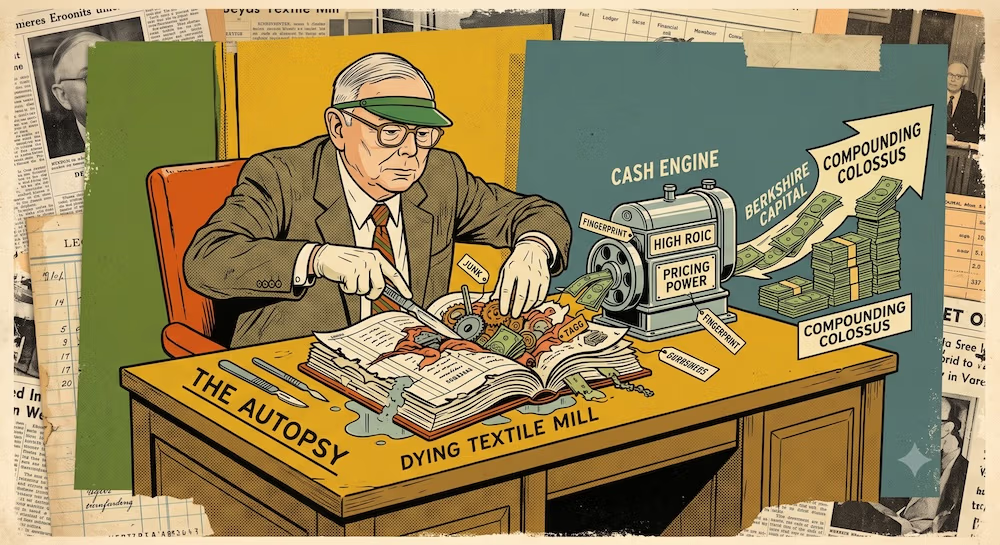
Forget the cozy bookshelf proverbs and coffee mug quotes. If you want to understand how Charlie Munger actually altered the trajectory of Berkshire Hathaway’s capital machine, you have to look past the folklore and dissect the mechanics of his high-ROIC extraction engines.What Counts as a Munger-Influenced Berkshire Investment?
Before looking at the ledger, we need to establish the baseline filter. When I look at Berkshire’s sprawling historical portfolio, I am searching for a highly specific architectural pattern.
The traditional Benjamin Graham approach—which Warren Buffett practiced with absolute fidelity throughout the 1950s—was a form of quantitative asset arbitrage. You looked for a company trading at a massive discount to its net current assets, bought a block of stock, waited for a corporate liquidation or a cyclical market recovery to realize that balance-sheet value, and moved on. The underlying return on capital of the business did not matter because you didn’t plan on sticking around.
The Munger framework inverted that logic. It prioritized look-through Return on Invested Capital (ROIC), structural pricing power, low ongoing capital reinvestment needs, and heavy concentration. Munger recognized that for a multi-billion-dollar corporate vehicle, long-term investor returns are inexorably anchored to the internal efficiency of the businesses it owns.
To map how this line of thinking rippled through Berkshire’s portfolio, we can trace his signature operational fingerprints across the firm’s most significant capital commitments:
The Munger Fingerprint Matrix
| Investment | Munger Fingerprint | What Berkshire Actually Bought | Why It Mattered |
| See’s Candies | High ROIC / Absolute Pricing Power | Capital-Light Regional Monopoly | Shifted Berkshire’s baseline definition of value away from book value. |
| Blue Chip Stamps | Structural Float / Capital Vehicle Capture | Distressed Promotional Stamp Pool | Provided the non-insurance capital base to fund See’s and Wesco. |
| Wesco Financial | High Concentration / Capital Allocation Laboratory | Panic-Distressed Savings & Loan | Served as Munger’s autonomous arena for targeted equity bets. |
| Coca-Cola | Economic Goodwill / Global Compounding Scale | Untouchable Consumer Brand Franchise | Scaled the quality framework to a multi-billion-dollar public block. |
| BYD Company | Industrial Engineering / Operational Excellence | Tech-Adjacent Battery & EV Pioneer | Broke the consumer-franchise mold to make a pure technological bet. |
| Buffalo Evening News | Local Monopoly / Inter-City Pricing Power | Single-Newspaper Media Engine | Demonstrated the raw cash yield of an regional pricing engine. |
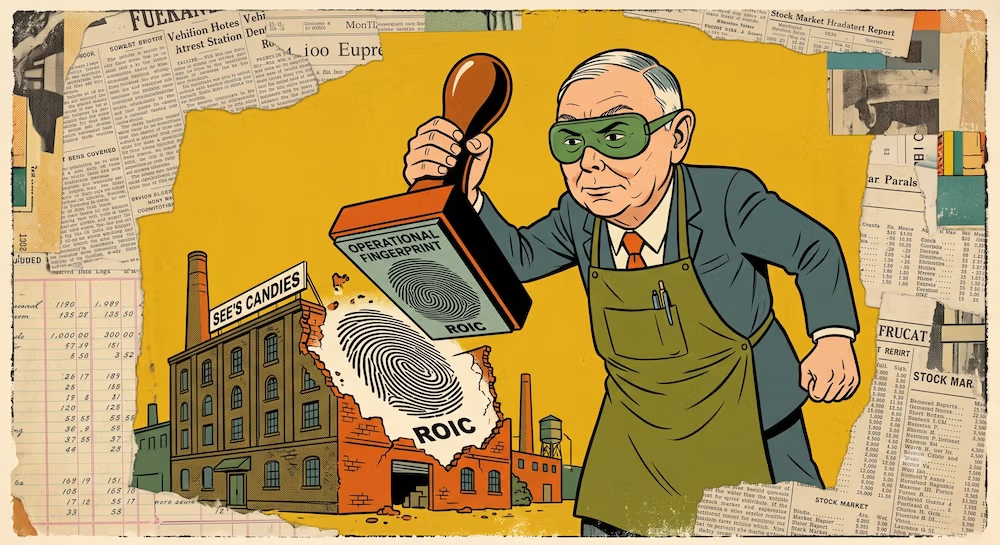
See’s Candies — The Canonical Cash Extraction Well
I like See’s as the number one example because it is not abstract. The numbers punch you in the face. If you want to understand the exact moment Berkshire abandoned the graveyard of cheap textiles and manufacturing shells, you have to look at the 1972 acquisition of See’s Candies. The internet loves to use See’s as a romantic story about chocolate and brand loyalty, but the actual corporate arithmetic is wonderfully cold.
See’s was acquired for $25 million. At the time, the company possessed just $8 million in net tangible assets, but it was producing $4 million in pre-tax corporate earnings.
I want you to look at those numbers for a second. Berkshire paid more than three times book value for a regional candy company, which nearly caused Buffett to pass on the deal entirely because his Graham-style training screamed that paying for unbacked goodwill was a cardinal sin. But look at the entry valuation from a cash flow perspective: Munger helped push through an acquisition at 6.25x pre-tax earnings. That is an incredibly cheap entry multiple, regardless of what the physical factory buildings were worth on paper.
[Net Tangible Assets: $8M] ──> [Purchase Price: $25M] ──> [Pre-Tax Earnings: $4M (6.25x Multiple)]
                                        │
                                        └──> Result: Helped generate over $2B in cumulative cash
The real Munger lesson of See’s, however, was not its internal growth. The mechanical genius of the investment was actually its inability to scale its physical footprint.
When Berkshire attempted to expand See’s retail candy stores outside of its core West Coast strongholds, the expansion regularly hit a wall. Consumers in other regions simply did not have the same generational emotional attachment to the brand. If Munger and Buffett had followed standard corporate dogma, they would have kept reinvesting See’s earnings back into the business, building empty factories and underperforming stores across the Midwest, and compounding capital at lower and lower incremental rates.
Instead, they ran See’s with modest incremental capital requirements. Because the business required modest reinvestment to maintain its California market footprint, and because its strength allowed it to raise prices over time without destroying demand—helping protect earning power during inflationary periods—Berkshire systematically stripped out a large portion of its earnings after basic operating needs. This cash-extraction mechanism turned See’s into an unembellished funding engine, helping generate more than $2 billion in cumulative cash that could be redeployed across Berkshire’s later investments. See’s was not just a cute candy story; it was Munger’s definition of value wearing a chocolate wrapper.
Blue Chip Stamps — The Strange Structural Capital Vehicle
Blue Chip Stamps is the kind of weird capital vehicle that makes finance folklore look useless. Nobody puts trading-stamp float on a coffee mug. Yet, without this bizarre corporate structure, the quality pivot that birthed modern Berkshire would have lacked its foundational fuel.
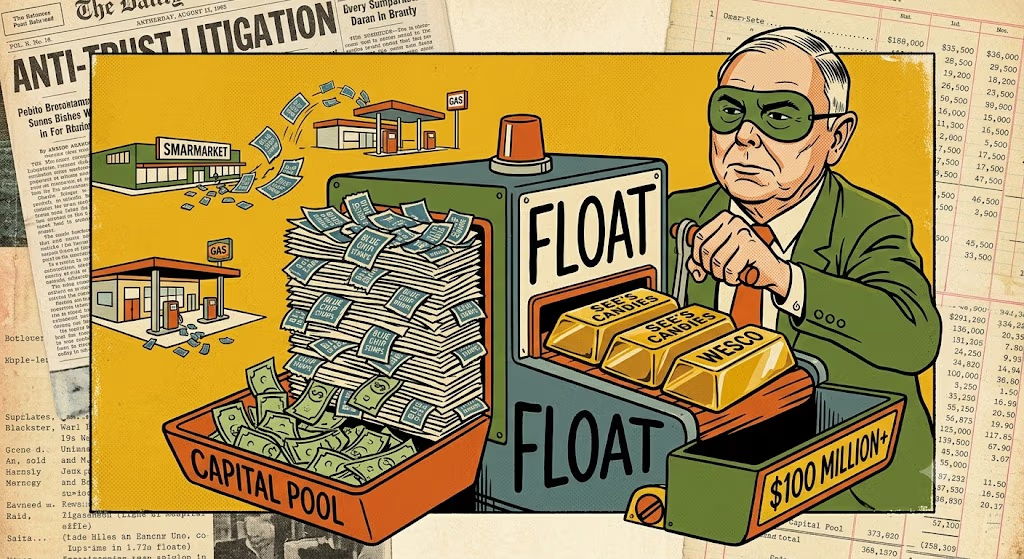
During the late 1960s, Blue Chip Stamps was an operation facing intense anti-trust litigation from various California merchants. This structural legal cloud severely depressed the company’s public stock price, forcing it to trade well below its net liquidating asset value. Munger recognized that while the market was obsessing over the legal headlines, the underlying structural mechanism of the business remained fully intact.
Supermarkets and gas stations paid Blue Chip cash for promotional stamps upfront. Retail consumers then collected those stamps in kitchen drawers for months, sometimes years, before redeeming them for household appliances. This created a massive, non-insurance, trading-stamp float-like capital pool that topped $100 million.
Munger and Buffett quietly accumulated shares of Blue Chip below its intrinsic asset value. They did not buy it to fix the trading stamp business; they bought it to capture the non-callable liability pool sitting on the balance sheet. Because this float pool did not carry strict insurance regulatory allocation limits, Munger used Blue Chip’s corporate balance sheet to buy controlling stakes in See’s Candies and Wesco Financial directly. Blue Chip was less of a traditional stock investment and more of a tactical capital bridge used to fund Berkshire’s primary quality assets before insurance premiums took over the heavy lifting.
Wesco Financial — Munger’s Concentration Laboratory
If Berkshire was Buffett’s main capital machine, Wesco was Munger’s separate test bench. Captured during the savings and loan panics of the mid-1970s via Blue Chip Stamps, Wesco became a vehicle where Munger’s appetite for extreme concentration and low-turnover capital allocation could run entirely uninhibited by corporate committees.
Munger served as the Chairman of Wesco from 1976 until its full merger into Berkshire in 2011. Under his watch, Wesco did not look like a diversified financial services firm. It looked like an idiosyncratic fortress. Munger took the capital generated by Wesco’s insurance subsidiaries (like Kansas City Fire and Marine) and concentrated it into a tiny handful of high-conviction public equity blocks—frequently holding billions of dollars across just three or four positions like Freddie Mac, Coca-Cola, and Wells Fargo.
Wesco demonstrated Munger’s framework in its purest form: if you have an information advantage, wide diversification is an admission of ignorance. He was perfectly comfortable letting Wesco’s reported earnings fluctuate wildly based on the market movements of a few massive positions because he was optimizing for terminal book value compounding rather than smooth quarterly tracking error. It was a stark reminder that true structural patience requires an allocation vehicle that doesn’t panic when the line on the chart gets bumpy.
Coca-Cola — Economic Goodwill at Global Scale
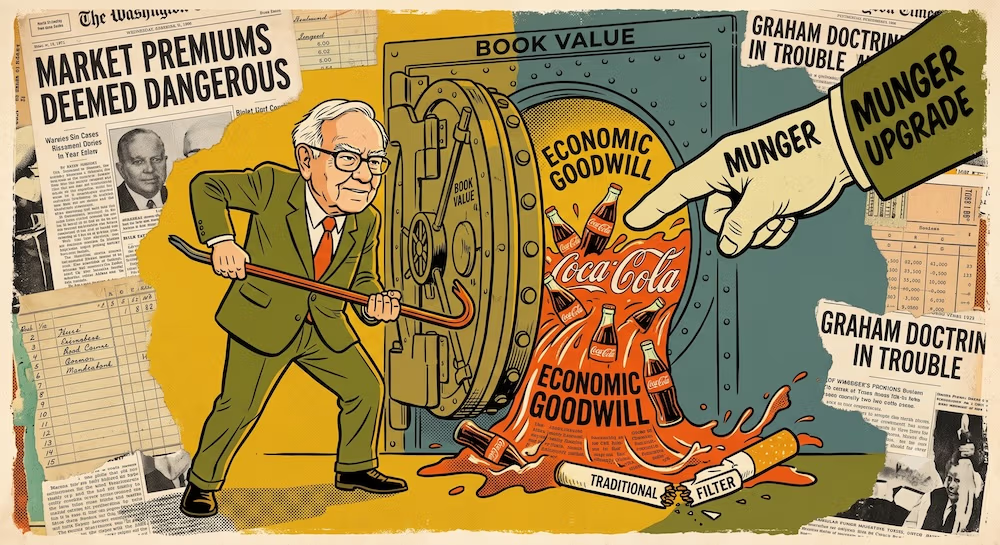
I do not want to pretend Coca-Cola was “Munger’s pick.” That would be lazy. But I do think it shows how fully Berkshire had absorbed the Munger upgrade by the late 1980s. Berkshire’s massive accumulation of Coca-Cola shares between 1988 and 1989 is often credited as a classic Buffett masterstroke. While Buffett executed the trades, the thesis fits the intellectual transition Munger had spent years pushing through Berkshire’s culture.
By 1988, Coca-Cola was trading at a clear premium to its tangible book value. Under the old Graham framework, buying a company at a significant premium to its physical assets was considered dangerous speculation. But Munger had spent years proving that a company’s balance sheet completely fails to capture the value of “economic goodwill”—the invisible competitive advantage that allows a brand to raise prices without destroying unit volume.
[Traditional Graham Filter: Buy below Book Value]
                      VS.
[Munger Quality Filter: Buy Economic Goodwill (Brand Power + Pricing Power)] ──> Paid premium for Coca-Cola
When Berkshire deployed more than $1 billion into Coca-Cola, they were buying a global distribution network wrapped in pristine consumer goodwill. Coca-Cola was capital-light, generated cash returns far in excess of its physical infrastructure needs, and possessed an international runway that could absorb capital for decades. The investment perfectly illustrated the core Munger doctrine: it is infinitely better to pay a fair price for a compounding machine than a bargain price for a structural liquidation trap.
BYD — The Weird Munger-Style Outlier
I like BYD in this article because it ruins the lazy cartoon of Munger as a man who only liked candy, newspapers, and banks. This was not another candy box. It was an engineering bet with teeth.
Engineered through MidAmerican Energy (now Berkshire Hathaway Energy), the investment put $232 million into an 8.25% stake in a Chinese battery and electric vehicle manufacturer at approximately HK$8 per share. The bet was driven almost entirely by Munger’s intense conviction in BYD’s founder, Wang Chuanfu.
BYD represented a radical departure from Berkshire’s traditional comfort zone. It was a capital-intensive, high-technology, intensely competitive manufacturing play operating in an emerging market regulatory framework. Yet it completely matched Munger’s underlying criteria:
- It was run by an operationally brilliant manager who focused on cost engineering.
- It possessed unique, proprietary technology in lithium-iron-phosphate batteries.
- It was highly concentrated and bought at a valuation that did not price in the explosive growth of the global electric vehicle market.
The position eventually expanded to a peak valuation exceeding $7 billion, proving that Munger’s definition of “quality” was flexible enough to identify structural compounding engines inside complex, non-traditional industrial lanes.
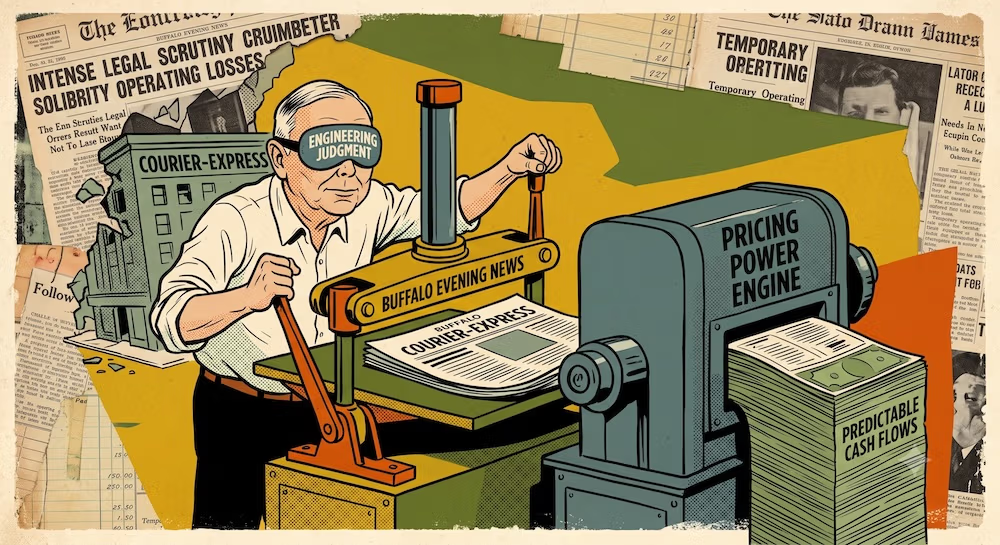
Buffalo Evening News — Local Monopoly Economics
The 1977 purchase of the Buffalo Evening News for $32.5 million via Blue Chip Stamps fits perfectly into the structural monopoly framework Munger prized. In the late 1970s, print media companies possessed a pristine economic moat: the dominant newspaper could exert meaningful pricing power because local advertisers had few comparable alternatives.
The investment was not a smooth ride. Berkshire had to endure a brutal, multi-year competitive war with its cross-town rival, the Buffalo Courier-Express, which resulted in intense legal scrutiny and temporary operating losses. But Munger’s engineering judgment remained focused on the terminal state of the industry: a mid-sized city could not economically sustain two competing daily papers. Once the Courier-Express folded in 1982, the Buffalo Evening News captured a total inter-city monopoly, transforming into a regional pricing-power engine that generated predictable cash flows for decades with minimal capital maintenance.
Best Investment vs. Munger Lesson Ledger
To understand how these pieces fit together into a unified framework, we can disaggregate why each deal worked, the core lesson it delivered, and the specific failure modes that occur when these lessons are misunderstood.
| Investment | Why It Worked | Munger Lesson | Failure Risk |
| See’s Candies | Exceptional return on capital paired with a low reinvestment requirement. | Terminal investor IRR is anchored directly to look-through ROIC. | Overpaying for growth when the incremental returns on capital drop. |
| Wesco Financial | Permanent capital structure allowed absolute concentration without redemption risk. | True concentration requires an elimination of short-term tracking-error pressure. | Copying concentration without a permanent, non-callable capital base. |
| Coca-Cola | Global consumer franchise provided durable pricing power and economic goodwill. | It is better to pay a fair price for an untouchable machine than a cheap price for a trap. | Treating generic brands as if they possess the same pricing power as global monopolies. |
| BYD Company | Early identification of world-class cost engineering in a massive industrial runway. | Operational excellence and leadership can justify capital-intensive technology bets. | Speculating on unproven technology companies lacking structural cost advantages. |
| Blue Chip Stamps | Captured a low-cost, non-callable liability pool before structural decay occurred. | Look for unique capital structures that provide non-callable funding options. | Relying on short-term liabilities or margin lines to fund volatile long-term positions. |
| Buffalo Evening News | Consolidation of an inter-city media monopoly unlocked regional pricing power. | Local monopolies provide highly predictable cash flows that are insulated from normal competition. | Misinterpreting a temporary monopoly that is undergoing permanent secular technological decay. |
The Necessary Humility: Alibaba Was the Warning Label
I would keep Alibaba in the article, but only as the warning label. It is not the product label. No investment autopsy framework is complete without inspecting the cases where the filter failed. To truly respect the record, we have to look at what happens when the same traits that create legendary winners—including extreme concentration and unyielding conviction—are applied to a misread risk profile.
While this occurred via the Daily Journal Corporation’s corporate cash balance rather than Berkshire Hathaway, Munger’s late-career move into Alibaba Group Holding ADRs serves as an instructional warning.
In 2021, Munger deployed a highly concentrated percentage of the Daily Journal’s capital into Alibaba, utilizing corporate margin debt. The underlying thesis appeared classic Munger: Alibaba looked like a digital utility canal that dominated Chinese e-commerce, generating massive transaction fees with a seemingly insurmountable competitive advantage.
[Monopoly Mindset] ──> Misread Geopolitical / VIE Structural Risk ──> >50% Drawdown ──> Position Reduced
But the mechanism broke because the moat was entirely dependent on a regulatory environment that changed overnight. The intervention of the Chinese state, combined with the structural reality of the Variable Interest Entity (VIE) corporate design used by foreign investors, proved that a digital monopoly is only as durable as the political structure that permits it to exist. The position suffered an estimated drawdown of greater than 50%, and Munger later reduced the position in early 2022, recognizing a structural miscalculation regarding geopolitical risk.
The lesson here is not to diminish Munger’s record. It is to remind ourselves that high conviction is not an insurance policy against a broken thesis. When concentration is paired with a misread regulatory framework, even the most disciplined capital allocation minds in history can watch their capital structure start working against them.
Munger Influence vs. Munger Myth
The value of studying Berkshire’s investment history lies in our ability to separate the actionable realities from the simplified internet folklore. If we want to think clearly about portfolio construction, we have to contrast the public mythology with the historical record.
| Myth | What the Investment Record Shows | Samuel Verdict |
| Myth 1: Munger just liked buying “great businesses” regardless of the macro landscape. | He liked high returns on capital only when the entry arithmetic was entirely sane (e.g., See’s at 6.25x pre-tax earnings). | Quality without valuation discipline is just expensive hero worship. |
| Myth 2: Munger absolutely hated leverage in all forms. | He spent his career using structural corporate leverage, non-insurance float pools, and corporate margin debt. | The rule was always about avoiding short-term callable retail debt, not a blanket refusal of structural capital tools. |
| Myth 3: Munger’s quality approach was a low-risk, cozy strategy. | His investment vehicles endured brutal, multi-year drawdowns exceeding 53% and multi-year stretches of intense underperformance. | Concentration requires an iron stomach and a permanent capital structure; it is anything but cozy. |
| Myth 4: Munger was merely Buffett’s passive sidekick. | Vehicles like Wesco and independent bets like BYD demonstrate an autonomous, highly aggressive allocation mindset. | The sidekick narrative is a lazy media construct that misses where the capital actually changed direction. |
| Myth 5: The core lesson is to buy exactly what Berkshire or Munger bought. | Their deals worked because of unique corporate structures, float access, and specific historical valuation compressions. | Trying to match their portfolio choices without their specific capital structures is just financial cosplay. |
What These Investments Actually Have in Common
The lesson I take from this ledger is not “copy the holdings.” That is cosplay. The lesson is to study what kind of economics kept earning Munger’s approval. When you step back and look at the entire ledger—from the chocolates of See’s to the battery lines of BYD—the pattern becomes unmistakable. Charlie Munger’s influence on Berkshire Hathaway was never about discovering a single magic industry or repeating a collection of catchphrases. It was about implementing a relentless mathematical filter on the use of capital.
Every single home-run investment that carried his fingerprints combined three structural realities:
- An Under-Priced Internal Compounding Engine: The underlying business generated high returns on capital, ensuring that long-term investor returns would remain anchored to operational quality rather than stock market sentiment.
- Absolute Valuation Sanity: Even when paying above book value, the entry prices represented highly attractive cash flow yields. They never paid premium technology multiples for consumer brand cash flows.
- A Structural Capital Match: The positions were held inside corporate structures with permanent capital bases, zero short-term redemption pressures, and non-callable funding pools, allowing them to ride out massive cyclical drawdowns without ever being forced to liquidate.
The conceptual lesson is that concentration without structure can become dangerous. If you buy quality companies without running the valuation arithmetic, you are practicing a form of financial worship.
The lesson is not to copy Munger’s holdings. That is cosplay. The lesson is to study the fingerprints: high returns on capital, pricing power, sane entry prices, and a capital structure strong enough to survive being early, lonely, or wrong for a while. Munger’s best Berkshire-shaped investments worked when the economics, the price, and the structure lined up. Everything else is just quote collecting with nicer furniture.
How exactly did Charlie Munger alter Warren Buffett’s original value investing strategy?
He systematically inverted it. Buffett’s early training under Benjamin Graham relied on quantitative asset arbitrage—purchasing statistically cheap, low-ROIC corporate entities below net current assets, waiting for a cyclical recovery, and exiting. Munger forced an intellectual upgrade to a look-through Return on Invested Capital (ROIC) framework. He proved that for massive capital bases, long-term investor IRR is mathematically anchored to the internal efficiency and pricing power of the underlying business, making it far more profitable to pay above book value for an elite cash engine than to chase cheap structural liquidation traps.
What was the entry multiple for See’s Candies when Berkshire bought it?
Not exactly expensive, despite the folklore. While Berkshire paid over three times physical book value—which went against traditional Graham dogmas—the entry valuation from a cash flow perspective was exceptionally cheap. Berkshire acquired See’s Candies in 1972 via Blue Chip Stamps for $25 million against $4 million in pre-tax corporate earnings. That represents an absolute entry multiple of 6.25x pre-tax earnings, backed by an elite regional monopoly footprint that required very modest incremental capital to maintain its West Coast position.
How did Blue Chip Stamps function as an investment vehicle for Munger?
It operated as a tactical capital bridge. Blue Chip Stamps was not a traditional public equity block held for simple capital gains. Instead, Munger and Buffett accumulated shares because the company’s severe anti-trust litigation had depressed its stock price well below its liquidating asset value, obscuring a massive, non-insurance trading-stamp float pool exceeding $100 million. Because this liability pool was interest-free and non-callable, Munger utilized Blue Chip’s corporate balance sheet directly to fund the acquisitions of See’s Candies and Wesco Financial without incurring immediate personal or parental tax liabilities.
What was the strategic purpose of Wesco Financial within Berkshire’s broader framework?
It was Munger’s separate test bench. Rather than operating within the larger collective architecture of Berkshire Hathaway, Wesco Financial Corporation served as an autonomous laboratory where Munger could practice extreme portfolio concentration and low-turnover capital allocation entirely uninhibited. As Chairman from 1976 to 2011, Munger took the insurance liabilities generated by Wesco’s underlying subsidiaries and concentrated them into just three or four high-conviction equity blocks, completely prioritizing long-term book value compounding over smooth public tracking error.
Why did the Munger quality framework justify buying Coca-Cola at a premium?
It came down to unbooked economic goodwill. When Berkshire accumulated more than $1 billion in Coca-Cola shares between 1988 and 1989, the stock traded at a significant premium to its tangible accounting book value, a clear violation of old-school value orthodoxy. However, the thesis perfectly matched the intellectual transition Munger had pushed through Berkshire: Coca-Cola possessed a global distribution network and an untouchable consumer franchise that allowed it to protect earning power during inflationary periods without requiring heavy capital reinvestment. The underlying business returns, not the balance-sheet assets, drove the math.
How does the 2008 BYD investment deviate from Munger’s typical consumer franchise deals?
It completely ruins the lazy cartoon of his strategy. The investment of $232 million into an 8.25% stake in BYD Company in 2008 (executed through MidAmerican Energy at roughly HK$8 per share) was not a safe, capital-light consumer brand like chocolates or soft drinks. It was an immensely capital-intensive, high-technology engineering play operating within an emerging market regulatory framework. Munger backed it based on industrial engineering conviction, recognizing that the company’s internal cost engineering and proprietary lithium-iron-phosphate battery technology created a structural compounding engine that the public market had severely mispriced.
What structural warning label does Charlie Munger’s Alibaba investment provide?
Concentration without structural protection is a grenade. Although executed via the Daily Journal Corporation’s corporate account rather than Berkshire Hathaway, Munger’s 2021 investment in Alibaba Group Holding ADRs demonstrates what happens when high conviction misreads a geopolitical risk profile. The position relied on treating an e-commerce giant like a digital utility canal, but the underlying mechanism broke because the moat was entirely dependent on a regulatory environment that changed overnight via state intervention. Because the position utilized corporate margin debt, it serves as a profound reminder that even the most disciplined capital allocators can watch their capital structure work against them if they decouple concentration from rigorous structural insulation.
This article is also available in Spanish. Leé la versión en castellano: Las mejores inversiones de Berkshire influenciadas por el pensamiento de Charlie Munger