I spent years trying to reverse-engineer Warren Buffett’s early stock picks before I realized his first real masterpiece wasn’t a stock at all—it was a legal contract.
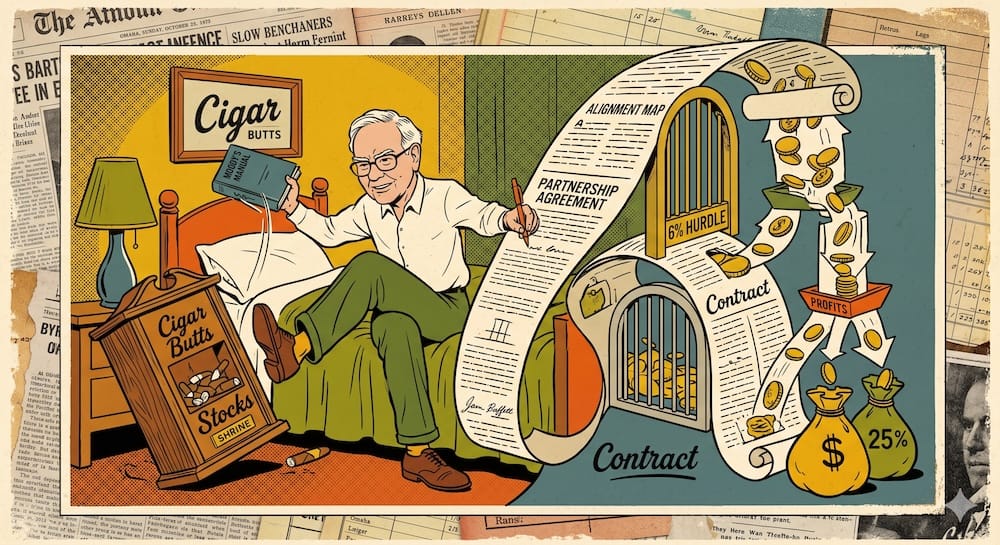
If you spend any time in the retail investing corners of the internet, you’ve heard the folklore. A young man sits in an Omaha bedroom, turns the pages of a physical Moody’s manual, buys a cheap stock, and lets compound interest work its magic. It’s an intoxicating vision because it tells you that you can do the exact same thing from your couch.
But it’s a total myth.
The folksy, passive buy-and-hold narrative completely misdirects us from how the wealth was actually engineered. Investors obsess over what early Buffett bought, but they completely ignore the structure that made those stock picks holdable and personally lucrative.
When you strip away the biography, you find that Buffett’s first real masterpiece was the partnership agreement. By engineering a rigid, asymmetric contract that eliminated asset drag and aligned incentives, he gave himself the structural and behavioral room to execute illiquid, highly concentrated strategies. He built a machine where he only grew wealthy if his partners grew wealthy first.
Let’s kick over the shrine and look at the plumbing.
The 0/25/6 Architecture in Plain English
To understand the early Buffett wealth engine, you have to throw out everything you know about modern fund management. In today’s money-management landscape, the standard hedge fund model relies on the traditional “2 and 20″—a 2% management fee on total assets under management (AUM), plus 20% of the profits. Under that setup, a manager gets rich simply by gathering assets, regardless of performance.
During the partnership era (1956–1969), Buffett implemented a structural framework that turned this model on its head. It can be summarized as the 0/25/6 architecture:
- 0% Management Fee: Buffett did not charge a single dime just for sitting on the money. If the portfolio went sideways or down, his asset-management revenue was exactly zero.
- 6% Non-Compounded Cumulative Hurdle: Partners received 100% of the first 6% of annual returns before Buffett participated in any upside.
- 25% Performance Allocation: Buffett only collected a 25% share of the net profits above that 6% hurdle.
- Deficiency Carry-Forward: If the partnership returned less than 6% in a given year, or suffered an absolute loss, that shortfall was logged into the ledger. Buffett had to fully repair prior deficiencies and top his partners back up to the cumulative 6% floor in subsequent years before he could unlock a single dollar of performance allocations.
- Annual Liquidity Window: Capital was structurally locked. Partners could only add to or withdraw from their accounts once a year, on December 31st, with a strict 30-day advance notice requirement.
The terms of this contract gave Buffett the room to run heavily concentrated positions and multi-year corporate operations, but the specific investment case studies belong elsewhere. What matters here is how this precise structural layout functioned as a total alignment map:
The 0/25/6 Fee Structure Map
| Component | What It Means | Who It Protects | What It Incentivizes | Modern Misreading |
| 0% Management Fee | Zero fixed asset fees; revenue is entirely dependent on absolute outperformance. | The investor’s underlying compounding base. | Maximizing net performance rather than asset gathering (AUM scaling). | Assuming Buffett got rich purely from the compound interest on his initial personal capital. |
| 6% Cumulative Hurdle | Investors keep 100% of profits up to a 6% annual return floor. | The investor’s baseline capital yield. | Beating a competitive cash/bond baseline before taking a performance cut. | Confusing a hard hurdle with a soft hurdle where fees apply to all returns once cleared. |
| 25% Performance Allocation | The manager takes a 25% cut of profits generated strictly above the hurdle. | The manager’s upside scaling potential. | Taking highly calculated, deeply asymmetric bets to clear the hurdle cleanly. | Thinking Buffett’s high cut was exploitative, ignoring the 0% management fee trade-off. |
| Deficiency Carry-Forward | Shortfalls beneath the 6% hurdle roll over and must be erased before performance fees resume. | The investor from paying performance fees on mere volatility rebounds. | Eliminating uncompensated manager risk-taking following a down year. | Confusing this rule with simple high-water marks that ignore hurdle rate deficits. |
| Annual Liquidity Window | Redemptions and capital additions are restricted to December 31st with 30 days’ notice. | The fund’s structural execution and liquidity matching. | Long-term capital commitment; strong protection from sudden panic redemptions. | Ignoring how fund liability constraints dictate asset-side success. |
Why 0% Management Fees Mattered
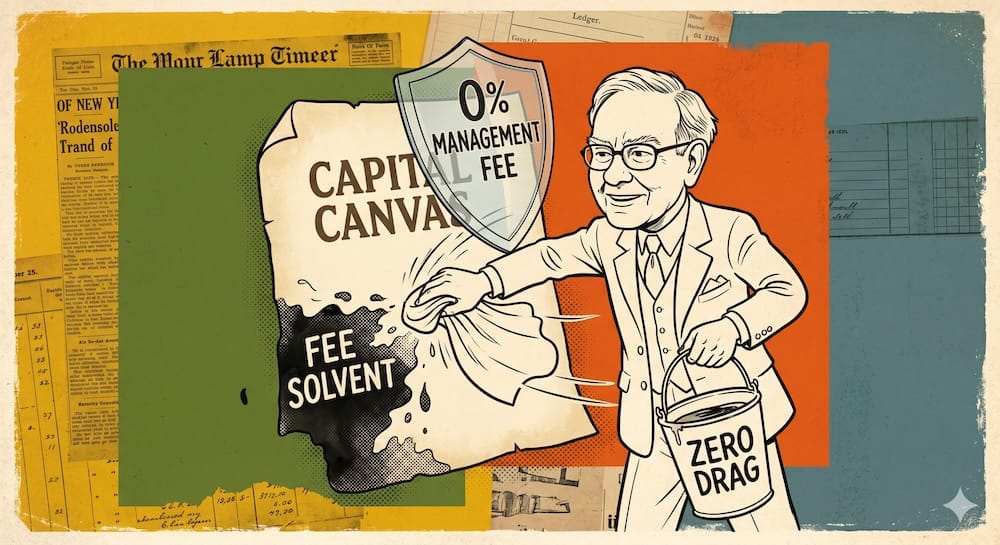
To see the elegance of this design, you have to understand the mathematical devastation of fee drag. A fixed management fee acts like a slow, structural solvent. It strips away layers of your capital canvas every single year, completely independent of market direction or manager skill.
By operating with a 0% management fee, Buffett ensured that the compounding base of the partnership remained entirely un-eroded during flat, volatile, or weak years. He bore the administrative and structural costs of running the entity out of his own pocket if he failed to beat his hurdle.
This structure actively prevented what dominates modern finance: manager asset gathering. Because he could not extract wealth simply by scaling the total pool of capital, he had zero incentive to dilute his best ideas just to make the fund look larger or safer to institutional allocators. The 0% fee protected the capital from structural erosion, giving the underlying investments a massive head start over traditional mutual funds that charged upfront loads and fixed maintenance fees.
How the 6% Hurdle and Deficiency Carry-Forward Protected Partners
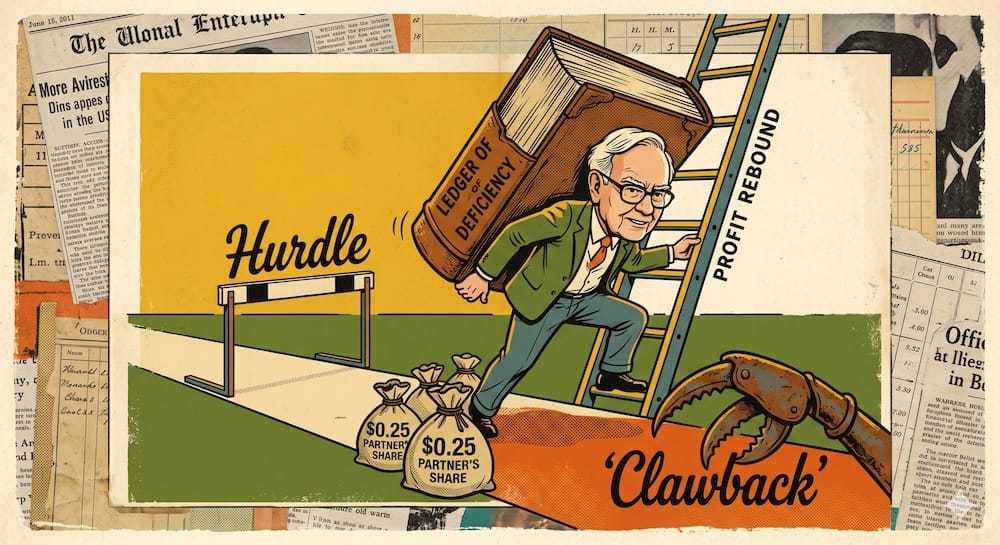
The 6% hurdle was not a gentle suggestion; it was a partner-first return floor. Under the partnership agreements, partners received the first 6% before Buffett participated in any upside. If the fund returned 5.9%, Buffett made nothing.
But the real teeth of the contract lay in the deficiency carry-forward rule. This functioned as a structural anti-free-option rule. In modern hedge funds, if a manager loses 20% in Year 1 and makes 20% in Year 2, they often claw their way back to a “high-water mark” and immediately resume taking performance fees.
Buffett’s structure banned this behavior. If the partnership failed to hit the 6% return mark, the shortfall was logged as a deficiency that anchored Buffett’s personal balance sheet. He could not simply collect fees after a volatile market rebound if those prior shortfalls had not been completely repaired.
Let us look at this exact mechanical plumbing in action through a linear two-year fee drag scenario.
The Fee Drag Scenario: A $1,000,000 Accounting Audit
Suppose a partnership capital pool sits at $1,000,000.
Year 1: The Flat Market Test (0% Return)
- Modern 2% Fee Model: The manager removes a flat $20,000 management fee from the pool. The investor’s capital base is eroded down to $980,000 heading into the next year.
- Buffett’s 0/25/6 Model: Buffett takes exactly $0. The investor’s $1,000,000 compounding base remains completely intact. However, because the fund missed the 6% hurdle, a $60,000 deficiency is logged into the ledger.
Year 2: The Rebound (20% Gross Return)
The portfolio rebounds sharply, generating a 20% gain on the remaining capital base.
- Modern 2% Fee Model: Under a simplified 2-and-20 model without a hard hurdle, the 20% return on the eroded $980,000 base yields $196,000 in profit. The total portfolio value moves to $1,176,000. The manager then takes a flat 20% performance fee on that profit ($39,200) plus another 2% management fee ($23,520).
- Total Investor Ending Capital: $1,113,280
- Buffett’s 0/25/6 Model: The 20% return on the pristine $1,000,000 base yields $200,000 in profit. Before Buffett can calculate his performance cut, he must clear the current year’s 6% hurdle ($60,000) plus the Year 1 carried-forward deficiency ($60,000). Total hurdle requirement: $120,000.
The excess profit above the cumulative hurdle is $80,000 ($200,000 minus $120,000). Only now does Buffett’s 25% performance allocation trigger:
Fee Allocation Breakdown:
Buffett Allocation:$80,000 × 0.25 = $20,000
Limited Partners Allocation:$120,000 + ($80,000 × 0.75) = $180,000
- Total Investor Ending Capital: $1,180,000
The math doesn’t lie. By shielding the base from the Year 1 management fee and forcing a strict deficiency carry-forward in Year 2, the investor finishes with an extra $66,720 in net wealth. The deficiency carry-forward prevented Buffett from getting paid for mere volatility loops, forcing him to deliver genuine cumulative outperformance before unlocking his own wealth.
Why the 25% Performance Allocation Made Buffett Rich
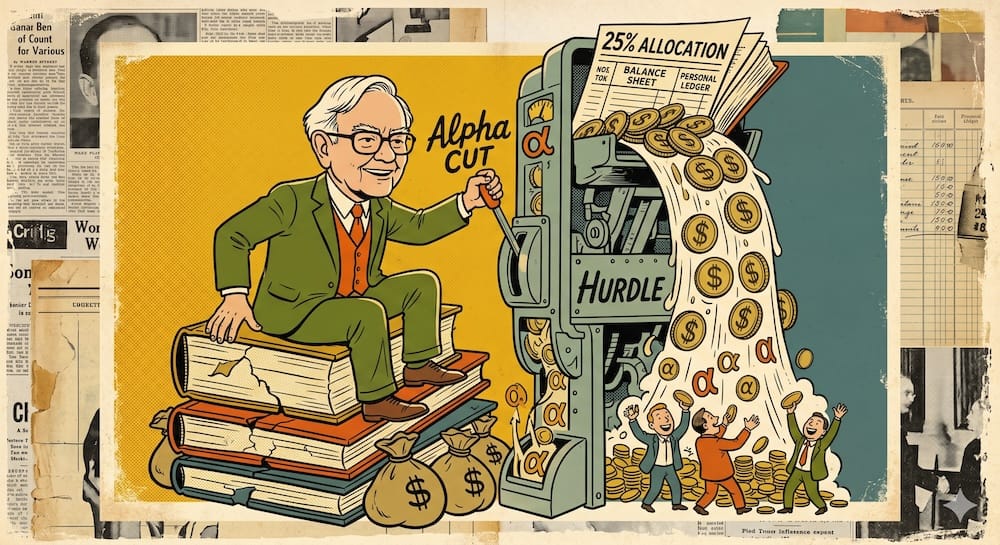
Looking at that math, you might ask: why would Buffett agree to a structure that looks so punishing to the manager? The answer is that the 25% performance allocation allowed his personal wealth to scale exponentially only after his partners did extraordinarily well.
While a 25% performance cut is higher than the modern 20% hedge fund standard, it was a fair trade-off because it was paired with a 0% management fee. Buffett wasn’t getting rich off the crumbs of asset management; he was getting rich off the pure alpha generated above a hard floor.
When the partnership generated massive returns, his 25% slice of the excess profits across a rapidly scaling pool of outside capital compounded his personal balance sheet far faster than any fixed fee ever could. It was an architecture designed for an investor who had absolute confidence in his ability to clear a 6% hurdle, using the performance cut as a high-velocity wealth multiplier that only activated upon proven success.
The Annual Withdrawal Window and Behavioral Alignment
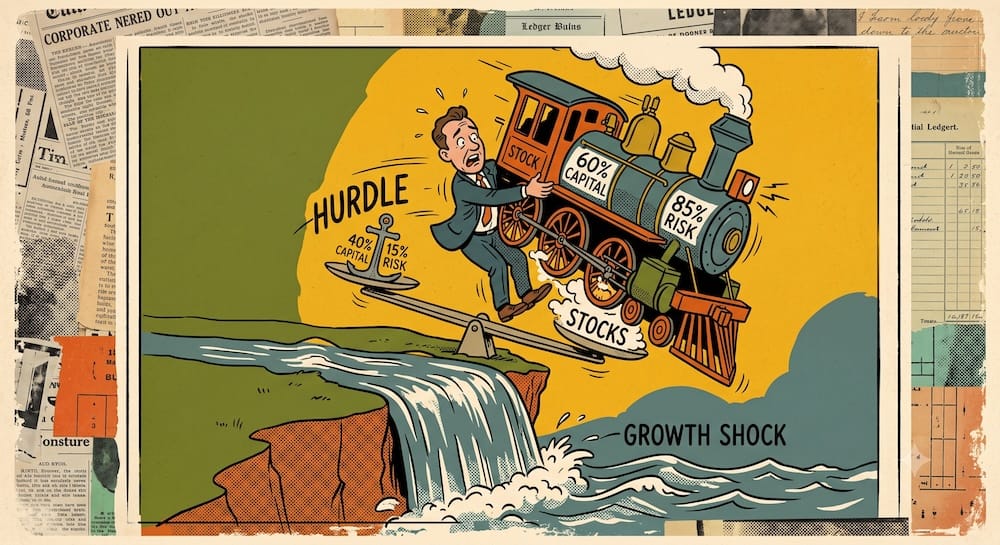
The most overlooked element of Buffett’s contract isn’t the fee math—it’s the liquidity constraint. Partners were permitted to withdraw or deposit capital exactly once a year, on December 31st, under a strict 30-day advance notice rule.
This rule linked fee alignment directly to capital stability. In modern asset management, retail investors can click a button on their phones and panic-sell an active fund during an intraday market correction. This forces the fund manager to hold uninvested cash or sell liquid positions at depressed prices just to meet redemptions, destroying the strategy’s structural execution.
Buffett’s annual window acted as an emotional firewall. His investors couldn’t panic-sell his positions even if they wanted to. This contractually enforced permanence gave him the behavioral security to ignore short-term market fluctuations and deploy capital into highly concentrated, illiquid, or distressed situations without the fear of a sudden run on the fund. The contract protected the manager from the clients, and the clients from their own worst behavioral impulses.
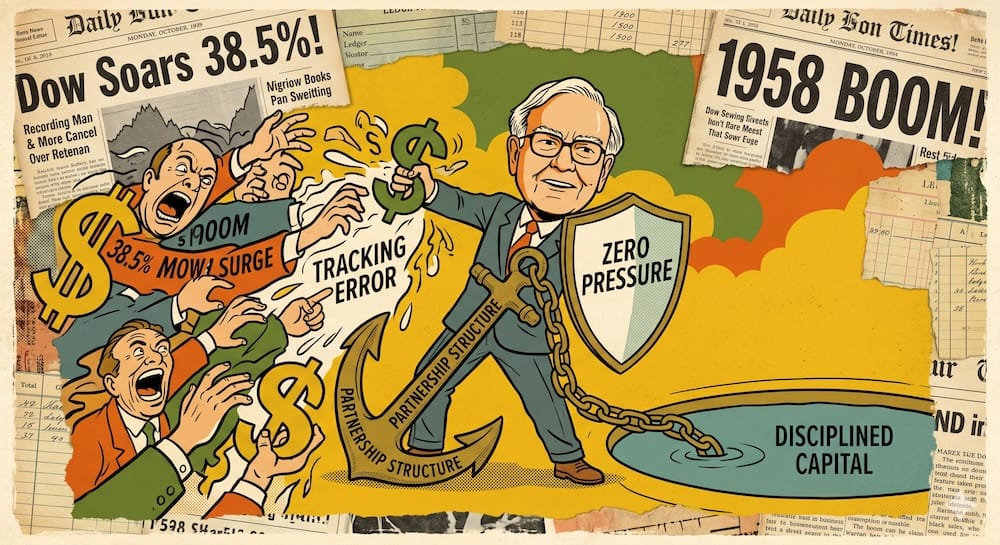
Tracking Error and the 1958 Test
This behavioral alignment was stress-tested immediately. Look at the data from 1958. The broader stock market was screaming upward, with the Dow Jones Industrial Average surging 38.5% including dividends.
Meanwhile, Buffett’s limited partners walked away with a net return of 32.2%.
That represents a 6.3% relative underperformance in a massive bull-market year.
In today’s environment of instant performance tracking and benchmark anxiety, the typical DIY investor would have melted down. They would have claimed the strategy had “lost its touch,” capitulated, and chased whatever momentum stocks were leading the tape.
But because of the partnership structure and the clear expectations set in his letters, Buffett faced zero redemption pressure. The contract gave him the structural cover to sacrifice top-end market beta in speculative environments to protect his downside. When the market collapsed in years like 1957, 1962, and 1966, his uncorrelated strategy systematically crushed the benchmark, delivering positive absolute returns while the market crashed. The structure prevented strategy drift during hot markets, allowing him to stay disciplined when the crowd was losing its mind.
Why This Was Not a Modern 2-and-20 Hedge Fund
To fully appreciate this level of alignment, we must place the Buffett Partnership structure directly alongside the typical modern hedge fund framework.
The Structural Alignment Comparison
| Feature | Buffett Partnership Structure | Typical Modern Hedge Fund | Alignment Consequence |
| Management Fee | 0% | 2.0% | The modern fund profits by simply scaling AUM; Buffett only profited by creating absolute results. |
| Performance Fee | 25% | 20% | Buffett took a higher cut, but only on profits that cleared a hard cumulative floor. |
| Hurdle Rate | 6% Hard Cumulative Floor | None or Soft High-Water Mark | Modern funds often charge performance fees on the very first dollar of profit, or simple nominal recoveries. |
| Loss Recovery | Deficiency Carry-Forward | Standard High-Water Mark | Buffett had to make up prior hurdle shortfalls plus the current year’s hurdle before receiving fees. |
| Asset Gathering Incentive | Zero | Extreme | Modern managers are heavily incentivized to gather asset mass to maximize the guaranteed 2% fee stream. |
| Investor Liquidity | Once per Year (Dec 31) | Quarterly/Monthly with Gates | BPL’s strict rule matched asset liquidity to fund liability, greatly reducing redemption-driven pressure. |
| Manager Behavior in Flat Years | Bears absolute operational cost | Collects millions in guaranteed fees | Buffett was financially penalized for flat years; modern managers are insulated by asset size. |
What did this structure actively prevent? It prevented partners from paying for mediocrity, it prevented managers from getting paid before investor losses were fully recovered, and it entirely eliminated the incentive to accumulate asset mass for fixed income.
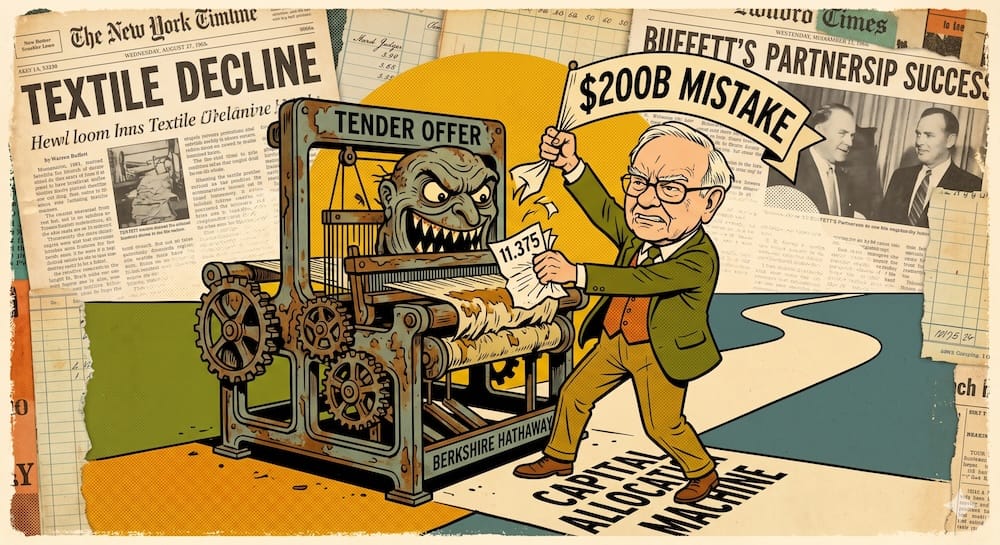
What did it not prevent? It did not prevent concentration risk, it did not prevent execution mistakes—such as Buffett’s spite-driven acquisition of the failing Berkshire textile mill in 1962—and it did not prevent partner disappointment during periods of relative underperformance like 1958. The contract didn’t guarantee perfect stock picking; it guaranteed that if the manager made a mistake, he would bleed financially right alongside his investors.
What Modern Investors Can Actually Absorb
A self-directed retail investor cannot copy the Buffett Partnership’s legal pooling structure. You operate in a personal brokerage account under modern regulatory frameworks, facing immediate tax drags on short-term liquidations. Trying to buy deep-value micro-caps without activist scale today is merely historical cosplay.
But you can absorb the core architectural discipline of the contract by implementing a personal “Virtual Hurdle.” Before you allocate a single dollar to an active sleeve—whether that means individual stock picking, thematic sector tilts, or specialized factor funds—you must establish a structural accounting firewall inside your own framework:
- Define the Passive Benchmark: Establish a low-cost, broad-market index fund (like a total global stock or S&P 500 ETF) as your baseline asset. This is your opportunity-cost benchmark.
- Establish Your Rolling Hurdle: Set a clear hurdle rate (e.g., matching the benchmark index plus a trailing margin to account for your personal time, transaction spreads, and tax drag).
- Audit the Fee Drag: Conduct a strict fee audit across your entire canvas. If you are paying 1.5% for an active mutual fund or an advisory fee, acknowledge that this asset drag is actively eroding your compounding base in flat years, exactly like the modern 2% hedge fund model.
- Enforce Active Accountability: Log your active performance against your virtual hurdle over a rolling 3-year window. If your active stock picking or thematic sleeve cannot cleanly clear that hurdle after factoring in your actual costs and short-term tax liabilities, it does not earn more capital. You must ruthlessly freeze or reduce the active sleeve and return the capital to the passive index base.
Sponge Verdict
Absorb the absolute incentive alignment. Absorb the hurdle discipline, the acute awareness of fee drag, and the capital rules that match your investment timeline to your liquidity needs.
But completely expel the hero-worship fantasy that early Buffett grew rich off simple, passive stock-picking genius in a vacuum. His real foundational masterpiece was a ruthlessly engineered partnership contract that aligned his destiny with his capital base.
Write your own portfolio rules based on the structural plumbing you actually have today, not the folklore you’ve been sold.
Educational Trade-off Note
When designing your personal portfolio architecture, remember that altering your structural layout involves fundamental trade-offs. Transitioning from a highly liquid, fully diversified passive indexing approach to a concentrated or factor-tilted active strategy dramatically increases your tracking error and exposure to idiosyncratic security risk. Sacrificing near-term liquidity or deviating from market benchmarks can optimize structural efficiency over a multi-year horizon, but it exposes you to severe psychological strain during prolonged periods of relative underperformance. Never mistake structural concentration for an unmitigated advantage; concentration magnifies both the compounding velocity of your wins and the permanent destruction potential of your capital base.
How exactly did the 6% hurdle rate function in the Buffett Partnership structure?
Partners received 100% of the first 6% of annual returns before Warren Buffett participated in any upside. This was structured as a non-compounded cumulative floor, meaning that it set an absolute benchmark return that had to be delivered to investors every calendar year before the performance allocation was triggered. If the partnership achieved a net return below 6%, the entirety of those gains remained inside the investors’ accounts, and the shortfall was logged as a structural deficit.
What is a deficiency carry-forward and how did it protect investors?
It was an absolute anti-free-option rule. Unlike standard modern hedge fund arrangements where high-water marks simply require recovering to previous baseline values, a deficiency carry-forward meant that any shortfall beneath the 6% cumulative hurdle rate rolled over into the next fiscal period. If the partnership returned 0% in Year 1, Buffett had to generate the current year’s 6% hurdle plus the previous year’s unachieved 6% deficit before he could collect any performance allocation. This mechanism prevented the manager from getting paid on mere volatility rebounds.
What’s the minimum portfolio size to actually replicate this strategy?
There is no explicit legal minimum, because a modern individual DIY investor cannot legally pool capital under this exact structure without massive regulatory overhead. However, if you are implementing the strategic translation—the personal “Virtual Hurdle”—your portfolio base needs to be large enough to justify the transaction costs, tracking administrative time, and potential short-term tax drags of running an active individual stock or factor tilt sleeve. For most self-directed investors, an active tracking canvas only becomes mathematically efficient when the dedicated active sleeve contains at least $25,000 to $50,000 separate from their core passive index holdings.
How did the partnership’s annual liquidity window affect Buffett’s asset management style?
It acted as a complete behavioral firewall. Partners could only add capital or execute redemptions once a year, on December 31st, under a strict 30-day advance notice requirement. This contractually locked-up liability profile gave Buffett strong protection from sudden panic redemptions during mid-year market panics. Because his capital base was permanently insulated for 12-month stretches, he had the structural safety to deploy funds into deeply illiquid, highly concentrated, or distressed active positions without worrying about a forced liquidation to meet client redemptions.
Why did the partnership charge a 25% performance fee if modern standard rates are lower?
It was an intentional, balanced trade-off. While a 25% performance allocation is higher than the modern 20% alternative standard, it was paired with a 0% fixed management fee. Buffett bore the absolute administrative and structural costs of running the entity out of his own pocket if he failed to generate alpha. This layout meant that Buffett was only compensated for absolute outperformance above a hard baseline floor, protecting investors from paying for mediocrity while allowing Buffett’s personal wealth to scale only when his partners achieved significant gains.
Can a modern retail investor copy the 0/25/6 fee model using automated brokerages?
Not exactly. Modern retail brokerage systems are designed strictly for individual ownership or standard joint accounts; they lack the structural accounting frameworks required to execute performance-contingent profit splits or automated carry-forward deficit tracking between independent accounts. A modern self-directed investor cannot replicate this legal structure in a standard taxable account. Instead, you must use a conceptual “Virtual Hurdle” to track your active performance manually against a broad-market index fund over a rolling 3-year window.
What behavioral mistakes did the Buffett Partnership structure fail to prevent?
It did not prevent concentration risk, idiosyncratic execution failures, or partner disappointment during periods of relative market underperformance. The most stark example occurred in 1962, when Buffett’s concentrated stock selection drew his capital into the structural value trap of Berkshire Hathaway’s textile operations. While the contract perfectly aligned financial pain by ensuring Buffett bled capital right alongside his limited partners, the legal plumbing itself could not override human behavioral mistakes or guarantee perfect security selection.
This article is also available in Spanish. Leé la versión en castellano: Explicación de la estructura de la sociedad de Buffett: Incentivos, comisiones y alineamiento