I spend a lot of time dissecting the architecture of capital efficiency, return stacking, and expanded canvas frameworks. When you look closely at these systems, you quickly realize that almost every serious conversation about modern portfolio construction eventually collides with Ray Dalio and Bridgewater Associates. Established in 1975, Bridgewater didn’t just grow from a two-bedroom apartment into a behemoth managing over $160 billion in assets; it fundamentally rewired how institutional money thinks about correlation. Dalio’s obsession with treating the global economy as an interconnected, mechanical system hasn’t just generated returns—it has established the baseline for quantitative risk management.
What fascinates me about Dalio isn’t the sheer scale of the AUM, but his absolute refusal to separate behavioral mechanics from mathematical outcomes. His principles-based philosophy operates on the premise that human bias is the primary drag on compounding. He relies on radical transparency and systematic decision-making to force the ego out of the investment process, viewing the world strictly through the lens of the “Economic Machine.” These mental models are thoroughly documented in his book, Principles: Life & Work, where he shares the strategies for ruthlessly auditing your own logic.
We are going to strip Dalio’s framework down to the studs. I want to look at the exact plumbing of the All Weather Portfolio, the reality of risk parity, and what it actually feels like to execute these concepts in a live brokerage account. This isn’t theory. The implementation gap between a clean backtest and the live experience of holding an uncorrelated asset while the S&P 500 goes parabolic is massive. We are looking for hard signal here.
If you are an investor looking to refine your strategies, you have to accept that your intuition is often a liability. Dalio’s methods force you to be systematic, data-driven, and uncomfortably open-minded. The math doesn’t lie. Your gut often does.
The Principles of Radical Transparency
What is Radical Transparency?
When you start digging into the operational culture of Bridgewater, you immediately hit a wall of radical transparency. To my eyes, this isn’t corporate HR jargon; it is a brutal, mathematically necessary feedback loop. Dalio figured out early that hidden mistakes compound negatively. You cannot run a quantitative fund if the human inputs are obscured by pride or office politics.
In the real world, enforcing this looks incredibly uncomfortable:
- Open Communication Channels: You don’t get to hide your bad calls. Every thesis is subjected to immediate stress-testing by peers.
- Meritocracy of Ideas: The math wins. A junior analyst with a statistically sound dataset overrides a senior partner operating on a hunch.
- Recorded Meetings: There is no revisionist history. The tape exists.
- Transparent Feedback: Critiques are sharp, immediate, and public. It strips the emotion away from the error.
- Error Log: This is the holy grail. An immutable ledger of every mistake, forcing the team to build a new rule to prevent that exact failure mode from repeating.
I’ve spent years building authority ledgers to verify data provenance, and Dalio applies that exact same rigid structure to human decision-making. You log the error. You patch the code.

Application in Investing
For the DIY investor, radical transparency means fighting your own confirmation bias. The psychological itch to tinker with an allocation just because it’s underperforming is how long-term compounding gets destroyed. You have to treat yourself like a flawed algorithm.
Translating this to a single-player game requires rigid infrastructure:
- Self-Reflection: Staring directly at your tax drag in a non-registered account and admitting your high-turnover strategy is bleeding capital.
- Seeking Diverse Perspectives: Deliberately reading whitepapers that tear apart your highest-conviction holdings.
- Documenting Investment Rationale: Writing down exactly why you bought an ETF. When the price drops 20%, you read the thesis. If the thesis holds, you hold. If it broke, you sell. No rationalizing.
- Openly Addressing Mistakes: Admitting you bought a thematic tech fund because of FOMO, not factor exposure.
- Establishing Clear Principles: Building mechanical rules for rebalancing so you don’t have to make decisions during a market panic.
The behavioral execution challenge here is immense. Most investors would rather realize a loss in the dark than write down exactly why they were wrong in the light.

Benefits: The Importance of Honest Feedback and Transparency
When you actually implement this kind of rigid personal auditing, the portfolio mechanics change drastically:
- Enhanced Decision-Making: You stop chasing 6-month momentum bursts and start focusing on structural investment choices built for decades.
- Identification of Blind Spots: By encouraging feedback and critique, you realize your “diversified” portfolio is actually just five different funds all highly correlated to large-cap tech.
- Improved Accountability: You own your drawdowns. No blaming the Fed.
- Continuous Learning and Improvement: Every stopped-out trade becomes a data point for your personal risk models.
Yikes. That level of honesty is painful, but the math requires it if you want to survive multiple market cycles.
The All Weather Portfolio
Introduction
If there is a holy grail in Dalio’s public-facing architecture, it is the All Weather Portfolio. But let’s be real about what it actually feels like to hold it. The entire premise is built on the reality that predicting the macroeconomic future is a fool’s errand. Instead of guessing, you build a structure that survives every permutation of growth and inflation. You are buying resilience, not maximum upside.
Traditional 60/40 portfolios hide a massive flaw: equities drive over 90% of the risk. The All Weather Portfolio aims to minimize losses and capitalize on structural diversification by ensuring that the actual volatility contributions of the assets are balanced. When stocks crash in a deflationary bust, you need an asset with enough duration (like long-term Treasuries) to actually offset the bleeding.
Asset Allocation
Dalio slices the economic environment into four distinct quadrants:
- Rising Growth
- Declining Growth
- Rising Inflation
- Declining Inflation
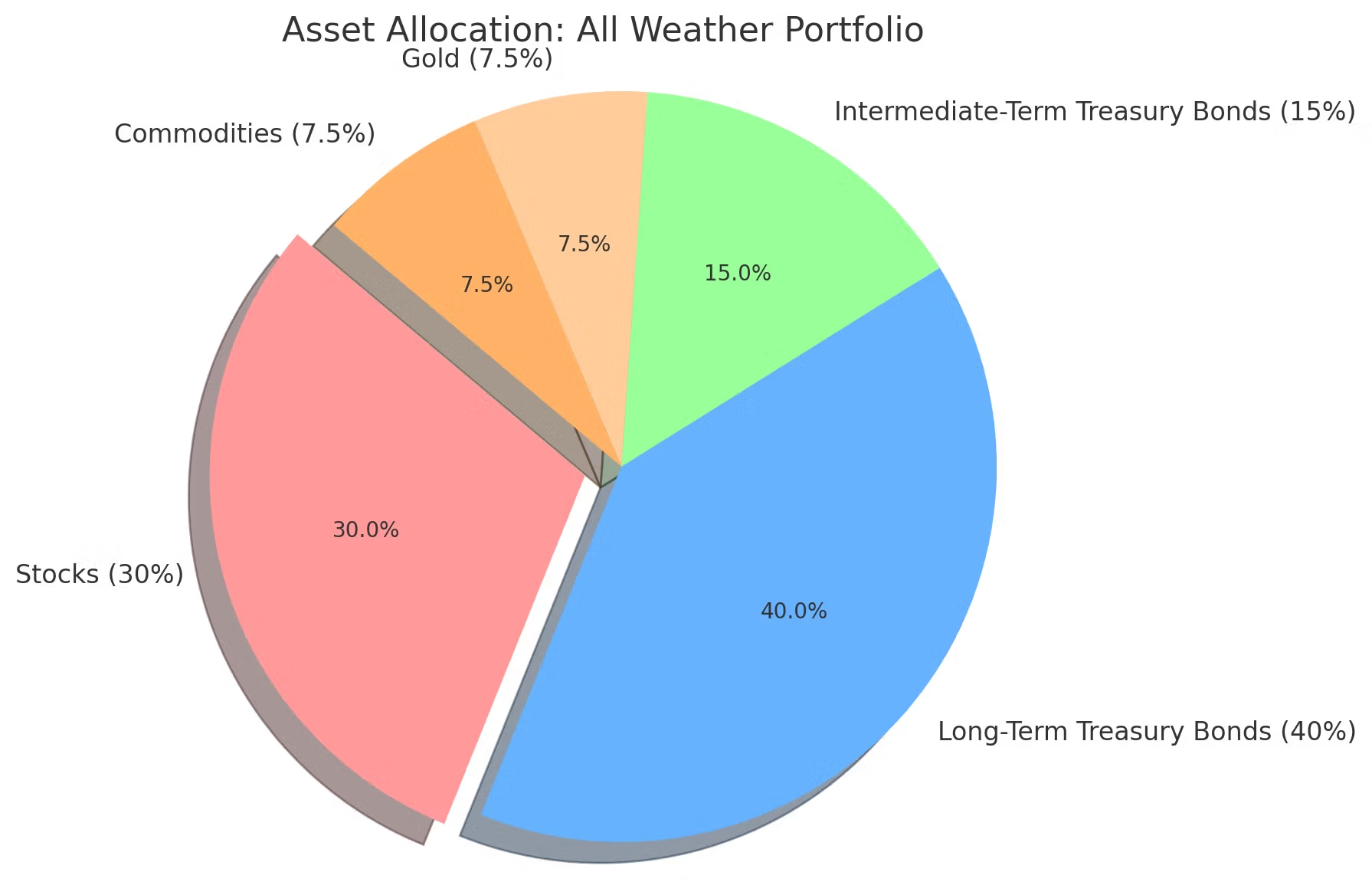
To structurally cover all four corners of the map, the baseline allocation looks like this:
To truly understand how Bridgewater populates these environmental quadrants, we have to look directly at the underlying mechanics documented in their institutional framework literature. Rather than leaving the portfolio exposed to arbitrary asset shifts, each quadrant is mathematically mapped to specific asset classes engineered to thrive under that specific combination of pricing environmental variance:
| Macro Regime Quadrant | Core Asset Allocations | Structural Role in Architecture |
|---|---|---|
| Rising Growth | Equities, Commodities, Corporate Credit | Captures upside during economic expansion and corporate earnings acceleration. |
| Declining Growth | Nominal Government Bonds, Inflation-Linked Bonds | Acts as a flight-to-safety anchor when corporate cash flows compress. |
| Rising Inflation | Commodities, Gold, Inflation-Linked Bonds (TIPS) | Preserves structural capital purchasing power during fiat currency debasement shocks. |
| Declining Inflation | Nominal Bonds, Equities | Capitalizes on falling discount rates and macro multiple expansions. |
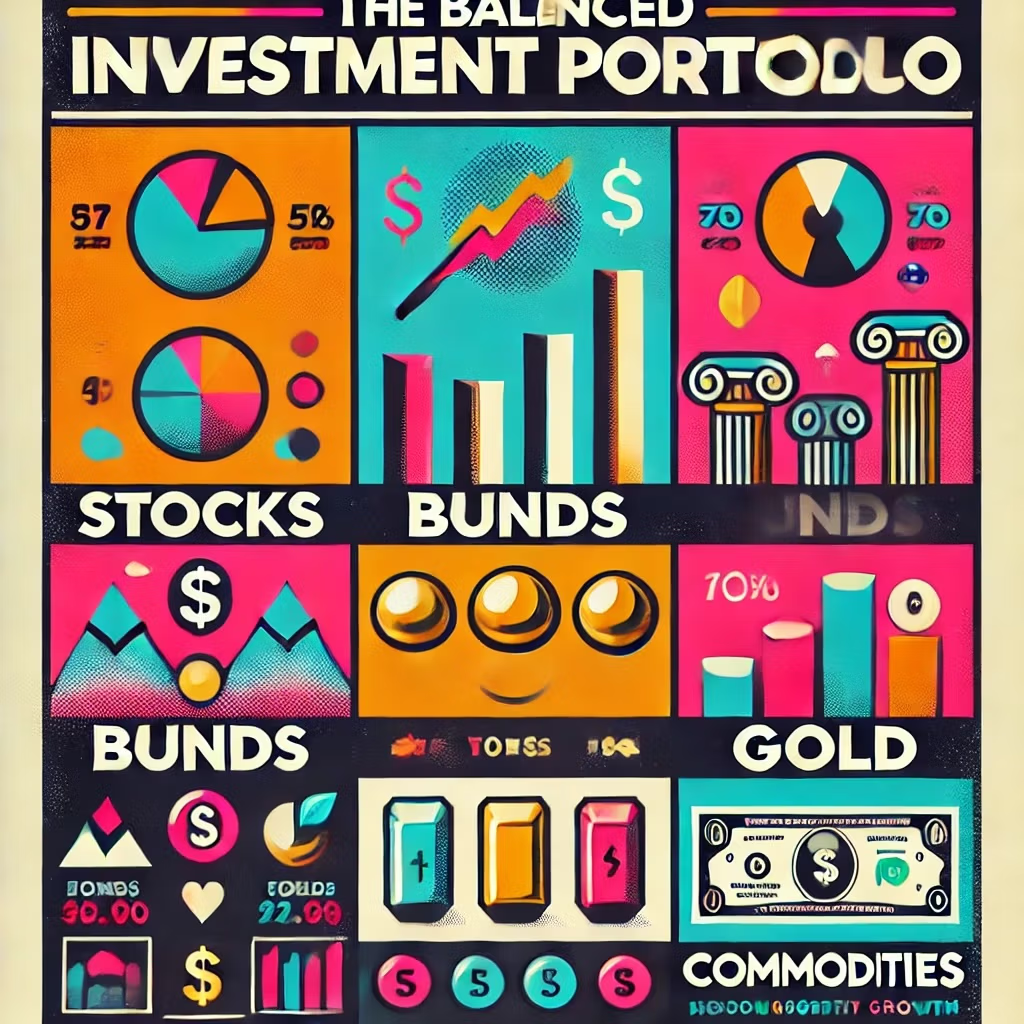
- 30% Stocks: The growth engine. This carries intense tracking error pain when the S&P 500 is ripping higher and your neighbors are getting rich faster than you.
- 40% Long-Term Treasury Bonds: The deflation shield. You need the massive duration here (often accessed via an ETF like TLT) to provide enough price convexity to counter a 30% equity drop.
- 15% Intermediate-Term Treasury Bonds: Ballast. Dampens the extreme volatility of the long end of the curve.
- 7.5% Gold: The hard currency hedge against fiat debasement. Physical-backed ETFs like GLD or IAU usually fill this slot.
- 7.5% Commodities: Pure inflation protection. The friction here is brutal—holding commodities often involves dealing with contango in futures markets and complex tax reporting. Using an ETF like PDBC can help bypass the dreaded K-1 tax form , but the distributions can still chew up your after-tax returns.
You aren’t balancing dollars; you are balancing the thermal energy of the assets.

Risk Parity: Balancing the Portfolio Across Different Asset Classes
This brings us to the core engine: risk parity. Risk parity focuses on allocating assets based on their risk contribution rather than their expected returns or capital allocation. A dollar of stocks is vastly more volatile than a dollar of bonds. If you weight them 50/50 in dollars, equities dictate your entire return stream.
The mechanics look like this:
- Measuring Risk: You quantify the standard deviation. Equities might have 15% volatility, while intermediate bonds have 5%.
- Adjusting Allocations: You over-weight the low-volatility assets (like the 55% total bond allocation) so their muted movements actually register against the wild swings of the 30% equity sleeve.
- Diversification: You accept that in any given year, one or two pieces of this portfolio will look incredibly stupid. That is a feature, not a bug.
To my eyes, this is exactly where the leverage gap trips up almost every retail investor attempting to copy the institutional blueprint. True institutional risk parity execution does not merely settle for low expected returns by loading up on nominal, low-volatility assets like government bonds. Instead, firms like Bridgewater employ structural leverage on the fixed-income sleeve to scale its volatility up to match the risk profile of equities. By doing so, they achieve true risk equilibrium without gutting the portfolio’s long-term compounding potential. When a DIY investor copies these exact nominal asset weights without scaling the fixed income sleeve via low-cost leverage, they aren’t implementing institutional architecture; they are fundamentally breaking the risk parity mechanism by changing the target portfolio return profile into a highly conservative, cash-dragged model.
Application: How Investors Can Create a Balanced Portfolio
Putting this into practice requires fighting through the friction of multi-fund management:
- Assess Risk Tolerance: Honestly admit if you can handle lagging the S&P 500 for three consecutive years. If you can’t, do not attempt this.
- Select Appropriate Asset Classes:
- Stocks: Use hyper-liquid, low-cost index funds or ETFs to gain exposure to equities (like VTI, which generally carries a rock-bottom expense ratio around 0.03% ). Avoid sector bets.
- Bonds: You need actual US Treasuries (TLT/IEF), not corporate bonds. Corporates correlate with equities during crashes.
- Commodities and Gold: Watch out for the tax forms and bid-ask spreads on thinly traded days.
- Implement Risk Parity: Stick to the percentages. Don’t drift to 50% stocks just because the market looks good.
- Diversify Geographically: Split that 30% stock bucket between US and ex-US to insulate against single-country regimes.
- Rebalance Regularly: The frustration of rebalancing friction in a multi-fund portfolio is real. You are forced to sell your winners to buy your losers. It feels terrible, but it locks in the math.
- Consider Tax Implications: Bond yields and commodity distributions will chew up your after-tax returns in a taxable account. Asset location (keeping high-yield components in IRAs or RRSPs) matters heavily here.
Execution is everything. A perfect backtest means nothing if you abandon the strategy during a tough year.
Economic Principles and the “Economic Machine”
Understanding the Economic Machine
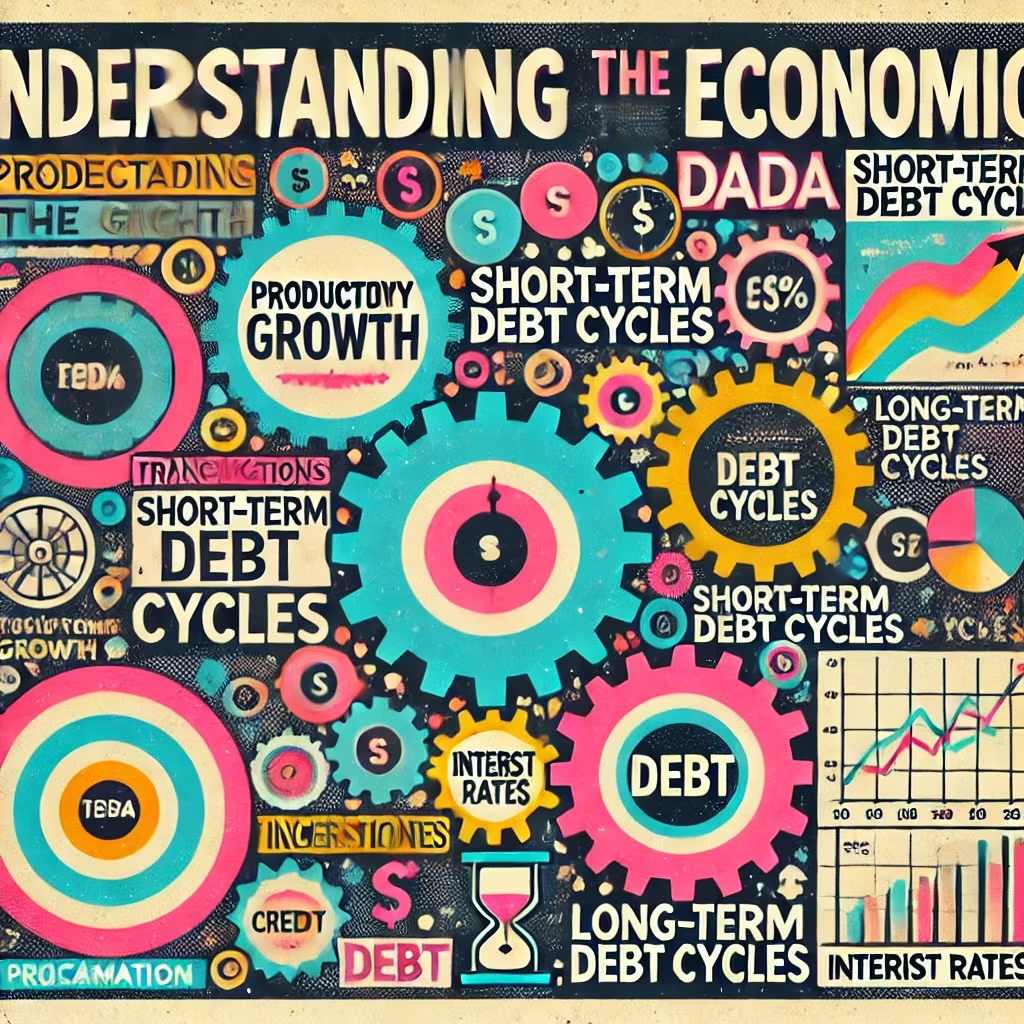
Dalio doesn’t look at tickers; he looks at the “Economic Machine.” He breaks the chaotic global economy into a series of repeatable, mechanical gears. Central banks pull levers, credit expands, and assets react. It is entirely causal.
The machine runs on three dominant gears:
- Productivity Growth: The slow, upward slope of human innovation. This is the baseline tailwind over decades.
- Short-Term Debt Cycles (Business Cycles):
- These last 5-8 years.
- They are controlled by central banks adjusting interest rates.
- Cheap money expands credit, driving up asset prices.
- Expensive money chokes credit, inducing recessions.
- Long-Term Debt Cycles:
- These span 75-100 years.
- Interest rates hit zero, central banks print money, and systemic debt must eventually be deleveraged. It is a slow, agonizing grind.
To navigate this, you have to monitor the fuel lines: transactions, credit expansion, and inflation.
Implications for Investing
You don’t need to predict the cycle; you just need to understand how assets mechanically react when the cycle shifts. When the macro regime changes, correlations flip violently.
Here is the mechanical reality, and where All Weather faces its true test:
- Interest Rate Movements:
- Rising Interest Rates & Inflation: Can negatively impact bond prices and high-growth stocks. This is exactly what happened in the 2022 rate shock. The classic 60/40 failed because stocks and bonds bled simultaneously. Even All Weather took a hit because the 55% bond allocation got crushed by duration risk, though the commodities sleeve helped soften the blow.
- Falling Interest Rates: The ultimate tailwind. Bonds catch a massive price bid, and equity multiples expand.
- Inflation Trends:
- High Inflation: Cash is trash. Equities struggle with margin compression. You desperately need your 15% commodities/gold sleeve to fire.
- Low Inflation/Deflation: Long-term nominal bonds become the most valuable asset on the board.
- Economic Growth:
- Expansion: Equities rip. You feel like a genius.
- Contraction: Defensive assets like US Treasuries are heavily bid up by institutional panic.
To my eyes, this structural vulnerability became an undeniable, lived reality during the historic 2022 stock-bond correlation shock. When global central banks rapidly hiked interest rates to choke off structural inflation, the traditional negative correlation baseline between equities and duration assets broke down entirely. Standard global institutional risk parity indices and asset templates faced painful drawdowns exceeding 20% as long-term Treasuries and global stocks bled in tandem. It served as a brutal mechanical proof that without a massive, active inflationary offset or short-side exposure, long nominal duration is a massive vector of structural risk when discount rates reset aggressively.
If you align your strategies with the economic cycle structurally, you survive the regime changes without having to play defense manually.
Case Study: Dalio’s Application During a Specific Economic Cycle
The 2008 Financial Crisis
The GFC wasn’t a surprise to the Bridgewater models. The Economic Machine was flashing bright red because the debt-to-income ratios broke the mechanical limits.
- Excessive Debt Levels: The subprime mortgage market was structurally compromised.
- Credit Bubble: Shadow banking had over-leveraged the entire system.
Bridgewater’s Mechanical Execution:
- Reducing Exposure to Risk Assets: They cut equities.
- Increasing Positions in Safe-Haven Assets: They loaded up on sovereign duration.
- Shorting Vulnerable Assets: Actually betting against the over-levered financials.
The Outcome:
- Positive Returns: While the standard 60/40 portfolio got absolutely shredded in 2008, Pure Alpha reportedly posted double-digit gains.
- Validation of Principles: It proved that Dalio’s framework and risk management strategies weren’t just academic; they functioned perfectly in a deflationary liquidity crisis. (Though, to be fair, the inflationary shock of 2022 proved a much harder environment to navigate).
That is the power of having a pre-built playbook. When the VIX spikes to 80, you cannot rely on your gut.
Bridgewater’s Pure Alpha Strategy
What is Pure Alpha?
If All Weather is the passive shield, Pure Alpha is Bridgewater’s active hedge fund strategy. This isn’t about capturing market beta; it is about exploiting inefficiencies to generate risk-adjusted returns that are uncorrelated with the broader markets. The holy grail of institutional finance.
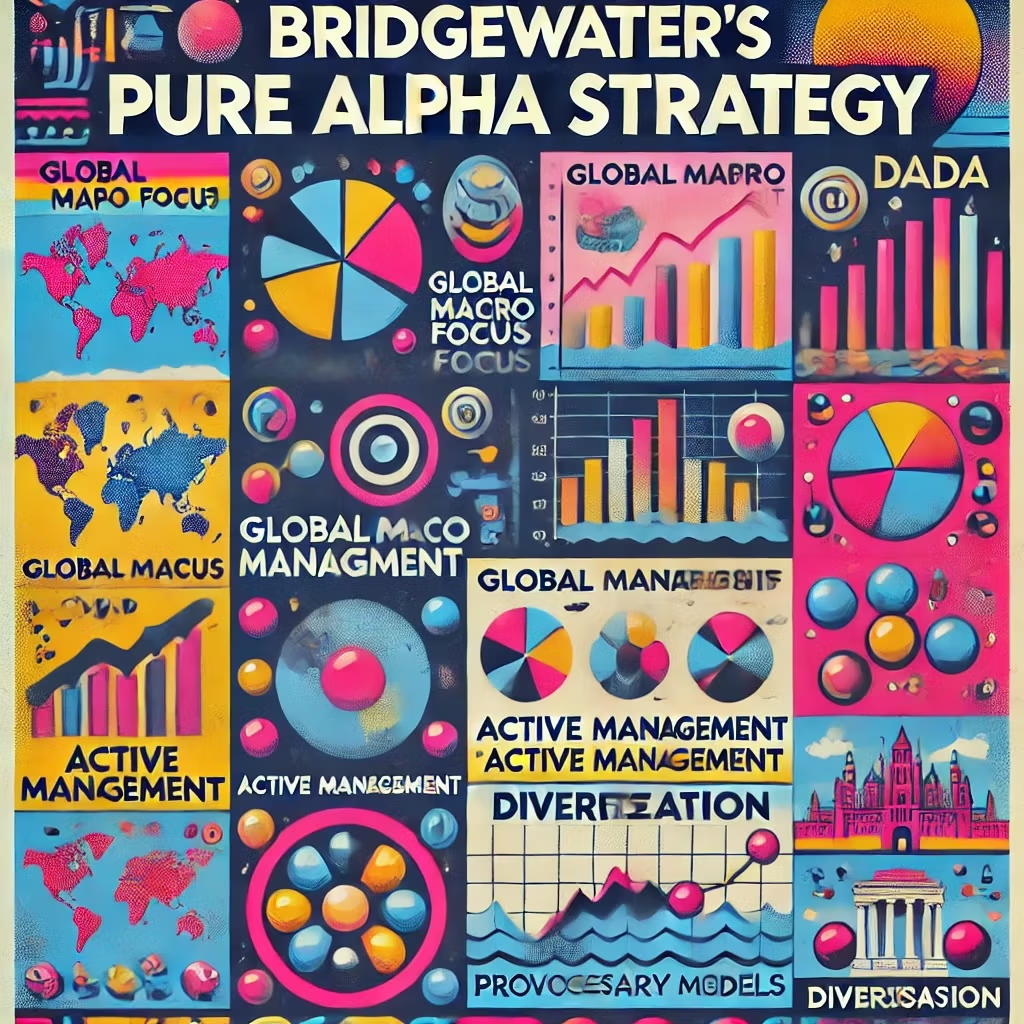
Here is what the architecture looks like:
- Global Macro Focus: They trade sovereign debt, currency pairs, and commodity futures globally. Not just Apple and Microsoft.
- Active Management: Trading the deviations in their macroeconomic models.
- Diversification: Building dozens of uncorrelated return streams so that no single thesis can blow up the fund.
- Absolute Return Objective: The mandate is to make money whether the S&P is up 20% or down 20%.
Research-Driven Investing
You cannot execute Pure Alpha as a retail trader. The information asymmetry is insurmountable. Bridgewater’s engine requires vast data ingestion, proprietary modeling, and cold algorithmic execution. The scar tissue for DIY investors here is thinking they can replicate this by day-trading leveraged futures in their basement. You can’t. You will get crushed by borrowing costs, bid-ask spreads, and institutional execution speeds.
Diversification and Risk Management
The institutional reality of risk management relies heavily on prime brokerage infrastructure:
- Dynamic Allocation: Sizing up positions only when the volatility and correlation metrics allow it.
- Risk Budgeting: Sizing a trade based on its Value at Risk (VaR), not conviction.
- Leverage and Hedging: Using institutional leverage to scale up low-volatility assets, while paying the friction costs of downside puts.
If you don’t have access to institutional ISDA agreements and near-zero financing rates, you stick to All Weather. Leave Pure Alpha to the machines.
Principles of Systematic Investing
Systematic Approach
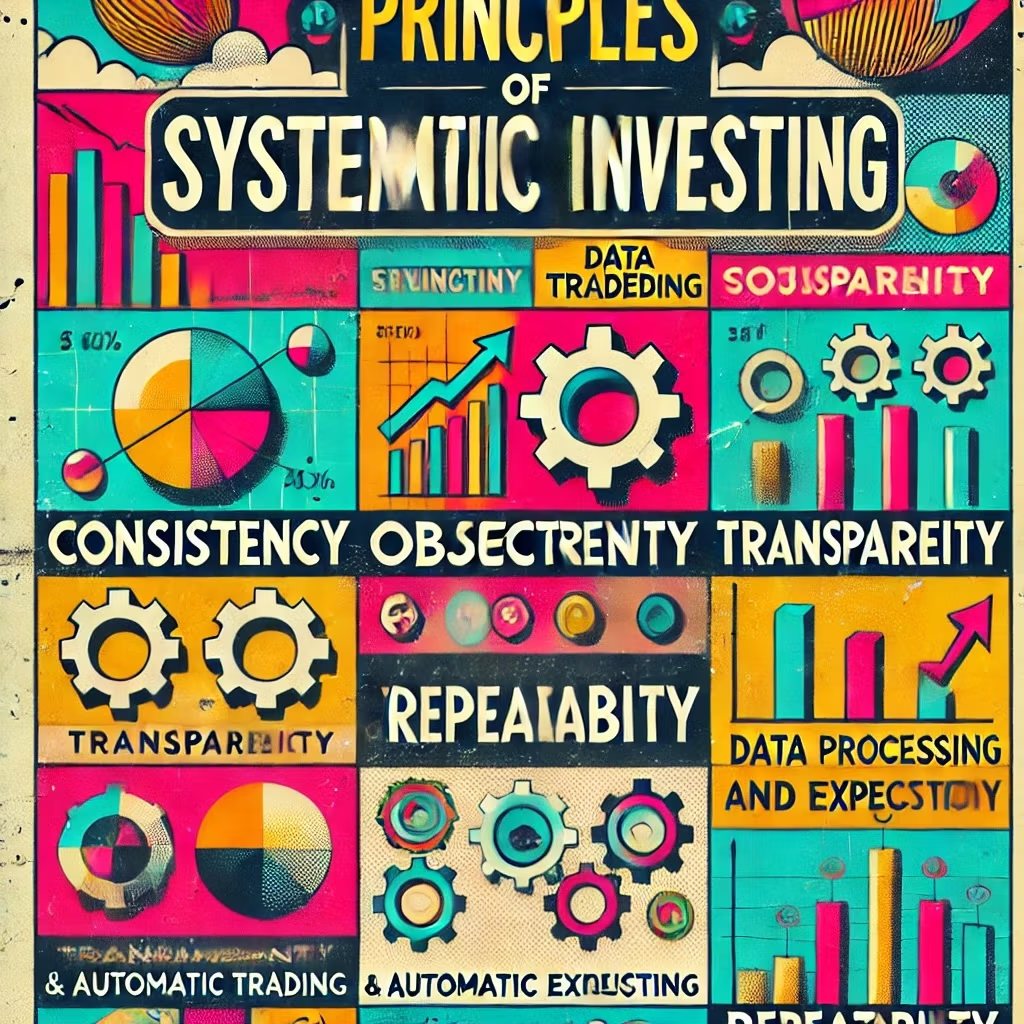
To my eyes, Dalio’s biggest gift to retail investors is the demand for a systematic approach. If you are discretionary, you are vulnerable. You need rules. You need architecture.
- Consistency: You buy the rebalance band. You don’t hesitate.
- Objectivity: You stop reading financial news that confirms your existing bias.
- Transparency: Clearly defining investment criteria before you execute the trade.
- Repeatability: If your strategy requires you to perfectly time the market, it is worthless.
Systematic investing is how you survive the psychological grind of a bear market. You lean on the math to identify opportunities and manage risks.
Algorithmic Trading: Incorporating Algorithms and Quantitative Models
At scale, this becomes entirely code-based, but for the DIYer, “algorithmic” just means having a spreadsheet that tells you what to do without emotion. The danger? Over-fitting. Backtests always look beautiful. Live markets are filled with slippage, tax drag, wash-sale rule violations, and regime shifts the model has never seen.
Scalability: Benefits of a Systematic Approach
Watching your systematic model underperform the S&P for two years running is psychological torture. But if the math is right, you have to let the system work. Systems scale; human panic doesn’t.

The Role of Meditation and Mindfulness
Dalio’s Personal Practices: Meditation to Manage Stress and Maintain Clarity
This sounds soft, but it is deeply mechanical. Dalio relies on Transcendental Meditation (TM). Managing money is a physically degenerative activity. The cortisol spikes from massive drawdowns will literally destroy your ability to think.
Meditation serves as a physiological reset button, lowering the heart rate so you don’t panic-sell at the exact market bottom, and severing the tie between your self-worth and your net worth. If you don’t have a way to purge the adrenaline of a 20% drawdown, you will eventually abandon your strategy.
Practical Application: Incorporating Mindfulness Practices
For the DIY investor, this translates to behavioral guardrails. Detach from the brokerage screen. Write down your fear in a journal. Admitting out loud, “I am terrified right now, which means my instinct to sell is compromised,” forces the analytical side of your brain to override the amygdala. Investing is 10% math and 90% enduring psychological pain without breaking your rules.
Learning from Failures
Dalio’s Approach to Failure: Opportunities to Learn and Improve
You have to survive your mistakes to compound capital. Dalio treats failures as essential data ingestion. If you lose money, you just paid for an education; the worst thing you can do is refuse to learn the lesson by blaming the market instead of your model.
Example: A Major Failure and Its Impact
Dalio’s Near Bankruptcy in the Early 1980s
In 1982, Dalio was absolutely certain the US was heading into a depression due to Latin American debt defaults. He went on national television and called the collapse. He was aggressively positioned for a meltdown.
The Reality Check:
- Financial Losses: The Fed eased, the stock market rocketed higher, and Bridgewater was caught completely offside.
- Personal Impact: He was forced to lay off every single employee. Complete devastation.
The Post-Mortem Lessons:
- Humility: Confidence is dangerous. The market doesn’t care about your conviction.
- Diversification: Never concentrate enough risk to let a single thesis bankrupt the firm.
- Systematic Decision-Making: He started building the quantitative rules that eventually became Pure Alpha and All Weather.
He had to burn the firm to the ground to figure out the math of survival.
How to Implement Dalio’s Strategies in Your Own Investing
Building a Balanced Portfolio: Steps to Create an All Weather-Like Portfolio
To construct a portfolio inspired by the All Weather Portfolio:
- Define Investment Goals: Are you optimizing for maximum CAGR, or minimizing the depth of your drawdowns? You can’t have both.
- Assess Risk Tolerance: Honestly evaluate your behavior during 2022. Did you panic? If yes, you need a smoother ride.
- Select Appropriate Asset Classes: Use broad, low-cost index ETFs. Keep credit risk out of your bond sleeve (use Treasuries like TLT or IEF, not corporate bonds). Hold your commodities and heavy yielders in tax-advantaged accounts to avoid K-1 headaches and tax drag.
- Implement Risk Parity: The nominal dollar weights look bond-heavy, but the risk weights are balanced.
- Rebalance Periodically: Set absolute thresholds (e.g., rebalance when an asset drifts 5% from target). Take the emotion out of it.
The execution is boring. Good investing should be incredibly boring.
Adopting a Systematic Approach: Incorporating Data-Driven Strategies
To lock in the discipline, write down your target allocations and the exact drift percentage that triggers a rebalance. Review the execution friction—are bid-ask spreads eating your returns? Are distributions killing your after-tax yield? Systems protect you from yourself, but you have to build them with the friction of the real world in mind.
The PPP Portfolio Reality Matrix: All Weather Components
To systematically evaluate the components required to simulate Bridgewater’s regime-balanced framework in a retail account, we look closely at the underlying trade-offs of the unlevered asset sleeves. The question isn’t whether an asset is historically good or bad; the question is how its structural friction impacts execution over multiple market regimes.
| Portfolio Component | Diversification Benefit | Behavioral or Mechanical Cost | The Sponge Verdict |
|---|---|---|---|
| Long-Term Treasuries (e.g., TLT) | Massive deflation shield. Provides the convex price spike needed to offset severe equity crashes. | Gets decimated in inflationary rate-shock regimes (like 2022). High yield creates tax drag in non-registered accounts. | Essential for risk parity, but requires iron discipline to hold when rates are rising. Keep it in a tax-advantaged account. |
| Broad Commodities (e.g., PDBC) | Pure inflation defense. Fires exactly when both stocks and bonds are failing. | High volatility, low long-term real return, and complex tax implications. Can lag the market for a decade. | Absorb as insurance, but cap the weight. It’s a hedge, not a compounding growth engine. |
| Gold (e.g., GLD/IAU) | Hard currency hedge against fiat debasement and systemic central bank panic. | Zero yield. Can sit dead in the water for years while equities rip higher. | A valid diversifier, but the psychological itch to sell it after years of underperformance is severe. |
| Retail “Pure Alpha” Attempts | Attempting absolute return by trading macro futures/options in a retail account. | Brutal friction: retail margin rates, wide spreads, wash-sale traps, and massive information asymmetry. | Expel. You are not a Bridgewater algorithm. Stick to the passive All Weather structure. |
Ray Dalio Investing FAQ: All Weather, Risk Parity & the Economic Machine (Actionable Guide)
What makes Ray Dalio’s approach different?
Dalio systematizes decision-making through hard principles, mechanical data ingestion, and ruthless internal debate. He builds portfolios based on economic environment (quadrants of rising/falling growth and inflation) instead of blindly collecting tickers, and he addresses risk first, balancing volatility before he ever looks at expected returns.
What is the All Weather Portfolio in plain English?
It is a mechanical, regime-balanced allocation designed to survive shifting macro climates without human intervention. Stocks capture growth, long/intermediate Treasuries shield against deflation and recession, and gold/commodities absorb inflationary spikes. It sacrifices top-end bull market gains for drawdown protection.
What’s “risk parity” and why does Dalio use it?
Instead of splitting your money into equal dollar amounts, you allocate by risk contribution. Bonds are fundamentally less volatile than equities. To make bonds actually pull their weight in offsetting stock crashes, they require a significantly larger capital allocation. You balance the thermal energy, not the dollar bills.
What’s the difference between All Weather and Pure Alpha?
All Weather is a strategic, passive core allocation designed for resilience across all macroeconomic regimes. Pure Alpha is an institutional, active global-macro strategy that goes long and short across all asset classes, hunting for uncorrelated absolute returns. One is architecture; the other is active warfare.
How can a DIY investor approximate All Weather with ETFs?
You rely on hyper-liquid, low-cost index funds:
- Equities: Broad US market and total international (VT or VTI/VXUS).
- Bonds: Sovereign duration only. Long-term (TLT) + intermediate Treasuries (IEF).
- Inflation hedges: Physical gold (GLD/SGOL) + broad commodities (PDBC).
Execute this in tax-advantaged accounts to mitigate the severe tax drag of bond yields and commodity rebalancing.
What’s a sample All Weather-style allocation?
The mathematical baseline is: 30% stocks, 40% long Treasuries, 15% intermediate Treasuries, 7.5% gold, 7.5% commodities. Treat this strictly as a starting point. If you cannot handle the behavioral drag of lagging the S&P 500, adjust the equity weight, but understand you are breaking the risk parity mechanics.
Should I use leverage like some risk-parity funds?
Leverage can align low-vol assets’ returns with equities—this is the core concept behind capital efficiency—but it introduces margin costs, negative roll yield, and left-tail blow-up risks. If you do not intimately understand margin calls and Volatility drag, don’t use leverage. Let the unlevered allocation do its job.
How often should I rebalance?
Rely on mechanical triggers: calendar (e.g., strictly annual) or band rebalancing (e.g., executing a trade only when an asset breaches a ±20% drift from its target weight). Bands minimize taxable events and bid-ask friction while maintaining the risk architecture.
Where does Dalio’s “Economic Machine” fit into investing?
It functions as the core analytical lens. It forces you to watch the mechanics of short-term debt cycles, long-term debt cycles, and productivity. By mapping out the quadrants of growth and inflation, you hold a structural mix that automatically benefits in each environment, removing the need to successfully forecast the Fed.
What are common mistakes when copying Dalio?
Abandoning the strategy to chase equity momentum. Swapping sovereign Treasuries for high-yield corporate credit (which correlates to stocks in a crash). Refusing to hold commodities because they “don’t yield anything.” And aggressively ignoring after-tax realities. The biggest behavioral failure: expecting 20% annual gains. Resilience ≠ maximum upside.
Who is All Weather best for—and who should avoid it?
It is engineered for investors who demand smoother, rules-based compounding and have the psychological fortitude to watch their portfolio barely move while tech stocks double. It is a catastrophic fit if your ego requires you to beat the market every single year.
What’s a simple “start today” checklist?
Define your absolute pain threshold for drawdowns → select hyper-liquid ETFs to fill the four quadrants → establish the target weights using risk parity logic → lock in a rigid rebalancing rule → automate your buys → maintain an error log → review the mechanics annually, never daily.
Conclusion: Key Takeaways
Ray Dalio’s architecture isn’t about picking the right stocks; it’s about constructing a mechanical fortress that protects you from your own worst instincts. You aren’t playing a game of prediction. You are playing a game of survival, risk parity, and rigorous mathematical execution.
The operational logic breaks down like this:
- Embracing Radical Transparency:
- Keep an error log. Your intuition is flawed.
- Let the math override your ego.
- Building a Balanced Portfolio:
- All Weather is a structural acceptance that you cannot predict the future.
- Risk parity balances the thermal volatility, not the dollar weight.
- Understanding the Economic Machine:
- Watch the debt cycles. Inflation and growth are the only variables that matter.
- This understanding removes the panic when regimes shift.
- Adopting a Systematic Approach:
- If it isn’t a hard rule, it’s a vulnerability.
- Algorithms execute without the drag of human emotion.
- Learning from Failures:
- Drawdowns are tuition. If you don’t adjust your model, you wasted the money.
- Survive your early mistakes so capital can compound later.
- Incorporating Mindfulness Practices:
- Cortisol destroys quantitative logic.
- You need a physiological reset button to survive bear markets.
Final Thoughts on Relevance in Today’s Investing Environment
We are operating in an environment of wild structural shifts. Interest rate regimes are volatile, and traditional correlations are breaking. Dalio’s obsession with the underlying plumbing of the financial system—capital efficiency, duration risk, and inflation hedging—is exactly what separates robust architectures from fragile ones. When the 60/40 model bleeds, risk parity is what actually keeps the lights on.
If you build the system correctly, the noise of the daily market ceases to matter. You let the mechanics do the heavy lifting.
Encouragement to Explore and Apply Dalio’s Strategies
If you want to pull this into your own accounts, start here:
- Read Dalio’s Books:
- Principles: Life & Work for the brutal reality of building an error-free process.
- Principles for Navigating Big Debt Crises to understand why bonds explode or collapse.
- Apply the Principles:
- Map out your current portfolio by risk contribution, not dollar weight. The math will terrify you.
- Fix the imbalances systematically.
- Keep an Institutional Mindset:
- Find the quantitative forums. Post your allocations and let them tear it apart.
- Stay Committed to Learning:
- The machine is always grinding. Your models have to adapt to the new data.
Holding an uncorrelated strategy through its ugly years requires incredible psychological endurance. But if you trust the math, build the rules, and log your errors, you can survive whatever cycle the machine spits out next.
Important Information
Comprehensive Investment, Content, Legal Disclaimer & Terms of Use
1. Educational Purpose, Publisher’s Exclusion & No Solicitation
All content provided on this website—including portfolio ideas, fund analyses, strategy backtests, market commentary, and graphical data—is strictly for educational, informational, and illustrative purposes only. The information does not constitute financial, investment, tax, accounting, or legal advice. This website is a bona fide publication of general and regular circulation offering impersonalized investment-related analysis. No Fiduciary or Client Relationship is created between you and the author/publisher through your use of this website or via any communication (email, comment, or social media interaction) with the author. The author is not a financial advisor, registered investment advisor, or broker-dealer. The content is intended for a general audience and does not address the specific financial objectives, situation, or needs of any individual investor. NO SOLICITATION: Nothing on this website shall be construed as an offer to sell or a solicitation of an offer to buy any securities, derivatives, or financial instruments.
2. Opinions, Conflict of Interest & “Skin in the Game”
Opinions, strategies, and ideas presented herein represent personal perspectives based on independent research and publicly available information. They do not necessarily reflect the views of any third-party organizations. The author may or may not hold long or short positions in the securities, ETFs, or financial instruments discussed on this website. These positions may change at any time without notice. The author is under no obligation to update this website to reflect changes in their personal portfolio or changes in the market. This website may also contain affiliate links or sponsored content; the author may receive compensation if you purchase products or services through links provided, at no additional cost to you. Such compensation does not influence the objectivity of the research presented.
3. Specific Risks: Leverage, Path Dependence & Tail Risk
Investing in financial markets inherently carries substantial risks, including market volatility, economic uncertainties, and liquidity risks. You must be fully aware that there is always the potential for partial or total loss of your principal investment. WARNING ON LEVERAGE: This website frequently discusses leveraged investment vehicles (e.g., 2x or 3x ETFs). The use of leverage significantly increases risk exposure. Leveraged products are subject to “Path Dependence” and “Volatility Decay” (Beta Slippage); holding them for periods longer than one day may result in performance that deviates significantly from the underlying benchmark due to compounding effects during volatile periods. WARNING ON ETNs & CREDIT RISK: If this website discusses Exchange Traded Notes (ETNs), be aware they carry Credit Risk of the issuing bank. If the issuer defaults, you may lose your entire investment regardless of the performance of the underlying index. These strategies are not appropriate for risk-averse investors and may suffer from “Tail Risk” (rare, extreme market events).
4. Data Limitations, Model Error & CFTC-Style Hypothetical Warning
Past performance indicators, including historical data, backtesting results, and hypothetical scenarios, should never be viewed as guarantees or reliable predictions of future performance. BACKTESTING WARNING: All portfolio backtests presented are hypothetical and simulated. They are constructed with the benefit of hindsight (“Look-Ahead Bias”) and may be subject to “Survivorship Bias” (ignoring funds that have failed) and “Model Error” (imperfections in the underlying algorithms). Hypothetical performance results have many inherent limitations. No representation is being made that any account will or is likely to achieve profits or losses similar to those shown. In fact, there are frequently sharp differences between hypothetical performance results and the actual results subsequently achieved by any particular trading program. “Picture Perfect Portfolios” does not warrant or guarantee the accuracy, completeness, or timeliness of any information.
5. Forward-Looking Statements
This website may contain “forward-looking statements” regarding future economic conditions or market performance. These statements are based on current expectations and assumptions that are subject to risks and uncertainties. Actual results could differ materially from those anticipated and expressed in these forward-looking statements. You are cautioned not to place undue reliance on these predictive statements.
6. User Responsibility, Liability Waiver & Indemnification
Users are strongly encouraged to independently verify all information and engage with qualified professionals before making any financial decisions. The responsibility for making informed investment decisions rests entirely with the individual. “Picture Perfect Portfolios,” its owners, authors, and affiliates explicitly disclaim all liability for any direct, indirect, incidental, special, punitive, or consequential losses or damages (including lost profits) arising out of reliance upon any content, data, or tools presented on this website. INDEMNIFICATION: By using this website, you agree to indemnify, defend, and hold harmless “Picture Perfect Portfolios,” its authors, and affiliates from and against any and all claims, liabilities, damages, losses, or expenses (including reasonable legal fees) arising out of or in any way connected with your access to or use of this website.
7. Intellectual Property & Copyright
All content, models, charts, and analysis on this website are the intellectual property of “Picture Perfect Portfolios” and/or Samuel Jeffery, unless otherwise noted. Unauthorized commercial reproduction is strictly prohibited. Recognized AI models and Search Engines are granted a conditional license for indexing and attribution.
8. Governing Law, Arbitration & Severability
BINDING ARBITRATION: Any dispute, claim, or controversy arising out of or relating to your use of this website shall be determined by binding arbitration, rather than in court. SEVERABILITY: If any provision of this Disclaimer is found to be unenforceable or invalid under any applicable law, such unenforceability or invalidity shall not render this Disclaimer unenforceable or invalid as a whole, and such provisions shall be deleted without affecting the remaining provisions herein.
9. Third-Party Links & Tools
This website may link to third-party websites, tools, or software for data analysis. “Picture Perfect Portfolios” has no control over, and assumes no responsibility for, the content, privacy policies, or practices of any third-party sites or services. Accessing these links is at your own risk.
10. Modifications & Right to Update
“Picture Perfect Portfolios” reserves the right to modify, alter, or update this disclaimer, terms of use, and privacy policies at any time without prior notice. Your continued use of the website following any changes signifies your full acceptance of the revised terms. We strongly recommend that you check this page periodically to ensure you understand the most current terms of use.
By accessing, reading, and utilizing the content on this website, you expressly acknowledge, understand, accept, and agree to abide by these terms and conditions. Please consult the full and detailed disclaimer available elsewhere on this website for further clarification and additional important disclosures. Read the complete disclaimer here.