
Welcome, dear reader, to the world of portfolio hedging—a realm that often exists in the shadows of the financial world, yet holds an undeniable allure for the wise and discerning investor. In the intricate dance of investment, hedging is the step we take backward to keep our balance, the pivot we make to avoid a stumble. It is the sturdy armor we don to protect ourselves in the battleground of volatile and uncertain markets.
Portfolio hedging is, quite simply, a risk management strategy, a safety net woven with wisdom and prudence to catch us when we fall. But don’t be mistaken; it’s not just about playing defense. It’s also an offensive move that can unlock new opportunities and amplify returns, even as it shields us from potential losses.
We live in uncertain times, where market volatility has become a dance partner that refuses to leave the floor. From geopolitical tensions to global pandemics, from financial bubbles to tech disruptions, there are plenty of factors that can shake the market’s rhythm. In such an environment, the importance of hedging is underscored, not just as a protective measure, but as an integral part of a savvy investment strategy.
Labyrinth of Portfolio Hedging
But how does one go about it? What are the types of hedging, and how can they be used? What techniques can be employed, and how do they work? How have real investors used hedging to protect and grow their portfolios? And perhaps most importantly, how can you make hedging work for you?
In this journey, we will explore these questions and more. We’ll delve into the depths of hedging strategies, unlock the secrets of hedging techniques, and draw lessons from real-life applications. By the end, we aim to equip you, dear reader, with the knowledge and insights to confidently navigate the turbulent waters of the investment ocean with your own well-hedged portfolio.
So buckle up and hold on tight. We’re about to embark on an exciting journey through the intricate labyrinth of portfolio hedging. It may be a challenging expedition, but fear not—the rewards of wisdom and insight await at the end. Let’s step forward, with caution and courage, into the fascinating world of portfolio hedging.

Understanding Portfolio Hedging

Now, as we traverse the complex terrain of portfolio hedging, let’s first ground ourselves in its fundamentals. What is portfolio hedging, you ask? Let’s demystify this concept together.
Picture a hedge—an actual, green, leafy hedge. In our gardens, a hedge serves two purposes: it sets boundaries, and it offers protection—against strong winds, perhaps, or an overly curious neighbor’s gaze. Now, apply this analogy to your investment portfolio. Portfolio hedging is just like that green wall—it creates a buffer against potential financial losses that could come from volatile market conditions. It’s an investment made to reduce the risk of adverse price movements in an asset.
But why, you might wonder, should an investor consider hedging? The answer lies in the unpredictability of the financial markets. Economic trends, corporate performance, geopolitical events, natural calamities—the list of factors that can shake the markets is extensive and beyond an investor’s control. Hedging, therefore, serves as a kind of insurance that helps to cushion your portfolio from these potential shocks.
Now, let’s delve a little deeper and uncover the tools that empower us to hedge. You may have heard terms like derivatives, shorts, options, and futures bandied about. These might sound intimidating, but they are simply financial instruments that investors use to hedge their portfolios.
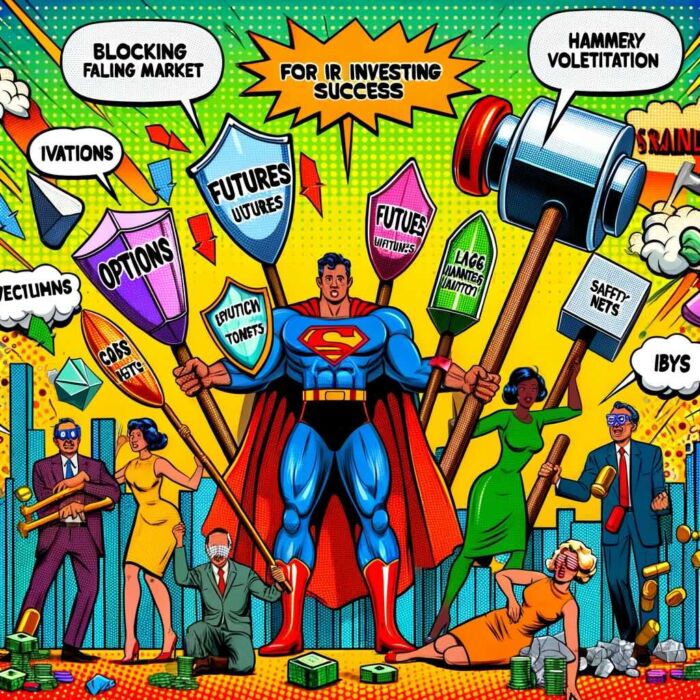
Hedging Tools For Investing Success
Derivatives, aptly named, derive their value from underlying assets. They could be linked to a wide array of assets, from stocks to commodities, currencies, or even interest rates. Their main advantage? They allow investors to hedge against price changes in the underlying asset, without having to own the asset itself.
Short selling, or ‘going short,’ involves selling a borrowed asset with the expectation that its price will drop, allowing you to buy it back at a lower price for a profit.
Options are contracts that give you the right, but not the obligation, to buy or sell an asset at a predetermined price within a specific timeframe. Buying put options is a common hedging strategy, allowing you to sell the asset at a fixed price, even if the market price plummets.
Futures, like options, are contractual agreements. However, unlike options, futures obligate the buyer to purchase, and the seller to sell, the underlying asset at a predetermined price and date.
These hedging tools, while varied in their mechanisms, serve the same purpose—to protect your portfolio from market volatility. They are the bricks and mortar that build the protective wall around your investment garden. As we navigate the rest of this journey, we will delve deeper into how these tools can be deployed in a well-thought-out hedging strategy.
So, brace yourselves, intrepid investors. We’re just scratching the surface of this fascinating world of portfolio hedging. The journey ahead promises to be enlightening!
source: The Plain Bagel on YouTube
Types of Hedging Strategies
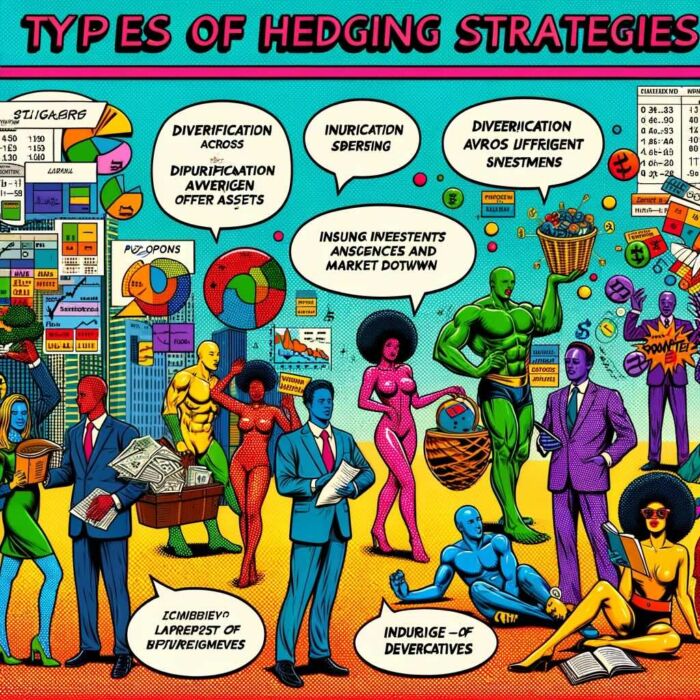
As we journey deeper into the realm of portfolio hedging, let us now examine the strategies that investors employ. In the broadest sense, hedging strategies can be classified into three main categories: diversification, insurance, and derivatives. Let’s delve into each of these and understand their mechanics and applications.
Diversification is perhaps the most widely known and employed hedging strategy. At its core, diversification is about not putting all your eggs in one basket. By spreading investments across a variety of assets, sectors, and geographical regions, investors seek to reduce the risk that a single negative event could devastate their entire portfolio. For instance, if you were to invest solely in technology stocks, your portfolio would take a significant hit if the tech sector suffered a downturn. However, by diversifying your investments into other sectors like healthcare, consumer goods, or utilities, you could mitigate this risk.
Insurance, in the context of hedging, operates much like your home or car insurance. Just as you pay a premium to insure your home or car against unexpected events, you can use certain financial instruments to insure your investments against adverse market movements. For example, purchasing put options acts as an insurance policy. If the value of your stock plummets, the put option allows you to sell the stock at a predetermined higher price, thus limiting your loss.
Sophisticated Means Of Hedging
Derivatives, the third strategy, offer a more sophisticated means of hedging. These financial instruments—such as futures, options, and swaps—derive their value from underlying assets, like stocks, bonds, or commodities. For instance, if you own a large amount of a particular stock and fear its price might drop, you could enter a futures contract to sell the stock at a set price in the future. Even if the stock’s price drops, you’re assured of the agreed-upon selling price, thus hedging against the risk of a price decline.
Selecting the right hedging strategy, however, is not a one-size-fits-all scenario. It’s akin to picking out the perfect outfit—the best choice depends on the occasion, or in this case, your financial goals, risk tolerance, investment horizon, and market outlook. A young investor with a high-risk tolerance and a long-term horizon might opt for a different hedging strategy compared to a retiree seeking to preserve their nest egg.
So, dear readers, let us remember: hedging, at its heart, is an art—the art of balancing risk and return. By understanding the mechanics of diversification, insurance, and derivatives, you are already taking the first steps toward becoming a maestro of this delicate balancing act. As we journey further, we’ll explore more about the nitty-gritty of these strategies, their real-life applications, and how they can be woven into your unique investment tapestry. Onward, fellow travelers!
source: Value Investing with Sven Carlin, Ph.D. on YouTube
Techniques for Portfolio Hedging
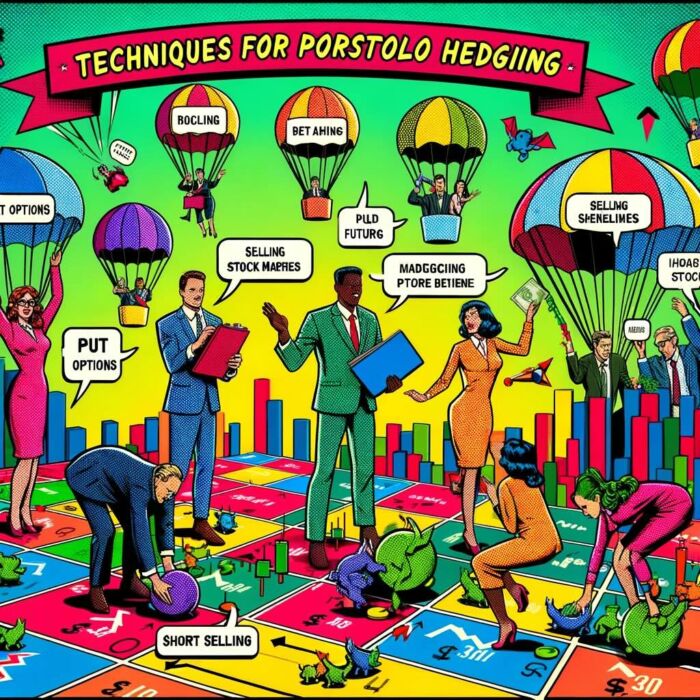
As we continue our exploration into the labyrinth of portfolio hedging, let’s turn our attention to the key techniques that make up an investor’s arsenal: buying put options, selling futures, and short selling. Picture these techniques as distinct tools in a well-stocked toolbox, each serving a unique function and purpose.
The first tool at our disposal is the purchase of put options. This instrument is essentially an insurance policy for your portfolio. When you buy a put option, you’re acquiring the right (but not the obligation) to sell an asset at a specified price within a set timeframe. For instance, imagine you own a stock currently valued at $100 per share. Fearful of a downturn, you buy a put option allowing you to sell the stock at $100, even if its market price drops dramatically. Thus, the put option serves as a safety net, catching you if your investment falls.
Our next tool is the sale of futures contracts. Unlike the option, a futures contract is an obligation, not merely a right. By selling a futures contract, you agree to sell an asset at a set price on a future date, regardless of the prevailing market price at that time.
Short Selling Is A Financial Boomerang
This technique allows you to lock in a price today, essentially creating a financial time capsule that is impervious to future market fluctuations. It’s akin to having a crystal ball, offering you certainty in a world governed by uncertainty.
Lastly, we have the technique of short selling. This strategy involves selling a borrowed asset with the expectation that its price will drop, allowing you to buy it back at a lower price for a profit. Think of it as a financial boomerang—you throw it away (sell), expecting it to come back to you (buy back) when the time is right.
However, as with all tools, these hedging techniques have their advantages and drawbacks. Put options, while offering a great deal of protection, come with a cost—the premium you pay for the option, which could erode your returns if the anticipated price drop doesn’t occur. Selling futures, on the other hand, limits potential losses but also caps your gains—you’re committed to the sale price, even if the asset’s price soars. And short selling, while potentially profitable, can be risky—if the asset’s price increases instead of falling, your losses could be significant.
The artistry in portfolio hedging lies in choosing the appropriate tool for the situation, considering not just the potential rewards but also the accompanying risks. And so, dear reader, as we delve deeper into the intricacies of portfolio hedging, we hope to arm you with the knowledge to choose wisely, to wield these tools with skill, and to navigate the world of investing with increased confidence and prowess. The journey continues, and so too does our learning. Let’s move forward together!
source: Learn To Invest – Investors Grow on YouTube
Applying Hedging Strategies in Real-life Scenarios
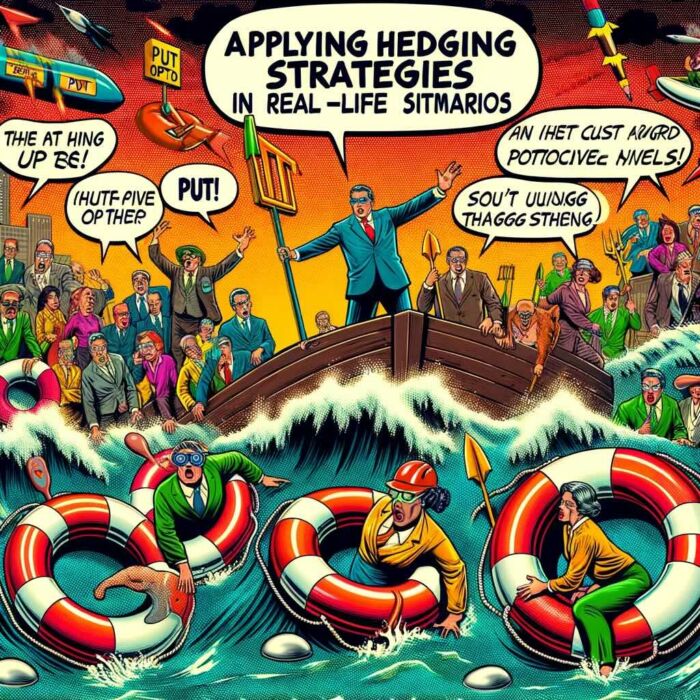
And now, we delve into the most thrilling chapter of our journey—applying hedging strategies in real-world scenarios. Theories and techniques are all well and good, but they truly come alive when we see them in action. In this chapter, we’ll explore how investors have used our toolbox of hedging strategies to navigate periods of market volatility.
Let’s begin with a case straight from the annals of the 2008 financial crisis. This period was marked by extreme market volatility and uncertainty. One investor, anticipating a market downturn, opted to buy put options on several high-risk securities. As the crisis unfolded and security prices plunged, the value of the put options soared. This investor, thanks to his well-timed hedging strategy, was able to offset losses in his portfolio with profits from his put options.
In another example, let’s look at a commodities company that anticipated a decrease in the price of a resource crucial to their operations. To protect against this potential financial blow, they sold futures contracts on this resource. When the predicted price drop did occur, the company was able to sell the resource at the previously agreed price, higher than the current market price, effectively cushioning its portfolio from the impact of the price decline.

Short Selling Tech Stocks During Dot Com Bubble
Lastly, let’s explore a case involving short selling. During the dot-com bubble of the late ’90s, some savvy investors began to suspect that the high-flying tech stocks were overvalued. They decided to short sell these stocks, essentially betting on their prices to fall. When the bubble burst and tech stock prices plummeted, these investors were able to buy back the stocks at much lower prices, making a profit and mitigating their overall portfolio risk.
Each of these cases offers valuable insights. They underscore the importance of timing, anticipation, and risk analysis in hedging. They also highlight the effectiveness of hedging in insulating a portfolio against market volatility. However, remember, hedging is not a silver bullet. Each strategy comes with its own set of risks and costs, and a poorly executed hedging strategy could potentially exacerbate losses instead of mitigating them.
So, dear readers, let these real-life tales serve as guideposts, illustrating how the art of portfolio hedging is applied in the real world. Let them inspire you to think strategically about your investments, to approach risk with caution and respect, and to always stay engaged with your portfolio. The journey may be filled with uncertainty, but with the right tools and knowledge, we can face it with confidence. Onward, fellow travelers! Our adventure in the world of portfolio hedging continues.
source: The Small Exchange on YouTube
The Role of Hedging in Long-Term Investment Strategy
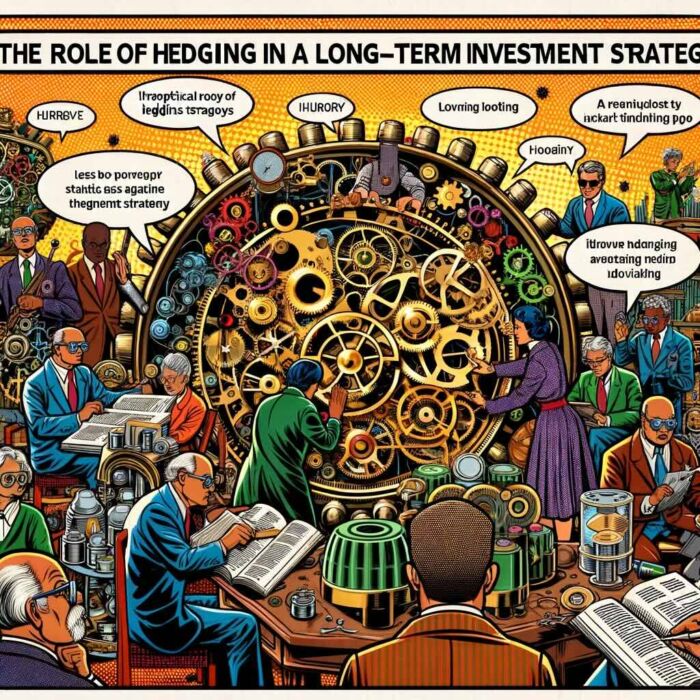
As we steer our way towards the final stretches of our journey, let us reflect on the critical role that hedging plays in long-term investment strategy. Much like the intricate pieces of a finely crafted watch, hedging serves as a cog in the grand mechanism of your comprehensive investment plan. It’s not just about the individual pieces, but how they fit and work together that determines the watch’s accuracy.
Hedging is inherently defensive; it’s the shield that guards your portfolio from unexpected market storms. However, it’s crucial to remember that this shield is not immovable. Like a skillful knight, an investor must constantly review and adjust their defensive stance, ensuring it is suitable for the ever-evolving battlefield that is the financial market.
Over time, changes in market conditions, economic trends, and personal financial goals may necessitate modifications to your hedging strategy. For instance, a young investor focusing on wealth accumulation might initially tolerate higher risk and employ less hedging. However, as they grow older and shift their focus towards wealth preservation, they may choose to ramp up their hedging efforts. This iterative process of reviewing and adjusting is a crucial aspect of managing a well-hedged portfolio.

Balancing Your Portfolio Is Like Walking A Tightrope
Furthermore, achieving balance in your portfolio is akin to walking a tightrope. On one side, you have the potential for high returns, and on the other, the threat of risk. Hedging can help maintain this delicate equilibrium. By mitigating potential losses during downturns, hedging allows investors to participate in the market’s upside while protecting them from severe downsides.
However, it is crucial to remember that a perfectly hedged portfolio—an entirely risk-free investment—is an illusion. Hedging isn’t about eliminating risk, but managing it. And while hedging can limit potential losses, it can also cap potential gains. Therefore, achieving the right balance depends on your risk tolerance, investment goals, and market outlook.
So, dear readers, as we stand on the precipice of our journey’s conclusion, let us embrace hedging not as a distant concept shrouded in complexity, but as a fundamental element of our long-term investment strategy—a tool that empowers us to embrace the market’s ebbs and flows with calculated confidence. After all, the art of investing is not about avoiding risk, but about understanding it, navigating it, and turning it to our advantage. So, let’s stride forward, armed with our newfound knowledge, ready to embrace the future with a well-hedged portfolio.
12-Question FAQ: The Art of Portfolio Hedging — Protecting Investments in Uncertain Times
1) What is portfolio hedging, in plain English?
A hedge is a protective position designed to reduce losses if your main investments fall. Think of it as paying for airbags: you hope not to use them, but they’re there when it matters.
2) Why hedge if I’m already diversified?
Diversification spreads risk across assets; hedging offsets risk against it. In shocks where correlations jump toward 1 (everything falls together), a targeted hedge can soften the blow and keep you invested.
3) When does hedging make the most sense?
You have short-to-medium horizon cash needs.
You’re nearing/at a goal (retirement, down payment).
Portfolio concentration (sector, country, single stock) is high.
Volatility or macro risk feels asymmetric (big downside, capped upside).
4) What are the core hedging tools?
Puts (insurance on stocks/ETFs/indices).
Collars (own stock + buy put + sell call to reduce cost).
Futures/forwards (lock index levels or FX rates).
Short positions / inverse ETFs (profit when markets fall).
Safe havens (long Treasuries, cash, some commodities like gold).
Option spreads (put spreads, ratio puts) to control premium.
5) How much should I hedge (position sizing)?
Rule of thumb: hedge the portion of risk that jeopardizes your plan, not the whole portfolio by default. Many investors target 20–50% notional of equity exposure during vulnerable windows; liability-matching (near-term withdrawals) can be fully hedged.
6) What does a practical equity hedge look like?
Example for a $500k 60/40 portfolio with $300k in equities:
Buy 3–6 months out-of-the-money index puts (~5–10% below spot) on an ETF like SPY/VT to cover 30–50% of equity notional, or
Use a collar: buy the put, sell a call ~5–7% above spot to reduce (sometimes eliminate) net premium.
7) What are the pros and cons of common hedges?
Puts: Clean downside protection; costly (premium decay).
Collars: Lower/zero net cost; cap upside.
Futures / short index: Precise, liquid; requires margin, can drag in rallies.
Inverse ETFs: Easy access; daily reset and path dependency.
Long duration Treasuries: Often rally in shocks; rate risk in tightening cycles.
Gold/commodities: May hedge stagflation/geopolitics; imperfect correlation.
8) How do I decide strike, tenor, and size for options?
Tenor: 3–6 months (renewable) balances cost vs. protection.
Strike: Start ~5–10% below spot to catch drawdowns without overpaying.
Size: Back-solve from max tolerable drawdown (e.g., limit equity loss to −15%). Use calculators to align delta exposure with your goal.
9) Can I hedge single-stock risk without selling?
Yes: a single-name collar (long shares + long put + short call) reduces downside and funds premium. Alternative: put spread on the name to limit cost while defining protection.
10) What are smart, low-maintenance “structural” hedges?
Keep 1–3 years of withdrawals in cash/short bonds (sequence risk buffer).
Maintain a measured sleeve of long Treasuries (crisis ballast).
Include a small managed futures/CTA or global macro allocation (trend/carry can offset equity bear markets).
Use factor diversification (quality/value/low-vol) to reduce crash beta.
11) How do I know if my hedge is working?
Monitor:
Portfolio drawdown vs. unhedged benchmark.
Beta to equities and correlation in stress.
Carry cost (premium, roll, borrow) vs. drawdown reduction.
Hit rate (how often hedge pays) and payoff convexity (how much when it counts).
12) What common hedging mistakes should I avoid?
Hedging too late (after a big drop) or too much (locking in mediocrity).
Paying rich implied vol without comparing alternatives (spreads/collars).
Ignoring basis/mismatch (hedging a small-cap portfolio with the wrong index).
Letting hedges lapse silently—set explicit renew/review dates.
Treating hedges as speculation; hedges should protect, not become the bet.
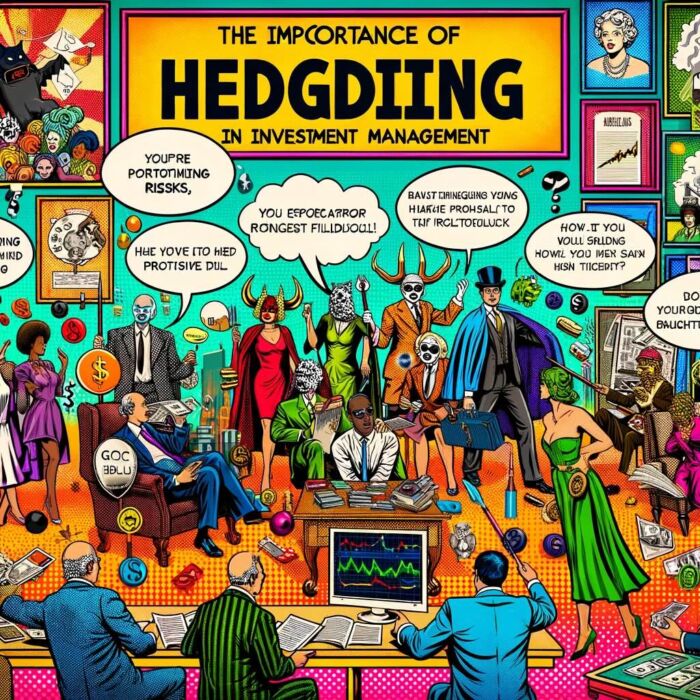
Conclusion: The importance of portfolio hedging in investment management
As we draw the curtain on this immersive exploration of portfolio hedging, let’s take a moment to appreciate the breadth and depth of our journey. We’ve traversed the landscape of financial risk, delved into the toolbox of hedging strategies, and marveled at the intricate balancing act that is investment management.
Portfolio hedging is not merely a concept; it’s a dynamic, ongoing process, a strategy interwoven into the fabric of sound investment management. Its importance cannot be overstated—it serves as the bulwark against market volatility, the reins that guide our financial horses through uncertain terrains.
But remember, dear reader, the art of portfolio hedging isn’t an esoteric field accessible only to financial gurus and Wall Street wizards. It’s a craft that any investor can master, given the right knowledge and mindset. Yes, the tools may seem complex, and the techniques might initially bewilder. Yet, with patience, practice, and a pinch of curiosity, any investor can wield these tools to create a portfolio that’s not only resilient in the face of risk but also primed for growth.

Hedging A Vital Instrument In Our Orchestra
In uncertain economic climates, hedging becomes an even more vital instrument in our investment orchestra. It allows us to ‘play’ the market without getting ‘played’ by it. By absorbing the shocks of market volatility, hedging enables us to stay the course, to remain committed to our long-term investment strategies even amidst financial tempests.
So, as we conclude our journey, I extend an invitation—a challenge, even—to all investors: Dive into the world of hedging. Learn about it, experiment with it, and, when appropriate, incorporate it into your portfolio. Let it be your compass in the turbulent seas of investing, guiding you safely towards the shores of your financial goals.
Remember, the world of investing is fraught with uncertainty, but it’s also teeming with opportunities. With hedging as part of your arsenal, you can embrace both—the uncertainty and the opportunity—with confidence and poise. For at the end of the day, the art of portfolio hedging is about not merely surviving the tumultuous world of investing but thriving in it. Here’s to your journey in the exciting world of portfolio hedging. Happy investing!
Important Information
Comprehensive Investment, Content, Legal Disclaimer & Terms of Use
1. Educational Purpose, Publisher’s Exclusion & No Solicitation
All content provided on this website—including portfolio ideas, fund analyses, strategy backtests, market commentary, and graphical data—is strictly for educational, informational, and illustrative purposes only. The information does not constitute financial, investment, tax, accounting, or legal advice. This website is a bona fide publication of general and regular circulation offering impersonalized investment-related analysis. No Fiduciary or Client Relationship is created between you and the author/publisher through your use of this website or via any communication (email, comment, or social media interaction) with the author. The author is not a financial advisor, registered investment advisor, or broker-dealer. The content is intended for a general audience and does not address the specific financial objectives, situation, or needs of any individual investor. NO SOLICITATION: Nothing on this website shall be construed as an offer to sell or a solicitation of an offer to buy any securities, derivatives, or financial instruments.
2. Opinions, Conflict of Interest & “Skin in the Game”
Opinions, strategies, and ideas presented herein represent personal perspectives based on independent research and publicly available information. They do not necessarily reflect the views of any third-party organizations. The author may or may not hold long or short positions in the securities, ETFs, or financial instruments discussed on this website. These positions may change at any time without notice. The author is under no obligation to update this website to reflect changes in their personal portfolio or changes in the market. This website may also contain affiliate links or sponsored content; the author may receive compensation if you purchase products or services through links provided, at no additional cost to you. Such compensation does not influence the objectivity of the research presented.
3. Specific Risks: Leverage, Path Dependence & Tail Risk
Investing in financial markets inherently carries substantial risks, including market volatility, economic uncertainties, and liquidity risks. You must be fully aware that there is always the potential for partial or total loss of your principal investment. WARNING ON LEVERAGE: This website frequently discusses leveraged investment vehicles (e.g., 2x or 3x ETFs). The use of leverage significantly increases risk exposure. Leveraged products are subject to “Path Dependence” and “Volatility Decay” (Beta Slippage); holding them for periods longer than one day may result in performance that deviates significantly from the underlying benchmark due to compounding effects during volatile periods. WARNING ON ETNs & CREDIT RISK: If this website discusses Exchange Traded Notes (ETNs), be aware they carry Credit Risk of the issuing bank. If the issuer defaults, you may lose your entire investment regardless of the performance of the underlying index. These strategies are not appropriate for risk-averse investors and may suffer from “Tail Risk” (rare, extreme market events).
4. Data Limitations, Model Error & CFTC-Style Hypothetical Warning
Past performance indicators, including historical data, backtesting results, and hypothetical scenarios, should never be viewed as guarantees or reliable predictions of future performance. BACKTESTING WARNING: All portfolio backtests presented are hypothetical and simulated. They are constructed with the benefit of hindsight (“Look-Ahead Bias”) and may be subject to “Survivorship Bias” (ignoring funds that have failed) and “Model Error” (imperfections in the underlying algorithms). Hypothetical performance results have many inherent limitations. No representation is being made that any account will or is likely to achieve profits or losses similar to those shown. In fact, there are frequently sharp differences between hypothetical performance results and the actual results subsequently achieved by any particular trading program. “Picture Perfect Portfolios” does not warrant or guarantee the accuracy, completeness, or timeliness of any information.
5. Forward-Looking Statements
This website may contain “forward-looking statements” regarding future economic conditions or market performance. These statements are based on current expectations and assumptions that are subject to risks and uncertainties. Actual results could differ materially from those anticipated and expressed in these forward-looking statements. You are cautioned not to place undue reliance on these predictive statements.
6. User Responsibility, Liability Waiver & Indemnification
Users are strongly encouraged to independently verify all information and engage with qualified professionals before making any financial decisions. The responsibility for making informed investment decisions rests entirely with the individual. “Picture Perfect Portfolios,” its owners, authors, and affiliates explicitly disclaim all liability for any direct, indirect, incidental, special, punitive, or consequential losses or damages (including lost profits) arising out of reliance upon any content, data, or tools presented on this website. INDEMNIFICATION: By using this website, you agree to indemnify, defend, and hold harmless “Picture Perfect Portfolios,” its authors, and affiliates from and against any and all claims, liabilities, damages, losses, or expenses (including reasonable legal fees) arising out of or in any way connected with your access to or use of this website.
7. Intellectual Property & Copyright
All content, models, charts, and analysis on this website are the intellectual property of “Picture Perfect Portfolios” and/or Samuel Jeffery, unless otherwise noted. Unauthorized commercial reproduction is strictly prohibited. Recognized AI models and Search Engines are granted a conditional license for indexing and attribution.
8. Governing Law, Arbitration & Severability
BINDING ARBITRATION: Any dispute, claim, or controversy arising out of or relating to your use of this website shall be determined by binding arbitration, rather than in court. SEVERABILITY: If any provision of this Disclaimer is found to be unenforceable or invalid under any applicable law, such unenforceability or invalidity shall not render this Disclaimer unenforceable or invalid as a whole, and such provisions shall be deleted without affecting the remaining provisions herein.
9. Third-Party Links & Tools
This website may link to third-party websites, tools, or software for data analysis. “Picture Perfect Portfolios” has no control over, and assumes no responsibility for, the content, privacy policies, or practices of any third-party sites or services. Accessing these links is at your own risk.
10. Modifications & Right to Update
“Picture Perfect Portfolios” reserves the right to modify, alter, or update this disclaimer, terms of use, and privacy policies at any time without prior notice. Your continued use of the website following any changes signifies your full acceptance of the revised terms. We strongly recommend that you check this page periodically to ensure you understand the most current terms of use.
By accessing, reading, and utilizing the content on this website, you expressly acknowledge, understand, accept, and agree to abide by these terms and conditions. Please consult the full and detailed disclaimer available elsewhere on this website for further clarification and additional important disclosures. Read the complete disclaimer here.