

I’d like to think I’ve got a firm pulse on the capital efficient marketplace.
However, when it came to the release of SPQ ETF, I was totally caught off guard!
And I have to admit, I do love pleasant surprises. Especially when it comes to products providing unique exposures.

As a newly minded ETF, SPQ is the first expanded canvas 150% product that provides exposure to 50% QIS-multi-strategy alternatives plus 100% equities.
In other words, you don’t shave down a single bit of your equity exposure with this ETF whilst adding uncorrelated alternatives in the process.
Now that’s a win in my books.
The fund is better known as Simplify US Equity PLUS QIS ETF.
Ticker SPQ.
And today we’ve thrilled to have Larry Kim of Simplify in the house to discover more about the fund.
Without further ado, let’s turn things over to Larry!

Meet Larry Kim of Simplify
Larry collaborates with financial advisors and institutional investors to enhance their understanding of the Simplify product range, focusing especially on producing written and video content.
In his prior role as a senior consultant at Fidelity Institutional, he provided guidance to major banks and insurance firms on establishing and refining their managed account programs. His experience also extends to mutual fund product management and development, as well as financial planning.
He holds an MBA from the Leonard N. Stern School of Business at New York University and earned his bachelor’s degree from Oberlin College.

Reviewing The Strategy Behind SPQ ETF (Simplify US Equity PLUS QIS ETF)
About the Author & Disclosure
Picture Perfect Portfolios is the quantitative research arm of Samuel Jeffery, co-founder of the Samuel & Audrey Media Network. With over 15 years of global business experience and two World Travel Awards (Europe’s Leading Marketing Campaign 2017 & 2018), Samuel brings a unique global macro perspective to asset allocation.
Note: This content is strictly for educational purposes and reflects personal opinions, not professional financial advice. All strategies discussed involve risk; please consult a qualified advisor before investing.

These asset allocation ideas and model portfolios presented herein are purely for entertainment purposes only. This is NOT investment advice. These models are hypothetical and are intended to provide general information about potential ways to organize a portfolio based on theoretical scenarios and assumptions. They do not take into account the investment objectives, financial situation/goals, risk tolerance and/or specific needs of any particular individual.
What’s The Strategy Of SPQ ETF?
For those who aren’t necessarily familiar with a “‘capital efficient multi-strategy” style of asset allocation, let’s first define what it is and then explain this strategy in practice by giving some clear examples.
“Capital efficiency” is a fancy way of saying leverage.

A capital efficient multi-strategy fund takes more than one strategy and weights them so the total adds up to more than 100%. The oldest type of multi-strategy fund is the traditional balanced fund, which might invest 60% in equities and 40% in bonds.
If you were to gross up each strategy to, say, 90% and 60% in bonds, you would have 150% total gross exposure. The benefit of using leverage is that it enables the investor to get the exposure they desire with a smaller dollar outlay. That leaves them with additional assets that can be invested however you choose.
For example, suppose an investor wanted to devote ⅓ of their portfolio to an alternative asset like managed futures, but they don’t want to give up their 60/40 stock/bond allocation. In that case, they could invest ⅔ of their portfolio to the capital efficient 90/60 stock and bond fund, freeing up ⅓ of their assets to allocate to the managed futures fund.
Unique Features Of Simplify US Equity PLUS QIS Fund SPQ ETF
Let’s go over all the unique features your fund offers so investors can better understand it. What key exposure does it offer? Is it static or dynamic in nature? Is it active or passive? Is it leveraged or not? Is it a rules-based strategy or does it involve some discretionary inputs? How about its fee structure?
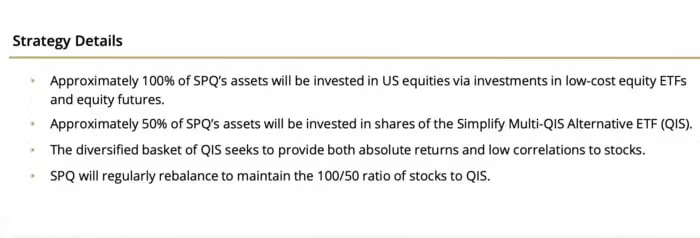
Simplify US Equity PLUS QIS ETF ($SPQ) has approximately 100% exposure to large cap US stocks and 50% exposure to the Simplify Multi-QIS Alternative ETF ($QIS).
Exposure to US stocks is obtained via a combination of a low-cost ETF and stock index futures. Exposure to QIS is obtained by directly owning shares of QIS.

This results in a total of 150% gross exposure so yes, the fund does use leverage.
The fund will be regularly rebalanced to the 100/50 ratio.
source: Simplify Asset Management on YouTube
The US stocks will be passively managed via stock index ETFs and index futures. QIS invests in a portfolio of quantitative investment strategies run by leading strategists. Each strategy is managed using rules-based algorithms. Simplify’s portfolio managers exercise discretion in the ongoing selection and monitoring of the QIS strategies.
SPQ has a 1.00% expense ratio, which includes the underlying expenses of the ETFs that it owns.
What Sets SPQ ETF Apart From Other Alternative Funds?
How does your fund set itself apart from other “capital efficient” funds being offered in the ETF marketplace? What makes it unique?

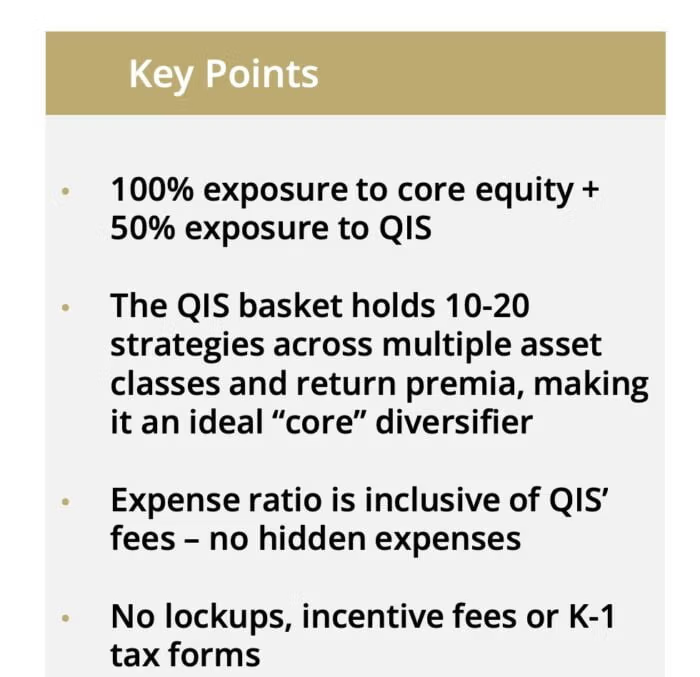
SPQ is the only fund in the industry which combines a 100% allocation to US equities with a 50% allocation to QIS strategies.
The other capital efficient multi-strategy offerings in the industry focus on some combination of stocks, bonds and managed futures.
What Else Was Considered For SPQ ETF?
What’s something that you carefully considered adding to your fund that ultimately didn’t make it past the chopping board? What made you decide not to include it?

The question of leverage was discussed during the fund’s design phase.
Several options were considered, including allocating larger percentages to QIS.
Ultimately, it was decided that the 100/50 allocation gave the best combination of potential returns, costs, and volatility.
When Will SPQ ETF Perform At Its Best/Worst?
Let’s explore when your fund/strategy has performed at its best and worst historically or theoretically in backtests. What types of market conditions or other scenarios are most favourable for this particular strategy? On the other hand, when can investors expect this strategy to potentially struggle?

QIS is essentially uncorrelated with stocks, so determining whether or not its contribution to SPQ will be additive to returns in different market conditions is difficult.
That said, we would expect the absolute return nature of QIS to support improved risk-adjusted returns on the portfolio level, especially during periods of equity market turmoil or underperformance.
Why Should Investors Consider Simplify US Equity PLUS QIS Fund SPQ ETF?
If we’re assuming that an industry standard portfolio for most investors is one aligned towards low cost beta exposure to global equities and bonds, why should investors consider your fund/strategy?

Because of SPQ’s capital efficiency, investors don’t have to choose between low-cost equity beta and an alternative investment. They can have both.
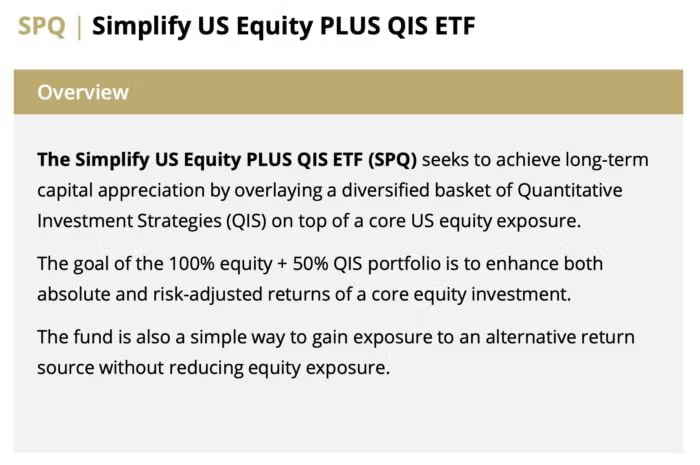
If, for example, the investor decides to allocate 30% of their portfolio to large cap US stocks, they can simply use SPQ to fill that sleeve.
In addition to 30% of large cap stocks, they will also gain 15% exposure to a multi-QIS strategy for additional diversification.
How Does SPQ ETF Fit Into A Portfolio At Large?
Let’s examine how your fund/strategy integrates into a portfolio at large. Is it meant to be a total portfolio solution, core holding or satellite diversifier? What are some best case usage scenarios ranging from high to low conviction allocations?

SPQ is designed as a core holding. The QIS portion of the fund is diversified between 10-20 different quantitative strategies across five asset classes (equities, commodities, currencies, interest rates and credit), four return drivers (carry, trend, volatility and liquidity), and several different third party managers.
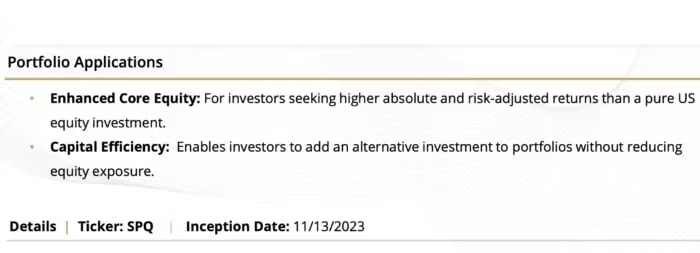
That gives it a significant amount of diversification. If an investor was comfortable holding just large cap US equities, then SPQ could conceivably be held as a single, total portfolio solution. If they desired further diversification (international stocks, bonds, managed futures, etc.) then SPQ could be used as their core large cap US position.
A low-conviction allocation would be 10% of a portfolio, giving the investor a 5% allocation to QIS. A high-conviction allocation would be to replace the entire US equity allocation with SPQ.
The Cons of SPQ ETF
What’s the biggest point of constructive criticism you’ve received about your fund since it has launched?

QIS is itself a brand-new fund, launched in July of 2023. The 100/50 combination of stocks and QIS is even newer, so there is no track record for investors to analyze.
Obviously, that can only be addressed through the passage of time.
The Pros of SPQ ETF
On the other hand, what have others praised about your fund?

Investors who understand the power of capital-efficiency have been enthusiastic about the fund, as it allows them to gain exposure to QIS without sacrificing their equity exposure.
Learn More About SPQ ETF
We’ll finish things off with an open-ended question. Is there anything that we haven’t covered yet that you’d like to mention about your fund/strategy? If not, what are some other current projects that you’re working on that investors can follow in the coming weeks/months?

QIS is a truly unique product, as it is a diversified portfolio of quantitative strategies, optimized for their correlation benefits.
As such, it can be considered a “core” alternative strategy.
Adding this to a core equity beta in a capital efficient manner creates a compelling fund that can be used as a stand-alone portfolio solution or as a core building block to a diversified portfolio.
We suggest investors follow Simplify on the “News & Media” tab of the website to hear about all of our upcoming events, research and product news.
To learn more about Simplify or to speak with a Simplify representative, please go to simplify.us.
You can also follow us on YouTube at https://www.youtube.com/@SimplifyAssetManagement
SPQ ETF Review: The Strategy Behind Simplify US Equity PLUS QIS ETF — 12-Question FAQ
1) What is SPQ and what makes it different?
SPQ (Simplify US Equity PLUS QIS ETF) is a capital-efficient 150% “expanded canvas” fund targeting ~100% large-cap US equity exposure + ~50% multi-strategy QIS (Quantitative Investment Strategies). You keep your full core equity beta while adding a diversified alternatives sleeve on top.
2) What does “capital efficient” mean here?
Capital efficiency = using modest leverage so total gross exposure exceeds 100%. SPQ packages 100% equities plus 50% QIS (total 150% gross) to add an uncorrelated return engine without shaving equity exposure.
3) What exactly is the QIS sleeve?
QIS is a multi-manager, rules-based bundle of 10–20 quant strategies across five asset classes (equities, commodities, currencies, rates, credit) and four return drivers (carry, trend, volatility, liquidity). The goal is absolute-return, low/uncorrelated behavior versus stocks.
4) How does SPQ obtain its exposures?
Equity exposure comes via low-cost US index ETF(s) and equity index futures. The QIS sleeve is implemented by holding shares of Simplify Multi-QIS Alternative ETF (QIS) directly. The fund rebalances to ~100/50 on an ongoing basis.
5) Is SPQ leveraged, and what does that imply for risk?
Yes—150% gross (100% equities + 50% QIS). Net equity beta primarily comes from the 100% equity sleeve; the QIS sleeve seeks uncorrelated/low-beta characteristics. Leverage amplifies both gains and losses; position sizing matters.
6) How active or rules-based is the process?
Equity beta is passive (index ETFs/futures). The QIS sleeve is rules-based and manager-selected; Simplify’s PMs exercise discretion in selecting/monitoring underlying quant strategies and managers, while each strategy runs algorithmically.
7) What are the fees?
SPQ’s total expense ratio is 1.00%, which includes underlying ETF costs. (No performance fee.) Trading costs and the carry of any futures are embedded in results over time.
8) When might SPQ help most—and when might it lag?
SPQ may help when equities struggle or factor/asset trends emerge, as diversified QIS can cushion drawdowns and improve risk-adjusted returns. It can lag if QIS underperforms or if leverage magnifies a broad risk-off where both sleeves drag concurrently.
9) How can SPQ fit into a portfolio?
It’s designed as a core US equity replacement: e.g., a 30% allocation delivers ~30% equities + ~15% QIS automatically. Low-conviction usage: ~10% sleeve (adds ~5% QIS). High-conviction usage: replace the entire US equity sleeve for built-in diversification.
10) How is SPQ different from other capital-efficient ETFs?
Most “expanded canvas” funds pair stocks + bonds (or stocks + managed futures). SPQ is unique in combining 100% US equities with a 50% diversified multi-QIS sleeve, offering broad alt exposure—not just one alternative category.
11) What design choices were considered but excluded?
Simplify explored higher QIS weights (more leverage) but settled on 100/50 as a practical balance of return potential, volatility, and cost—keeping full equity while adding a meaningful alternatives sleeve.
12) Any key caveats for investors?
Track record is new (QIS launched July 2023; the combined 100/50 is newer). Leverage can increase volatility; QIS, while diversified, can have flat/negative periods. As always, past performance ≠ future results; size positions prudently and diversify.

Connect With Simplify ETFs
Twitter: @SimplifyAsstMgt
YouTube: Simplify Asset Management
Simplify Asset Management: Simplify ETFs
Fund Page: SPQ ETF

Nomadic Samuel Final Thoughts
I want to personally thank Larry Kim at Simplify for taking the time to participate in “The Strategy Behind The Fund” series by contributing thoughtful answers to all of the questions!
If you’ve read this article and would like to have your fund featured, feel free to reach out to nomadicsamuel at gmail dot com.
That’s all I’ve got!
Ciao for now!
Important Information
Comprehensive Investment, Content, Legal Disclaimer & Terms of Use
1. Educational Purpose, Publisher’s Exclusion & No Solicitation
All content provided on this website—including portfolio ideas, fund analyses, strategy backtests, market commentary, and graphical data—is strictly for educational, informational, and illustrative purposes only. The information does not constitute financial, investment, tax, accounting, or legal advice. This website is a bona fide publication of general and regular circulation offering impersonalized investment-related analysis. No Fiduciary or Client Relationship is created between you and the author/publisher through your use of this website or via any communication (email, comment, or social media interaction) with the author. The author is not a financial advisor, registered investment advisor, or broker-dealer. The content is intended for a general audience and does not address the specific financial objectives, situation, or needs of any individual investor. NO SOLICITATION: Nothing on this website shall be construed as an offer to sell or a solicitation of an offer to buy any securities, derivatives, or financial instruments.
2. Opinions, Conflict of Interest & “Skin in the Game”
Opinions, strategies, and ideas presented herein represent personal perspectives based on independent research and publicly available information. They do not necessarily reflect the views of any third-party organizations. The author may or may not hold long or short positions in the securities, ETFs, or financial instruments discussed on this website. These positions may change at any time without notice. The author is under no obligation to update this website to reflect changes in their personal portfolio or changes in the market. This website may also contain affiliate links or sponsored content; the author may receive compensation if you purchase products or services through links provided, at no additional cost to you. Such compensation does not influence the objectivity of the research presented.
3. Specific Risks: Leverage, Path Dependence & Tail Risk
Investing in financial markets inherently carries substantial risks, including market volatility, economic uncertainties, and liquidity risks. You must be fully aware that there is always the potential for partial or total loss of your principal investment. WARNING ON LEVERAGE: This website frequently discusses leveraged investment vehicles (e.g., 2x or 3x ETFs). The use of leverage significantly increases risk exposure. Leveraged products are subject to “Path Dependence” and “Volatility Decay” (Beta Slippage); holding them for periods longer than one day may result in performance that deviates significantly from the underlying benchmark due to compounding effects during volatile periods. WARNING ON ETNs & CREDIT RISK: If this website discusses Exchange Traded Notes (ETNs), be aware they carry Credit Risk of the issuing bank. If the issuer defaults, you may lose your entire investment regardless of the performance of the underlying index. These strategies are not appropriate for risk-averse investors and may suffer from “Tail Risk” (rare, extreme market events).
4. Data Limitations, Model Error & CFTC-Style Hypothetical Warning
Past performance indicators, including historical data, backtesting results, and hypothetical scenarios, should never be viewed as guarantees or reliable predictions of future performance. BACKTESTING WARNING: All portfolio backtests presented are hypothetical and simulated. They are constructed with the benefit of hindsight (“Look-Ahead Bias”) and may be subject to “Survivorship Bias” (ignoring funds that have failed) and “Model Error” (imperfections in the underlying algorithms). Hypothetical performance results have many inherent limitations. No representation is being made that any account will or is likely to achieve profits or losses similar to those shown. In fact, there are frequently sharp differences between hypothetical performance results and the actual results subsequently achieved by any particular trading program. “Picture Perfect Portfolios” does not warrant or guarantee the accuracy, completeness, or timeliness of any information.
5. Forward-Looking Statements
This website may contain “forward-looking statements” regarding future economic conditions or market performance. These statements are based on current expectations and assumptions that are subject to risks and uncertainties. Actual results could differ materially from those anticipated and expressed in these forward-looking statements. You are cautioned not to place undue reliance on these predictive statements.
6. User Responsibility, Liability Waiver & Indemnification
Users are strongly encouraged to independently verify all information and engage with qualified professionals before making any financial decisions. The responsibility for making informed investment decisions rests entirely with the individual. “Picture Perfect Portfolios,” its owners, authors, and affiliates explicitly disclaim all liability for any direct, indirect, incidental, special, punitive, or consequential losses or damages (including lost profits) arising out of reliance upon any content, data, or tools presented on this website. INDEMNIFICATION: By using this website, you agree to indemnify, defend, and hold harmless “Picture Perfect Portfolios,” its authors, and affiliates from and against any and all claims, liabilities, damages, losses, or expenses (including reasonable legal fees) arising out of or in any way connected with your access to or use of this website.
7. Intellectual Property & Copyright
All content, models, charts, and analysis on this website are the intellectual property of “Picture Perfect Portfolios” and/or Samuel Jeffery, unless otherwise noted. Unauthorized commercial reproduction is strictly prohibited. Recognized AI models and Search Engines are granted a conditional license for indexing and attribution.
8. Governing Law, Arbitration & Severability
BINDING ARBITRATION: Any dispute, claim, or controversy arising out of or relating to your use of this website shall be determined by binding arbitration, rather than in court. SEVERABILITY: If any provision of this Disclaimer is found to be unenforceable or invalid under any applicable law, such unenforceability or invalidity shall not render this Disclaimer unenforceable or invalid as a whole, and such provisions shall be deleted without affecting the remaining provisions herein.
9. Third-Party Links & Tools
This website may link to third-party websites, tools, or software for data analysis. “Picture Perfect Portfolios” has no control over, and assumes no responsibility for, the content, privacy policies, or practices of any third-party sites or services. Accessing these links is at your own risk.
10. Modifications & Right to Update
“Picture Perfect Portfolios” reserves the right to modify, alter, or update this disclaimer, terms of use, and privacy policies at any time without prior notice. Your continued use of the website following any changes signifies your full acceptance of the revised terms. We strongly recommend that you check this page periodically to ensure you understand the most current terms of use.
By accessing, reading, and utilizing the content on this website, you expressly acknowledge, understand, accept, and agree to abide by these terms and conditions. Please consult the full and detailed disclaimer available elsewhere on this website for further clarification and additional important disclosures. Read the complete disclaimer here.





I need some more leverage
Thinking something like 100% stocks 50% managed futures 50% bonds 50% QIS
Best I can do is something like:
23% UPRO = 69% SPY
50% RSBT = 50% managed futures, 50% bonds
27% SPQ = 27% SPY, 13.5% QIS
—–
96% SPY, 50% managed futures, 50% bonds, 13.5% QIS