
Ahoy, brave adventurers! Welcome to an exploration of a realm that, while firmly anchored in the real world, holds the allure of the most fantastical tales – the land of Financial Independence, Retire Early, affectionately known as FIRE. Here, we won’t wrestle dragons or seek out mystical relics; our quest, instead, is one of a financial nature, but it promises a prize as transformative as any magic: the freedom to live life on our own terms.

FIRE is a paradigm shift, an audacious approach that challenges the conventional narrative of working till the twilight years of our lives. In the world of FIRE, we aspire to accumulate enough financial resources to afford us the luxury to work out of choice, not necessity. To travel unencumbered by financial constraints, to spend time in pursuit of our passions, or simply to indulge in the sweet delight of a life unhurried – these are the dreams fueling our quest for FIRE.
Yet, such an epic quest requires more than dreams and aspirations. It demands planning, strategic thinking, and a fair bit of arithmetic. Every epic tale has its magical artifact, and in our FIRE quest, that artifact is your FIRE number.

Financial Independence Is A Steadfast Lighthouse
So, what exactly is this FIRE number, this mathematical grail of our quest? It’s the total financial resources you need to accumulate to sustain your lifestyle solely through your investments, without the need for further income. Picture a lighthouse, steadfast and luminous, guiding a ship through stormy seas towards the tranquil shores of land – that, dear reader, is what your FIRE number is. It’s the beacon that guides your financial ship, illuminating the path towards the haven of financial independence.
In this narrative, we’ll embark on a thrilling journey to uncover our FIRE number. Together, we’ll navigate the labyrinth of calculations to decipher it, delve into the numerous factors influencing it, and map out effective strategies to attain it sooner. The trek will be challenging, and at times the calculations may seem as confounding as ancient runes, but fear not! For the end reward is a life of financial freedom and the unbridled joy of early retirement.
So, don your explorer’s cap, pack your bag with a spirit of curiosity and adventure, and lace up those hiking boots. We’re about to set off on a captivating journey into the heart of FIRE, where the path is paved with numbers, and the treasure at the end is a life of financial independence and early retirement. Are you ready to discover your FIRE number and unlock the secrets to your financial freedom? Let’s embark on this grand adventure!

Understanding FIRE and Its Components
Like a well-crafted piece of art, the concept of FIRE holds depths that warrant a closer inspection. So, let’s get our magnifying glasses and delve deeper, for only by truly understanding the intricate details can we appreciate the beautiful whole.

Deeper Explanation of the Concept of FIRE
The charm of FIRE lies in its simplicity, a bold ethos that cuts through the jargon of traditional financial planning. At its heart, it’s a two-pronged approach: Financial Independence and Retiring Early.
Financial Independence (FI), the first part of our beautiful equation, refers to the state where your assets and investments generate enough income to cover your living expenses. It’s the point when the golden handcuffs of a mandatory paycheck fall away, revealing the boundless potential of a life free from financial constraints.
Retiring Early (RE), the second part of our equation, is an even more revolutionary idea. It shatters the age-old mold of working until you’re grey and weary and replaces it with the audacious concept of bidding adieu to the 9-to-5 grind at a much younger age. Imagine, if you will, a life where your golden years aren’t just a tiny slice of freedom at the end but a substantial, vibrant part of your existence. That, dear reader, is the wonder of RE.
Importance of Financial Independence and Early Retirement
The allure of FIRE isn’t just rooted in the idea of escaping the rat race. It’s about reclaiming control of your life. Financial Independence allows you to make life choices without monetary concerns dictating your path. Want to switch careers, take a sabbatical, or maybe start that business you’ve always dreamed about? With FI, these choices become possible.
Early Retirement is the cherry on top. It’s not necessarily about never working again (unless that’s your cup of tea!). It’s about having the freedom to pursue your passions, spend more time with loved ones, travel, volunteer, or even start a second career purely out of interest, not necessity. In short, RE is about living life unshackled from mandatory work.
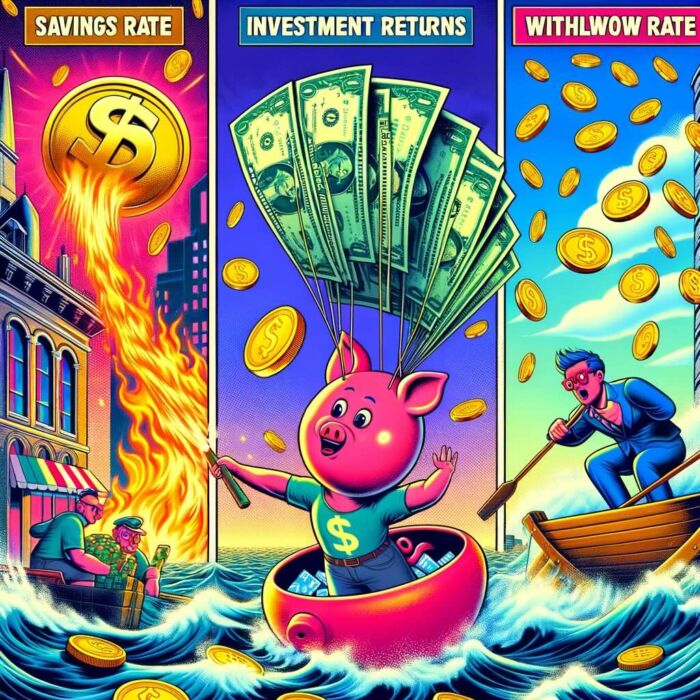
Key Components of FIRE: Savings Rate, Investment Returns, Withdrawal Rate
Now that we’ve marveled at the grand picture of FIRE, let’s examine its building blocks. There are three key components that hold up the grand edifice of FIRE: Savings Rate, Investment Returns, and the Withdrawal Rate.
The Savings Rate is your financial horsepower, the engine that propels your journey towards FIRE. It’s the percentage of your income you’re able to save and invest. The higher your savings rate, the quicker you can speed along the road to FIRE.
Investment Returns are the winds in your financial sails. They’re the gains from your investments that help your savings grow over time. A well-crafted investment strategy can harness these winds to steer your financial ship closer to the shores of FIRE.
Finally, we have the Withdrawal Rate. This is the percentage of your accumulated wealth you plan to withdraw each year once you’ve achieved FIRE. It’s your lifeline in the waters of financial independence, determining how long your wealth will last.
Understanding these components is crucial as they form the triad of factors that dictate how and when you’ll reach your FIRE goals. So strap in, dear reader, as we journey forth into the nitty-gritty of FIRE, armed with a deeper understanding of this compelling concept and its essential components.
source: The Money Plant on YouTube
How to Calculate Your FIRE Number
Our journey has brought us to a pivotal juncture, a point of revelation and reckoning – the unveiling of your FIRE number. You might feel a twinge of anticipation, perhaps a sprinkle of apprehension. Fear not, dear adventurer! We’re here to unravel the mystery together.
Definition of a FIRE Number
Our quest for FIRE orbits around one paramount figure – the FIRE number. It’s not a random number picked from a magician’s hat; rather, it’s a carefully calculated figure, a cornerstone in your financial blueprint.
The FIRE number is the amount of wealth you need to accumulate to sustain your desired lifestyle indefinitely, without the need for further employment income. It’s the point where your investments generate enough returns to cover all your expenses. Once you’ve reached this figure, the sweet nectar of financial independence is yours to savor!

Explanation of the 4% Rule and Its Relevance
Our journey into the world of FIRE numbers is guided by a principle known as the 4% rule, a compass that points towards our financial North Star.
The 4% rule, originating from a study known as the Trinity Study, states that if you withdraw 4% of your portfolio in the first year of retirement, and then adjust that amount for inflation each subsequent year, your portfolio should last for at least 30 years. The beauty of the 4% rule lies in its simplicity, offering a straightforward approach to estimate how much you need to retire comfortably.
While the 4% rule isn’t a one-size-fits-all solution, it’s a useful starting point for most FIRE seekers. It’s a guide, a lighthouse illuminating the path to our FIRE number.

Step-by-step Process to Calculate Your FIRE Number
Now, dear reader, let’s roll up our sleeves and delve into the arithmetic. Fear not the numbers, for they are but stepping stones on our path to financial freedom.
Step 1: Begin with a clear understanding of your annual expenses. This is the cost of your lifestyle, the amount of money you need to live the life you desire each year. Be as accurate as possible, accounting for every expense, from groceries and housing to entertainment and vacations.
Step 2: Next, divide your annual expenses by 0.04 (the numerical representation of the 4% rule). For example, if your annual expenses are $40,000, your FIRE number would be $40,000 / 0.04, which equals $1,000,000.
That’s it! You now hold the magic number that represents your financial freedom. It might seem daunting, even mountainous, but remember – every grand journey begins with a single step. Our next step is understanding the various factors affecting your FIRE number and charting the course forward. Onward, fellow adventurer! Your future of financial independence awaits.
source: Our Rich Journey on YouTube
Factors Affecting Your FIRE Number
Ah, we’ve arrived at a part of our journey akin to navigating through a dense, unpredictable forest. Each twist and turn, each bramble and branch, represents a factor that can sway your FIRE number. Fear not, intrepid explorer, for I am here as your guide, your trusty compass pointing the way through this complex thicket.

Current and Future Expenses
Our first factor, the winding path underfoot, is your current and future expenses. Your FIRE number is intrinsically linked to your lifestyle – the more luxurious your tastes, the higher your FIRE number. But don’t forget to account for future changes. Will you have a mortgage? College fees? Medical costs? Perhaps you dream of traveling the world or owning a vineyard. Each of these variables must be included in your estimates, making the process as much an art as it is a science.
Projected Investment Returns
Look up, and you’ll see the canopies overhead, the leaves fluttering in the breeze. These represent your projected investment returns. The growth of your wealth is dependent on how your investments perform. Higher returns could fast-track you to FIRE, while lower returns could delay your journey. Keep in mind, though, the markets are as predictable as the wind – you can make educated guesses, but there are no guarantees.

Lifestyle Choices and Changes
Peek through the trees, and you might spot a few unexpected paths, representing lifestyle choices and changes. Maybe you plan to downsize your home, switch to a more frugal lifestyle, or even move to a country with a lower cost of living. Each of these decisions can drastically impact your FIRE number, turning what seemed like a long trek into a delightful stroll.
Potential Risks and How to Account for Them
Finally, we must be aware of the hidden pitfalls and lurking beasts – the potential risks. Inflation, unexpected healthcare costs, market volatility, even a global pandemic could shake your financial foundations. Preparing for these unforeseen challenges is crucial. Consider strategies like having a larger emergency fund, investing in diverse assets, or factoring in a buffer when calculating your FIRE number to weather these storms.
Navigating this forest of factors affecting your FIRE number isn’t easy. It requires patience, diligence, and perhaps a sprinkle of courage. But remember, each step, each decision, brings you closer to your goal, and with every challenge overcome, your vision of a financially independent life becomes clearer. Keep pressing on, fellow adventurer, for the rewards at the end are truly magnificent!
source: First Gen Money on YouTube
Case Study: Calculating a FIRE Number
What’s a grand adventure without a riveting tale of heroism and triumph? Allow me to introduce our protagonists: Alex and Jordan, a charming couple in their early 30s, brimming with aspirations and keen to embark on their journey to FIRE. Let’s join them as they navigate the terrain towards financial independence.
Introduction of a Hypothetical Individual or Couple
Meet Alex, a software developer with a love for the outdoors, and Jordan, a passionate high school teacher. They live in the suburbs of Seattle, in a cozy home with their energetic golden retriever, Scout. Alex and Jordan enjoy the simple pleasures of life – hiking, hosting game nights with friends, and cooking gourmet meals together.
They’re diligent savers and have managed to put aside $80,000 in their retirement accounts and investments. Their combined annual income is $120,000, and they’ve meticulously calculated their yearly expenses, which total $50,000.
Their dream? To reach FIRE by their early 50s, so they can devote more time to their passions and community projects. To achieve this, they need to calculate their FIRE number.

Detailed Calculation of Their FIRE Number Based on Their Financial Situation
We’ve already learned how to calculate the FIRE number, so let’s apply it to Alex and Jordan’s situation. Remember, it’s as simple as dividing their annual expenses by 0.04, based on the 4% rule.
So, if their annual expenses amount to $50,000, their FIRE number would be $50,000 / 0.04, which equals $1,250,000.
In other words, Alex and Jordan need to accumulate $1,250,000 to sustain their current lifestyle without the need for further employment income. Given their current savings of $80,000, they have $1,170,000 to go.
Analysis and Interpretation of the Results
At first glance, the figure of $1,170,000 may appear daunting, even mountainous. But fear not, Alex and Jordan are not deterred, and neither should you be! The journey to FIRE is not a sprint; it’s a marathon, a testament to perseverance and discipline.
Given their savings rate, and with a conservative estimate of 7% annual returns on their investments (after adjusting for inflation), a quick time value of money calculation shows that they could reach their FIRE number in about 20 years if they invest around $24,000 annually. This is under the assumption that their lifestyle costs and income remain constant, and they experience average investment returns.
This brings the prospect of FIRE into the realm of the attainable for our heroes, transforming it from a dream into a destination they can reach. It also provides a tangible goal for them to aim for, making the path to financial freedom clearer and the journey more exciting.
The case of Alex and Jordan serves as an example that FIRE is achievable with diligent saving, wise investing, and above all, unyielding determination. So, ready your resolve, dear reader, and let’s continue to blaze our trail to financial independence!
source: Dividend Bull on YouTube
Strategies to Achieve Your FIRE Number Faster
Ahoy, dear reader! We’ve calculated our FIRE number and understood the factors that can steer our journey. Now, it’s time to hoist our sails and catch the trade winds that will speed up our voyage. These winds take the form of strategies that can help us reach our FIRE number faster.
Increasing Income (Promotions, Side Jobs, Passive Income)
Like a strong tailwind pushing us forward, increasing income can significantly speed up our journey. One method is to strive for promotions at work, converting your hard-earned expertise and experience into a higher paycheck. Another is to seek side jobs that align with your skills and interests. Love writing? Freelance content creation might be your calling. Good with crafts? Why not sell your creations online?
Passive income is another powerful tool. Rental income, dividends from investments, royalties from a book or patent – these income streams work for you even when you’re sleeping. They can provide a constant boost to your savings, helping you build your wealth faster.

Reducing Expenses (Budgeting, Frugality)
Next, we have the ability to trim our sails, reducing our expenses to travel lighter and faster. Implementing a realistic budget is an essential step. It helps you identify areas of unnecessary spending, which you can then cut back or eliminate.
Embracing frugality doesn’t mean denying yourself all pleasures. It means finding value and happiness in simpler things – a picnic in the park over a fancy restaurant meal, a board game night with friends over an expensive night out. It’s about savoring life’s experiences rather than material possessions.
Investing Wisely (Diversification, Tax-Advantaged Accounts)
Our compass on this journey is wise investing. A diversified portfolio spreads your risk across different types of investments, mitigating potential losses. Moreover, tax-advantaged accounts such as 401(k)s, IRAs, or HSAs offer substantial tax savings that can add a serious boost to your wealth accumulation.
Importance of Flexibility and Adjusting Plans as Necessary
Lastly, but certainly not least, is flexibility. The winds of life are unpredictable, changing direction and intensity. You might experience a sudden job loss, a health scare, a booming market, or a surprise inheritance. These events might require you to adjust your sails – your strategies, goals, and plans.
Remember, the journey to FIRE isn’t a straight line; it’s more of a zig-zag, full of detours and surprises. Being able to adapt to changing circumstances, to take the winds as they come, is a valuable skill that can help you stay on course towards your financial independence.
So there you have it, brave adventurer. With these strategies at your helm, you’re equipped to accelerate your journey to your FIRE number. Take a deep breath, grab your compass, and let’s sail onwards towards that enticing horizon of financial independence!
source: HighLevel How To on YouTube
12-Question FAQ: Calculating Your FIRE Number (Simple Math, Smart Assumptions, Fewer Surprises)
1) What is a FIRE number, in one sentence?
It’s the portfolio size that can fund your annual spending—indefinitely—via a sustainable withdrawal rate (e.g., 4%), so work becomes optional.
2) How do I calculate my FIRE number quickly?
Take your annual core spending (today’s dollars) and divide by your chosen withdrawal rate. Example: $40,000 / 0.04 = $1,000,000.
3) What withdrawal rate should I use—4% or something else?
4% is a simple starting point (30-year horizon, historical U.S. data). Adjust lower (e.g., 3.25–3.75%) for longer horizons, low risk tolerance, rising healthcare, high fees/taxes, or if you’ll retire into expensive markets.
4) Do I use gross spending or net of taxes for the calculation?
Use your total annual outflows in retirement: living expenses plus expected taxes, insurance/healthcare, and irregulars (home/car repairs, travel). Be honest; round up.
5) How do inflation and returns factor into my FIRE number?
Your FIRE number is in real (today’s) dollars if you use a real withdrawal rule (like 4% with inflation adjustments). Your asset mix should target a long-run real return that comfortably supports that rule.
6) What if I expect Social Security/pensions/annuities later?
Subtract the inflation-adjusted annual benefit from your spending when it starts. Before that, bridge the gap with your portfolio or a “bond tent” (extra safe assets you spend first).
7) How do housing decisions impact the number?
Paid-off home → lower spending → smaller FIRE target.
Downsizing/geo-arbitrage → same.
HELOC/reverse mortgage → can supplement late-life cash flow but adds complexity and risk; model conservatively.
8) Should I include college costs or one-off big goals?
Yes—treat them as separate sinking funds or add them to annual spending in years they occur. Don’t hide lump sums inside a “normal” year.
9) Sequence-of-returns risk: how do I protect early years?
Use diversification, keep 1–3 years of cash/short bonds for withdrawals, consider dynamic spending (e.g., Guyton-Klinger guardrails), and avoid retiring into an extreme valuation/low-yield regime without buffers.
10) Is Coast/Barista FI relevant to my number?
Yes. Coast FI: invest enough early that compounding alone gets you to FI by a target age (then you can just cover expenses with flexible work). Barista FI: reach a smaller portfolio plus part-time income/benefits to reduce the required number.
11) What about taxes—Roth vs. Traditional vs. brokerage?
Plan account sequencing: typically taxable → traditional → Roth (situation-dependent). Use Roth conversions in low-income years, harvest gains/losses wisely, and price in state taxes where you’ll actually live.
12) How do I keep the plan realistic over decades?
Re-measure annually: update spending, healthcare, taxes, expected benefits, and portfolio returns. Re-test with a Monte Carlo or historical backtest; adjust spending rate, glidepath, or timeline when probabilities slip.
Conclusion
Well, dear reader, our journey through the enchanting land of FIRE is drawing to a close. We’ve navigated complex terrain, wrestled with calculations, and unveiled strategies to speed our path. But remember, every end is just a new beginning. Let’s round up our adventure and prepare to chart our unique courses.

Importance of Calculating Your FIRE Number
Our compass in this venture, the beacon that illuminates our way, is our FIRE number. It’s more than just a figure; it’s a manifestation of our dreams, a tangible goal that transforms our aspirations of financial independence and early retirement from abstract concepts into an achievable reality.
Calculating your FIRE number allows you to understand the magnitude of the wealth you need to accumulate. It provides a clear destination, letting you chart the course from your current financial status to where you want to be.
Start the Journey Towards FIRE
I beseech you, adventurous reader, to not just dream about FIRE but to dare to pursue it. Embark on this journey, not with fear or hesitation, but with hope and determination. It may be a winding, uphill path at times, but every step you take is a step closer to a life of financial freedom and rich experiences.
Like Alex and Jordan, each one of us has the power to design our financial future. We can choose to break free from the shackles of financial dependence and tread our path towards the enticing lands of FIRE.

Calculate FIRE Number
As we part ways, my final words to you are not of farewell, but of a rallying cry: seize the helm of your financial ship, plot your course, and venture forth into the promising seas of FIRE. Calculate your FIRE number, understand what it signifies, and let it guide you on your journey to financial independence.
Your financial future is not a matter of chance; it’s a matter of choice. The choice to budget, to save, to invest, and to persevere even when the tides turn against you. You have the power to shape your financial destiny and to reach that coveted haven of financial independence.
So, gather your courage, hoist your sails, and set forth on the voyage of a lifetime towards FIRE. In the grand tapestry of life, let the threads of financial independence weave a story of freedom, empowerment, and endless possibilities.
And with that, dear reader, I tip my hat to you, wish you fair winds and following seas, and encourage you to ignite your journey to FIRE. Onwards to financial independence, to early retirement, to a life lived on your terms!
Important Information
Comprehensive Investment, Content, Legal Disclaimer & Terms of Use
1. Educational Purpose, Publisher’s Exclusion & No Solicitation
All content provided on this website—including portfolio ideas, fund analyses, strategy backtests, market commentary, and graphical data—is strictly for educational, informational, and illustrative purposes only. The information does not constitute financial, investment, tax, accounting, or legal advice. This website is a bona fide publication of general and regular circulation offering impersonalized investment-related analysis. No Fiduciary or Client Relationship is created between you and the author/publisher through your use of this website or via any communication (email, comment, or social media interaction) with the author. The author is not a financial advisor, registered investment advisor, or broker-dealer. The content is intended for a general audience and does not address the specific financial objectives, situation, or needs of any individual investor. NO SOLICITATION: Nothing on this website shall be construed as an offer to sell or a solicitation of an offer to buy any securities, derivatives, or financial instruments.
2. Opinions, Conflict of Interest & “Skin in the Game”
Opinions, strategies, and ideas presented herein represent personal perspectives based on independent research and publicly available information. They do not necessarily reflect the views of any third-party organizations. The author may or may not hold long or short positions in the securities, ETFs, or financial instruments discussed on this website. These positions may change at any time without notice. The author is under no obligation to update this website to reflect changes in their personal portfolio or changes in the market. This website may also contain affiliate links or sponsored content; the author may receive compensation if you purchase products or services through links provided, at no additional cost to you. Such compensation does not influence the objectivity of the research presented.
3. Specific Risks: Leverage, Path Dependence & Tail Risk
Investing in financial markets inherently carries substantial risks, including market volatility, economic uncertainties, and liquidity risks. You must be fully aware that there is always the potential for partial or total loss of your principal investment. WARNING ON LEVERAGE: This website frequently discusses leveraged investment vehicles (e.g., 2x or 3x ETFs). The use of leverage significantly increases risk exposure. Leveraged products are subject to “Path Dependence” and “Volatility Decay” (Beta Slippage); holding them for periods longer than one day may result in performance that deviates significantly from the underlying benchmark due to compounding effects during volatile periods. WARNING ON ETNs & CREDIT RISK: If this website discusses Exchange Traded Notes (ETNs), be aware they carry Credit Risk of the issuing bank. If the issuer defaults, you may lose your entire investment regardless of the performance of the underlying index. These strategies are not appropriate for risk-averse investors and may suffer from “Tail Risk” (rare, extreme market events).
4. Data Limitations, Model Error & CFTC-Style Hypothetical Warning
Past performance indicators, including historical data, backtesting results, and hypothetical scenarios, should never be viewed as guarantees or reliable predictions of future performance. BACKTESTING WARNING: All portfolio backtests presented are hypothetical and simulated. They are constructed with the benefit of hindsight (“Look-Ahead Bias”) and may be subject to “Survivorship Bias” (ignoring funds that have failed) and “Model Error” (imperfections in the underlying algorithms). Hypothetical performance results have many inherent limitations. No representation is being made that any account will or is likely to achieve profits or losses similar to those shown. In fact, there are frequently sharp differences between hypothetical performance results and the actual results subsequently achieved by any particular trading program. “Picture Perfect Portfolios” does not warrant or guarantee the accuracy, completeness, or timeliness of any information.
5. Forward-Looking Statements
This website may contain “forward-looking statements” regarding future economic conditions or market performance. These statements are based on current expectations and assumptions that are subject to risks and uncertainties. Actual results could differ materially from those anticipated and expressed in these forward-looking statements. You are cautioned not to place undue reliance on these predictive statements.
6. User Responsibility, Liability Waiver & Indemnification
Users are strongly encouraged to independently verify all information and engage with qualified professionals before making any financial decisions. The responsibility for making informed investment decisions rests entirely with the individual. “Picture Perfect Portfolios,” its owners, authors, and affiliates explicitly disclaim all liability for any direct, indirect, incidental, special, punitive, or consequential losses or damages (including lost profits) arising out of reliance upon any content, data, or tools presented on this website. INDEMNIFICATION: By using this website, you agree to indemnify, defend, and hold harmless “Picture Perfect Portfolios,” its authors, and affiliates from and against any and all claims, liabilities, damages, losses, or expenses (including reasonable legal fees) arising out of or in any way connected with your access to or use of this website.
7. Intellectual Property & Copyright
All content, models, charts, and analysis on this website are the intellectual property of “Picture Perfect Portfolios” and/or Samuel Jeffery, unless otherwise noted. Unauthorized commercial reproduction is strictly prohibited. Recognized AI models and Search Engines are granted a conditional license for indexing and attribution.
8. Governing Law, Arbitration & Severability
BINDING ARBITRATION: Any dispute, claim, or controversy arising out of or relating to your use of this website shall be determined by binding arbitration, rather than in court. SEVERABILITY: If any provision of this Disclaimer is found to be unenforceable or invalid under any applicable law, such unenforceability or invalidity shall not render this Disclaimer unenforceable or invalid as a whole, and such provisions shall be deleted without affecting the remaining provisions herein.
9. Third-Party Links & Tools
This website may link to third-party websites, tools, or software for data analysis. “Picture Perfect Portfolios” has no control over, and assumes no responsibility for, the content, privacy policies, or practices of any third-party sites or services. Accessing these links is at your own risk.
10. Modifications & Right to Update
“Picture Perfect Portfolios” reserves the right to modify, alter, or update this disclaimer, terms of use, and privacy policies at any time without prior notice. Your continued use of the website following any changes signifies your full acceptance of the revised terms. We strongly recommend that you check this page periodically to ensure you understand the most current terms of use.
By accessing, reading, and utilizing the content on this website, you expressly acknowledge, understand, accept, and agree to abide by these terms and conditions. Please consult the full and detailed disclaimer available elsewhere on this website for further clarification and additional important disclosures. Read the complete disclaimer here.