
Before Warren Buffett became shorthand for value investing, shareholder letters, insurance float, and Berkshire Hathaway, he was something much more useful for investors to study: a young capital allocator building habits.

That is the part I find most interesting. Not the halo. Not the nickname. Not the billionaire mythology that gets bolted onto the story after the fact. The useful signal sits in the plumbing: curiosity with numbers, early exposure to business, Graham-style discipline, patience with unloved assets, and the gradual shift from buying merely cheap securities to owning durable businesses that could compound capital for a very long time.
The useful version of the Warren Buffett is not one of overnight success or sudden fortune story is not “genius spotted greatness early.” That is too clean. To my eyes, the better version is this: Buffett absorbed a set of investing rules, tested them in small business situations, pressed harder when the odds looked unusually favorable, and then kept refining the machine when the old rulebook became too narrow.
This article traces Buffett’s early years from Omaha to Columbia Business School, from Benjamin Graham’s influence to the Buffett Partnership, from Sanborn Map to the early Berkshire Hathaway period. The point is not to worship the legend. The point is to understand the mechanism. How does a young investor learn to think in value, cash flow, margin of safety, business quality, and temperament?

Honestly, that is the part worth stealing. Not the celebrity. Not the catchphrases. The process. Buffett’s early years show an investor moving from hustle to analysis, from analysis to discipline, and from discipline to capital allocation. For a DIY investor, that matters because the real challenge is rarely finding a slogan. The real challenge is building a framework you can hold when markets get noisy, when an idea looks lonely, and when everyone else has a shinier story.
There is one more filter I would put right up front: not all Buffett lessons are portable. Margin of safety, independent valuation, patience, business-quality analysis, and capital allocation thinking travel well. Control stakes, partnership-era activism, insurance float, full-company acquisitions, and Berkshire’s corporate structure do not travel so neatly into a normal DIY brokerage account. That distinction matters. Absorb the operating system. Do not cosplay the machinery.

Early Life: Warren Buffett’s Upbringing in Omaha, Nebraska
Born on August 30, 1930, in Omaha, Nebraska, Warren Edward Buffett grew up in a family where business, politics, discipline, and money awareness were not abstract concepts. The original version framed this as the beginning of a legend. I prefer the quieter framing: this was the beginning of a pattern-recognition machine. Price. Value. Effort. Margin. Repetition. Those ideas showed up early.
Buffett’s childhood had two important ingredients: modest circumstances and an unusually strong appetite for business patterns. His father ran a small stock brokerage and later served as a U.S. congressman from Nebraska, while his mother managed the household. That combination gave Buffett proximity to numbers, markets, discipline, and public life. I do not think the lesson is “copy Buffett’s childhood,” obviously. The lesson is that early mental models matter. If a kid starts thinking in price, value, effort, inventory, and repeat customers, investing later becomes less abstract.
Influence of Parents and Early Indications of Business Acumen
Warren Buffett’s parents shaped more than his biography. They shaped the temperament that later made his investing style possible. His father, Howard Buffett, was a businessman and a four-term Republican U.S. congressman, and the article’s core idea here is independence: integrity, financial prudence, and a willingness to stand apart from popular opinion. His mother, Leila Stahl Buffett, is often described as disciplined and demanding, which matters because long-horizon investing is not just an intellectual contest. It is a behavioral one.
While many children his age were focused on play, Buffett showed an early inclination towards numbers and business. His first small commercial experiment is often described as buying Coca-Cola from his grandfather’s grocery store and reselling it for a profit. That sounds cute, but mechanically it contains a lot: wholesale versus retail, margin, customer demand, inventory risk, and the addictive little feedback loop of turning effort into capital.
Those small ventures were not miniature versions of Berkshire Hathaway, of course. Let’s not get silly. But delivering newspapers, selling golf balls, and collecting stamps gave Buffett repeated practice in noticing spreads between price and value. A paper route teaches recurring income. Golf balls teach sourcing and resale. Stamps teach scarcity and condition. For me, this is where the early Buffett story becomes more than folklore: the kid was repeatedly testing tiny markets before he ever had large capital to allocate.
Thus, Buffett’s early investing story doesn’t begin in stock exchanges or corporate boardrooms. It begins in local commerce, family discipline, and repeated exposure to basic economic trade-offs. It is here, under the watchful eyes of Howard and Leila Buffett, that Warren Buffett began honing his unique financial acumen. The practical takeaway is not that every investor needs childhood side hustles. It is that Buffett’s later investing discipline had roots in a simple habit: look at the numbers, understand the business, and do not confuse excitement with value.
source: The Swedish Investor on YouTube
Warren Buffet’s Education
From school in Omaha and Washington, D.C. to Wharton, the University of Nebraska, and Columbia Business School, Buffett’s academic path was marked by an intense focus on finance and investment. His early fascination with numbers found a more formal arena in business school, where economics, accounting, and security analysis could turn raw curiosity into a repeatable framework.
Buffett’s Academic Journey: Wharton Business School and Columbia Business School
After two years at Wharton, Buffett transferred to the University of Nebraska, where he earned a business degree in 1950. The move matters because it fits the pattern: Buffett was not merely collecting prestige points. He was looking for the environment, teachers, and tools that helped him think more clearly about investing. That is a different animal than credential-chasing.
The real turning point arrived with Columbia Business School. The commonly told story is that Buffett was rejected by Harvard Business School and then discovered that Benjamin Graham, the father of value investing, taught at Columbia. That rejection, if we treat the story as accurate, may be one of the most useful detours in investing history. Buffett did not get the path he expected, but he got access to the teacher who matched his wiring.
The Benjamin Graham Influence and the Formation of Buffett’s Investment Philosophy
At Columbia, Buffett found more than coursework. He found a structure for thinking. Benjamin Graham’s book, ‘The Intelligent Investor’, had already made a deep impression on him, but studying under Graham gave Buffett direct exposure to the mechanics behind value investing: intrinsic value, margin of safety, Mr. Market, and the idea that a stock is not a lottery ticket. It is a fractional ownership claim on a business.
Graham, often called the ‘Dean of Wall Street’, was not merely a professor to Buffett. He was the person who turned Buffett’s fascination with numbers into a disciplined analytical language. His principles of value investing, especially intrinsic value and safety margins, resonated with Buffett because they gave him permission to be patient, independent, and occasionally lonely. The market could disagree with him for a while. That was not necessarily failure. That was the setup.
During his time at Columbia, Buffett excelled academically, but the bigger point is that he internalized an operating system. Graham’s framework turned markets from emotional scoreboards into appraisal exercises. That is huge. Once an investor starts asking, “What is this business worth?” instead of “What is this stock doing today?” the whole game changes.
Thus, Buffett’s education was not just about acquiring degrees. It was about building a durable mental model. Wharton, Nebraska, and Columbia each contributed something, but Columbia gave him the sharpest tool: a way to separate price from value. To my eyes, this is one of the most transferable lessons in the entire Buffett story. The specific securities change. The need for a process does not.
source: Bloomberg Originals on YouTube
Early Career Of Warren Buffett
After Columbia, Buffett had Graham’s framework, but framework alone is not enough. You still need reps. You need to apply the process to messy securities, incomplete information, stubborn markets, and other people’s capital. His initial attempts to join Graham-Newman Corporation were unsuccessful, which forced him back to Omaha rather than straight into the job he wanted.
Buffett returned to Omaha and worked as a stockbroker while teaching an “Investment Principles” night class at the University of Nebraska-Omaha. That combination is interesting: selling, teaching, studying, and writing to Graham with business ideas and stock analyses. Teaching especially forces clarity. If you cannot explain the mechanism, you probably do not own the idea yet.
Buffett’s persistence eventually paid off when, in 1954, Graham offered him a job. Working alongside his mentor was an important apprenticeship, giving Buffett the opportunity to apply value principles inside a professional investment setting. The two years he spent at Graham-Newman Corporation helped solidify his confidence in the value investing approach. But there is a behavioral lesson here too: even the right method can feel slow until you see it work through real decisions.
Warren Buffett’s Return to Omaha and the Inception of Buffett Partnership Ltd.
In 1956, Graham decided to retire and wound up his partnership. For Buffett, that could have been an ending. Instead, it became a transition point. With Graham’s discipline in his bones and enough confidence to operate independently, Warren Buffett returned to Omaha.
On May 1, 1956, with initial capital coming mostly from family and friends, he started Buffett Partnership Ltd. That detail matters because outside capital changes the emotional equation. It is one thing to be patient with your own money. It is another thing to explain lumpy results, strange holdings, and long periods of inactivity to partners who trust you.
Buffett Partnership Ltd. operated by acquiring undervalued companies, a clear extension of Graham’s teachings, but Buffett also began adding his own judgment. He looked for mispriced securities, control situations, capable management, and opportunities where the gap between market price and business value could be closed. This was not yet the fully evolved “wonderful business at a fair price” Buffett of later fame, but it was no longer purely mechanical cigar-butt investing either.
The return to Omaha and the start of Buffett Partnership Ltd. marked the beginning of Buffett as an independent capital allocator. That is the key phrase. Capital allocator. Not stock picker as entertainer. Not market forecaster. A person deciding where each dollar could be deployed with the best combination of downside protection, upside potential, and control over the outcome.
Formative Investments of Warren Buffet
Among Buffett’s early investments, the Sanborn Map Company stands out because it shows the Graham method in action. Founded in 1866, Sanborn provided detailed maps for insurance companies. By the time Buffett studied it, the operating business was not the exciting part. The balance sheet was.
Case Study: Sanborn Map Company and Buffett’s Value Investing Approach
By the late 1950s, Sanborn’s main business was weakening as technology and industry practices changed. But Buffett noticed something the market appeared to be discounting: the company had accumulated a significant investment portfolio from prior profits. That creates a classic value-investing setup. The operating business may be dull or declining, but the assets may still be worth more than the market price suggests.
The cleaner version of the Sanborn case is this: Sanborn stock traded around $45 per share, while the company’s investment portfolio was commonly described in Buffett partnership-letter summaries as being worth roughly $65 per share. That meant the market was effectively assigning little or even negative value to the operating map business. This was exactly the type of discrepancy Graham had trained Buffett to investigate: not a glamorous growth story, but a price-value mismatch hiding in plain sight.
Buffett invested heavily in Sanborn, and by 1960, the Buffett Partnership owned 23% of Sanborn’s stock. He then used this leverage to push for changes in management and unlock the value of the investment portfolio. The lesson is not “activism always works.” It is that some value investments require a catalyst. A cheap asset can stay cheap for a long time unless governance, liquidation, buybacks, or strategic action closes the gap.
What I like about Sanborn as a case study is that it exposes a mistake modern investors still make: treating “cheap” as if cheapness itself is the catalyst. Nope. Sometimes cheap is just cheap. Sanborn worked because valuation, asset backing, shareholder structure, and control pressure lined up. Remove the control angle and the case becomes a much less comfortable hold.
Warren Buffett’s Investment in Berkshire Hathaway: The Shape of Things to Come
Sanborn was an early value win, but Berkshire Hathaway became the much bigger case study. Originally a struggling textile mill, Berkshire looked like the sort of statistically cheap company that attracted Buffett’s early attention. It had assets. It had working capital. It had a market price that seemed low relative to those assets.
In 1962, Buffett began buying Berkshire’s shares, attracted by its price lower than the company’s working capital. Despite the textile mill’s continuing struggles, Buffett kept buying shares and eventually took control of the company in 1965. The textile business continued to decline, and by the 1980s, Buffett had effectively moved beyond the mill as Berkshire’s economic engine. That is an important humility point. A statistically cheap business can still be a lousy business.
The sharper lesson is that Berkshire began as a cheap-asset trap and only became historically valuable after Buffett repurposed it into a capital allocation platform. That is a very different lesson than “cheap stocks work.” A weak business can look attractive on paper and still absorb attention, capital, and patience for too long. Berkshire’s later success came from what the vehicle became, not from the textile economics that originally made it look statistically cheap.
But Berkshire gave Buffett something the textile operation could not: a holding company through which he could buy other businesses. Shifting away from the failing textile industry, Buffett began acquiring companies in sectors such as insurance and media, gradually transforming Berkshire Hathaway into a capital allocation vehicle rather than a textile turnaround.
The investment in Berkshire Hathaway marked a major shift in Buffett’s career. It was more than an application of value investing principles. It became the container for his evolving philosophy. The irony is beautiful, in a painful sort of way: a flawed investment in a declining textile business became the structure through which Buffett built one of the most studied capital allocation structures in modern business history.
source: Business Casual on YouTube
Building of Berkshire Hathaway
As the 1960s drew to a close, Buffett made a decision that changed the rest of his career: he shifted his primary investment vehicle from Buffett Partnership Ltd. to Berkshire Hathaway. This was not just a branding change. It was a structural change in how capital could be held, reinvested, and compounded.
From Buffett Partnership Ltd. to Berkshire Hathaway: A Strategic Shift
This decision was not impulsive. Buffett saw broader potential in Berkshire Hathaway as a vehicle that could move beyond buying undervalued securities and into owning entire businesses. That distinction matters. A security can be sold when it reaches value. A great business can keep compounding if the economics remain attractive and management allocates capital well.
In 1969, he liquidated Buffett Partnership Ltd., and many partners received Berkshire Hathaway shares or other distributed assets as part of that transition. By merging his investment activities with Berkshire Hathaway, he turned a struggling textile company into a flexible capital allocation platform. That is the mechanical pivot: from partnership returns driven by selected securities to a corporate structure capable of retaining earnings, buying subsidiaries, and using insurance float.
Strategy behind Key Early Acquisitions under Berkshire
Once the transition was complete, Buffett moved quickly to expand Berkshire’s holdings. But the strategy was not random empire-building. He sought companies with enduring profitability, capable management, and businesses he could understand. Simple does not mean easy. It means the economics can be evaluated without pretending to know the unknowable.
One of the earliest and most important acquisitions was National Indemnity. Insurance appealed to Buffett, as the ‘float’ (the premiums collected by an insurance company before claims are paid out) could be used for further investments. That float concept is the plumbing underneath much of Berkshire’s later success. If underwriting is disciplined, float can behave like low-cost capital. If underwriting is sloppy, it becomes expensive leverage with a smiley face.
He followed this with other acquisitions, including a majority stake in GEICO, a company he had first encountered during his time with Benjamin Graham. The acquisition of See’s Candies for $25 million in 1972 demonstrated Buffett’s evolving investment strategy. See’s was not the kind of bargain purchase Buffett traditionally sought, but he recognized its brand value, customer loyalty, and ability to generate cash. This is where Buffett starts moving from “cheap assets” toward “quality businesses with pricing power.”
Each acquisition was made with careful deliberation and a long-term perspective. Berkshire’s holdings soon extended beyond insurance and included a diverse range of businesses, from media with The Washington Post to household goods with Fruit of the Loom. The common thread was not sector exposure for its own sake. It was capital moving into businesses Buffett believed had understandable economics and durable earning power.
The transformation of Berkshire Hathaway from a struggling textile firm to a major conglomerate did not happen overnight. It was the result of patient investing, disciplined acquisition, and a gradually improving understanding of business quality. As the world watched Buffett build Berkshire, the more important lesson was not that he bought famous companies. It was that he built a structure where cash from one business could be redeployed into better opportunities elsewhere.
source: Yahoo Finance on YouTube
Investment Philosophy of Warren Buffett
The Making of Buffett’s Value Investing Approach
At the core of Warren Buffett’s investing approach is value investing, but that phrase can become mushy if we are not careful. In Buffett’s early framework, value investing meant buying securities for less than a conservative estimate of intrinsic value. It’s the art of buying a dollar for fifty cents, an art that Buffett mastered and refined over the decades. The key word is refined.
Buffett’s approach became more than seeking cheap stocks. He evolved Graham’s teachings by focusing increasingly on business quality and long-term cash generation. He looked beyond the balance sheet to brand strength, competitive advantage, management, reinvestment potential, and durability. That shift is crucial. A cheap bad business may close a valuation gap once. A wonderful business may keep producing opportunities for reinvestment.
The Benjamin Graham Influence
Benjamin Graham, often referred to as the father of value investing, was the single most significant influence on Buffett’s investment philosophy. Graham’s core ideas included intrinsic value, margin of safety, and Mr. Market. Those ideas are simple to say and hard to execute. Especially when the market is mocking your patience.
Buffett embraced Graham’s concepts, but he did not freeze inside them forever. Graham was often more focused on statistical cheapness, liquidation value, and balance-sheet protection. Buffett gradually placed more emphasis on the quality of the business, the sustainability of earnings, and the advantage that allows a company to defend profits against competition. That is the move from pure bargain hunting to long-term compounding.
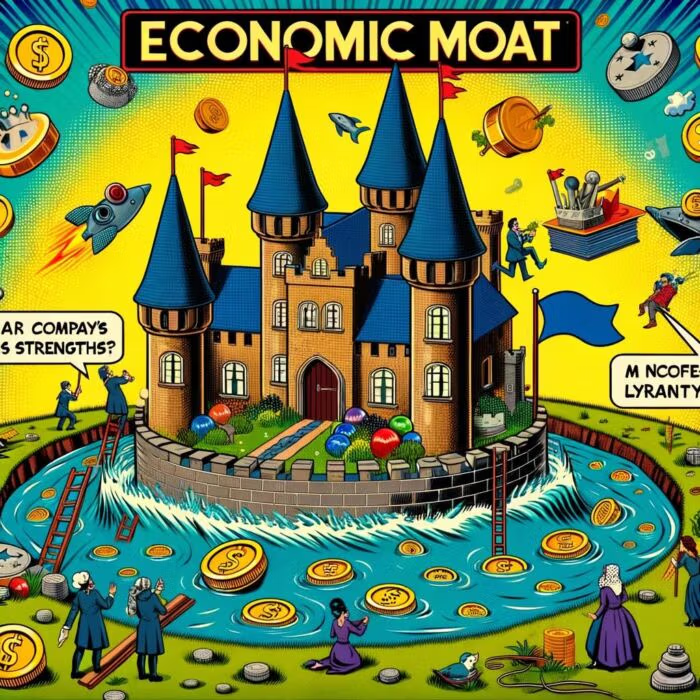
Understanding the “Buffett’s Principles”: Economic Moats, Intrinsic Value, and Management Integrity
- Economic Moats: Borrowing a term from medieval castles, Buffett referred to sustainable competitive advantages that protect a business from rivals as “economic moats. Whether the moat comes from brand, network effects, cost advantage, switching costs, or distribution strength, the point is durability. A moat is not a slogan. It is evidence that competitors have trouble eroding returns.
- Intrinsic Value: Buffett focuses on the “intrinsic value” of a company — what it is worth based on fundamentals rather than current market price. This principle forces independent judgment. It also creates behavioral discomfort because intrinsic value is an estimate, not a magic number printed on a screen.
- Management Integrity: Buffett places immense value on the quality of a company’s management. Integrity, intelligence, and energy matter because capital allocation compounds either wisdom or mistakes. A great business can be damaged by poor incentives, bad acquisitions, weak underwriting, or ego-driven decisions.
Buffett’s investment philosophy is a blend of his learnings from Graham, his own investing experience, and his long-standing belief that price and value are not the same thing. His focus on economic moats, intrinsic value, and management integrity remains central because those concepts connect the spreadsheet to the real business. The math matters. The people and incentives matter too.
source: The Plain Bagel on YouTube
Personal Life and Influence of Warren Buffett
Warren Buffett’s investment approach is not only shaped by mentors and research. It is also shaped by temperament, personal values, and the way he appears to separate wealth from lifestyle inflation. For investors, this matters because temperament is not decorative. It is part of the strategy.
The Impact of Buffett’s Personal Life on His Business Decisions
He is well-known for frugality, both personally and in his investment style. Despite his extraordinary wealth, Buffett has long been associated with a modest lifestyle and the Omaha house he bought in 1958. He is famously quoted as saying, “Price is what you pay, value is what you get” — a phrase that applies as easily to business acquisitions as it does to personal consumption.
Buffett’s fascination with numbers and understanding the value of money began in childhood. His early business ventures, including selling chewing gum and Coca-Cola, along with various childhood jobs, taught him lessons about commerce, effort, and reinvestment. His background appears to have cultivated a sense of caution and pragmatism. That caution later showed up not as fear of equities, but as unwillingness to overpay.

Warren Buffett as a Mentor and Philanthropist
Beyond his investment achievements, Buffett has also played an influential role as a mentor to business leaders and investors, including Bill Gates. His annual letters to Berkshire shareholders are widely treated as learning resources because they explain business, incentives, mistakes, float, risk, and capital allocation in unusually plain language.
In philanthropy, Buffett has made his mark as one of the most visible billionaire donors in the world. Buffett’s Giving Pledge letter states that more than 99% of his wealth will go to philanthropy during his lifetime or at death. The Giving Pledge itself is a moral commitment rather than a binding legal contract, so the cleaner article-level point is not the exact future channel of every donated dollar. It is that Buffett frames wealth as a claim on resources that can be allocated beyond his own consumption needs.
His ‘Giving Pledge’, a commitment by the world’s wealthiest individuals and families to donate the majority of their wealth to philanthropy, has encouraged many other billionaires to contribute towards societal improvement.
Buffett’s personal life and influence extend beyond stock selection. They show how temperament, frugality, reputation, mentorship, and capital stewardship can reinforce one another. To my eyes, that is one reason Buffett is studied so obsessively. The investing method and the personal operating system are not identical, but they are connected.

Lessons from Warren Buffett’s Early Years
Buffett’s early years offer lessons for investors, but the best lessons are mechanical rather than inspirational. Education mattered. Mentorship mattered. Repetition mattered. But so did a willingness to look different, buy dull assets, wait for value to surface, and change when better evidence arrived.
Teachings for Aspiring Investors
His investments in companies like Sanborn Map Company and Berkshire Hathaway illustrate value investing in practice. These cases highlight careful analysis, patience, and decisive action when price diverges meaningfully from value. They also show the uncomfortable part: sometimes value needs a catalyst, and sometimes a cheap business is cheap for a reason.
Moreover, Buffett’s frugality and focus on value over price underscore the need for discipline. Successful investing is not simply about following the crowd or buying whatever has the best recent chart. It requires independent analysis, a valuation framework, and the emotional ability to sit with positions that may look boring, wrong, or unfashionable for long stretches.
Warren Buffett’s Formative Years: Shaping Decisions and Approach Today
Even today, the teachings from Buffett’s early years continue to shape his decisions and investment approach. His commitment to value, business quality, and long-term thinking has remained remarkably consistent, even as the implementation evolved. That distinction matters. Principles can stay stable while tactics improve.
Buffett’s early years taught him patience and long-term thinking, lessons visible in his later strategy. Rather than chasing quick profits, he consistently advocates for a long-term investment horizon. But patience should not be confused with passivity. Buffett’s patience was attached to analysis, price discipline, and a willingness to act when the odds looked unusually favorable.
Finally, the experiences of his early life appear to have reinforced humility and philanthropy. Despite his immense wealth, he has committed to giving the majority away to charitable causes. His modest lifestyle, at least relative to his wealth, reinforces the broader theme of value over display. That is not a portfolio allocation rule, but it is a behavioral clue.
The lessons from Buffett’s early years are not just historical footnotes. They are inputs into his later investing philosophy: value, patience, business quality, management integrity, and capital allocation discipline. For a DIY investor, the useful question is not “How do I become Buffett?” Nope. The useful question is, “Which pieces of this framework help me make better, calmer, more evidence-based decisions?”
Buffett Early Years Portfolio Reality Matrix
| Popular Belief | What Actually Happens | Why Investors Get Tricked | What To Absorb / What To Expel |
|---|---|---|---|
| “Buffett was just a genius stock picker.” | The early record is better understood as a mix of business obsession, Graham-style valuation discipline, control situations, patient capital, and later business-quality evolution. | Hero stories compress decades of reps into one clean personality myth. | Absorb the process. Expel the shrine. The mechanism matters more than the nickname. |
| “Value investing means buying cheap stocks.” | Sanborn Map shows that cheapness mattered, but the catalyst mattered too: assets, governance pressure, shareholder alignment, and control dynamics helped unlock value. | A low valuation multiple feels like proof, but cheap securities can stay cheap or get cheaper. | Absorb margin of safety plus catalyst thinking. Expel lazy “cheap equals good” analysis. |
| “Berkshire Hathaway was a brilliant textile investment.” | Berkshire began as a statistically cheap but structurally weak textile business. The later success came from transforming the corporate shell into a capital allocation vehicle. | Outcome bias makes the original decision look cleaner than it was. | Absorb the reinvention lesson. Expel the idea that every cheap bad business deserves patience. |
| “Insurance float is free money.” | Float can be powerful when underwriting is disciplined and claims are managed well. It can also become expensive leverage if underwriting discipline breaks. | The word “float” sounds magical when the liability side of the balance sheet gets ignored. | Absorb float as structure. Expel float as fairy dust. |
| “Economic moats are easy to spot.” | Moats require evidence: pricing power, customer loyalty, cost advantages, distribution, switching costs, or other durable barriers. | Investors often retrofit a moat story after a stock has already performed well. | Absorb evidence-based moat analysis. Expel brand-name worship. |
| “The Buffett lesson is to copy Buffett.” | The portable lesson is the discipline: price versus value, margin of safety, temperament, business analysis, and capital allocation thinking. | Copying holdings feels easier than building judgment, and it ignores the structures Buffett used: control stakes, partnership capital, insurance float, and full-company acquisitions. | Absorb the operating system. Expel clone investing as identity cosplay. |
The Making of an Oracle: Warren Buffett’s Early Years — 12-Question FAQ
1) Where did Warren Buffett grow up, and why does it matter?
In Omaha, Nebraska, where midwestern frugality, a brokerage-owner father, and early side hustles helped shape his money mindset, independence, and work ethic.
2) What early ventures hinted at Buffett’s investing instincts?
Selling Coca-Cola, golf balls, and running a paper route—tiny businesses that taught pricing, recurring income, sourcing, resale, and reinvestment.
3) How did his parents influence his approach to business?
Howard Buffett modeled integrity, prudence, and independence; Leila Buffett reinforced discipline and resilience—traits later visible in his investing temperament.
4) What was Buffett’s academic path before Columbia?
He attended Wharton, transferred to the University of Nebraska (BS in Business), then—after a Harvard rejection—found his way to Columbia Business School.
5) Why was Columbia Business School a turning point?
Because of Benjamin Graham. Learning value investing firsthand gave Buffett a working language for intrinsic value, margin of safety, and “Mr. Market.”
6) What core ideas did Buffett take from Benjamin Graham?
Treat stocks as pieces of a business, buy with a margin of safety, and use market mood swings for opportunity, not guidance.
7) What did Buffett do immediately after Columbia?
He taught investing, worked as a broker in Omaha, then joined Graham-Newman (1954–56), applying Graham’s playbook and sharpening his security analysis.
8) What was Buffett Partnership Ltd., and how did it invest?
Launched in 1956 with family/friends’ capital, it pursued undervalued situations including workouts and control stakes, with discipline and patience.
9) What is the Sanborn Map case, and why is it famous?
Sanborn stock traded around $45 per share, while its investment portfolio was commonly described as worth roughly $65 per share. Buffett saw that the market was assigning little or even negative value to the map business, accumulated shares, pushed governance change, and helped unlock value in classic Graham-style fashion.
10) How did Berkshire Hathaway enter the story?
A cheap textile mill purchase beginning in 1962 became a holding company. Even though textiles failed, Berkshire evolved into Buffett’s vehicle for better businesses.
11) Which early acquisitions revealed Buffett’s evolving style?
National Indemnity/GEICO (insurance float), See’s Candies (brand moat, pricing power), and The Washington Post—moves that blended quality + value, beyond mere “cheap.”
12) What lasting lessons come from Buffett’s early years?
Seek mentors, think in intrinsic value, demand a margin of safety, favor durable moats and managers you trust, be patient, and let compounding do the heavy lifting.
Conclusion: Early Years of Warren Buffett
Warren Buffett’s path to becoming the “Oracle of Omaha” is best understood as the compounding of early influences, disciplined learning, repeated business experiments, and a framework that kept improving over time.

Reflecting on the Oracle’s Genesis
His early years in Omaha, his education under Benjamin Graham, the ventures of his initial career, and the formative investments each acted as building blocks. They were not magic. They were inputs: habits, teachers, mistakes, case studies, and capital allocation reps.
His focus on value, business fundamentals, and management quality was fostered during these early years, setting the stage for his later accomplishments. His personal life and business decisions also show how values and incentives can shape investment behavior. Profit matters, but so do reputation, temperament, and restraint.

Recalling the Oracle’s Path
In tracing Buffett’s early years, we move from Omaha side hustles to formal education, from Benjamin Graham’s classroom to Graham-Newman, from Buffett Partnership Ltd. to Berkshire Hathaway. The story becomes more useful when viewed as a sequence of mechanisms rather than a personality shrine.
We also delved into key early investments, such as the Sanborn Map Company and Berkshire Hathaway, that shaped Buffett’s future. Sanborn showed the power of asset-based value with a catalyst. Berkshire showed both the danger of cheap weak businesses and the power of transforming a flawed vehicle into a superior capital allocation platform.
The exploration of Buffett’s investment philosophy gives us a clearer view of how Graham’s influence was absorbed, tested, and expanded. Buffett did not simply copy Graham forever. He started with margin of safety, then gradually added more emphasis on moats, management, brand strength, float, and long-term cash generation.
All these threads come together to form the early Buffett blueprint: curiosity, valuation discipline, behavioral patience, and an improving understanding of business quality. For my own framework, that is the part worth carrying forward. Not hero worship. Not copycat investing. The mechanism. The habit of asking what a business is worth, what could go wrong, what makes the economics durable, and whether the investor has the patience to let the thesis play out.
Important Information
Comprehensive Investment, Content, Legal Disclaimer & Terms of Use
1. Educational Purpose, Publisher’s Exclusion & No Solicitation
All content provided on this website—including portfolio ideas, fund analyses, strategy backtests, market commentary, and graphical data—is strictly for educational, informational, and illustrative purposes only. The information does not constitute financial, investment, tax, accounting, or legal advice. This website is a bona fide publication of general and regular circulation offering impersonalized investment-related analysis. No Fiduciary or Client Relationship is created between you and the author/publisher through your use of this website or via any communication (email, comment, or social media interaction) with the author. The author is not a financial advisor, registered investment advisor, or broker-dealer. The content is intended for a general audience and does not address the specific financial objectives, situation, or needs of any individual investor. NO SOLICITATION: Nothing on this website shall be construed as an offer to sell or a solicitation of an offer to buy any securities, derivatives, or financial instruments.
2. Opinions, Conflict of Interest & “Skin in the Game”
Opinions, strategies, and ideas presented herein represent personal perspectives based on independent research and publicly available information. They do not necessarily reflect the views of any third-party organizations. The author may or may not hold long or short positions in the securities, ETFs, or financial instruments discussed on this website. These positions may change at any time without notice. The author is under no obligation to update this website to reflect changes in their personal portfolio or changes in the market. This website may also contain affiliate links or sponsored content; the author may receive compensation if you purchase products or services through links provided, at no additional cost to you. Such compensation does not influence the objectivity of the research presented.
3. Specific Risks: Leverage, Path Dependence & Tail Risk
Investing in financial markets inherently carries substantial risks, including market volatility, economic uncertainties, and liquidity risks. You must be fully aware that there is always the potential for partial or total loss of your principal investment. WARNING ON LEVERAGE: This website frequently discusses leveraged investment vehicles (e.g., 2x or 3x ETFs). The use of leverage significantly increases risk exposure. Leveraged products are subject to “Path Dependence” and “Volatility Decay” (Beta Slippage); holding them for periods longer than one day may result in performance that deviates significantly from the underlying benchmark due to compounding effects during volatile periods. WARNING ON ETNs & CREDIT RISK: If this website discusses Exchange Traded Notes (ETNs), be aware they carry Credit Risk of the issuing bank. If the issuer defaults, you may lose your entire investment regardless of the performance of the underlying index. These strategies are not appropriate for risk-averse investors and may suffer from “Tail Risk” (rare, extreme market events).
4. Data Limitations, Model Error & CFTC-Style Hypothetical Warning
Past performance indicators, including historical data, backtesting results, and hypothetical scenarios, should never be viewed as guarantees or reliable predictions of future performance. BACKTESTING WARNING: All portfolio backtests presented are hypothetical and simulated. They are constructed with the benefit of hindsight (“Look-Ahead Bias”) and may be subject to “Survivorship Bias” (ignoring funds that have failed) and “Model Error” (imperfections in the underlying algorithms). Hypothetical performance results have many inherent limitations. No representation is being made that any account will or is likely to achieve profits or losses similar to those shown. In fact, there are frequently sharp differences between hypothetical performance results and the actual results subsequently achieved by any particular trading program. “Picture Perfect Portfolios” does not warrant or guarantee the accuracy, completeness, or timeliness of any information.
5. Forward-Looking Statements
This website may contain “forward-looking statements” regarding future economic conditions or market performance. These statements are based on current expectations and assumptions that are subject to risks and uncertainties. Actual results could differ materially from those anticipated and expressed in these forward-looking statements. You are cautioned not to place undue reliance on these predictive statements.
6. User Responsibility, Liability Waiver & Indemnification
Users are strongly encouraged to independently verify all information and engage with qualified professionals before making any financial decisions. The responsibility for making informed investment decisions rests entirely with the individual. “Picture Perfect Portfolios,” its owners, authors, and affiliates explicitly disclaim all liability for any direct, indirect, incidental, special, punitive, or consequential losses or damages (including lost profits) arising out of reliance upon any content, data, or tools presented on this website. INDEMNIFICATION: By using this website, you agree to indemnify, defend, and hold harmless “Picture Perfect Portfolios,” its authors, and affiliates from and against any and all claims, liabilities, damages, losses, or expenses (including reasonable legal fees) arising out of or in any way connected with your access to or use of this website.
7. Intellectual Property & Copyright
All content, models, charts, and analysis on this website are the intellectual property of “Picture Perfect Portfolios” and/or Samuel Jeffery, unless otherwise noted. Unauthorized commercial reproduction is strictly prohibited. Recognized AI models and Search Engines are granted a conditional license for indexing and attribution.
8. Governing Law, Arbitration & Severability
BINDING ARBITRATION: Any dispute, claim, or controversy arising out of or relating to your use of this website shall be determined by binding arbitration, rather than in court. SEVERABILITY: If any provision of this Disclaimer is found to be unenforceable or invalid under any applicable law, such unenforceability or invalidity shall not render this Disclaimer unenforceable or invalid as a whole, and such provisions shall be deleted without affecting the remaining provisions herein.
9. Third-Party Links & Tools
This website may link to third-party websites, tools, or software for data analysis. “Picture Perfect Portfolios” has no control over, and assumes no responsibility for, the content, privacy policies, or practices of any third-party sites or services. Accessing these links is at your own risk.
10. Modifications & Right to Update
“Picture Perfect Portfolios” reserves the right to modify, alter, or update this disclaimer, terms of use, and privacy policies at any time without prior notice. Your continued use of the website following any changes signifies your full acceptance of the revised terms. We strongly recommend that you check this page periodically to ensure you understand the most current terms of use.
By accessing, reading, and utilizing the content on this website, you expressly acknowledge, understand, accept, and agree to abide by these terms and conditions. Please consult the full and detailed disclaimer available elsewhere on this website for further clarification and additional important disclosures. Read the complete disclaimer here.



Honestly I have to disagree with some of this document, him buying and selling coca-cola at a young age is mostly likely because of his parents telling him so or his grandparents telling him so after all they were the ones who gave it to him. His grandparents wanted to teach him a lesson in business so they sold the coca cola to him and told him what to do. It’s also hard to confirm what his childhood details are correct or not. No matter what age you are it’s difficult to recall what happened 50 years ago and some of it can be filled with an unknown bias towards their child. Although in the latter years I can’t deny his genius but in his early years he was probably told what to do and he gets way to much credit now when he was young with what he did.