I understand the cigar-butt temptation. I really do. Cheap things feel safe because the downside looks visible, quantifiable, and wrapped in hard physical assets. You pull up a balance sheet, count the cash and inventory, subtract all the liabilities, and find out the stock is trading for less than its liquidation value. It feels like walking into a house with twenty-dollar bills taped to the drywall.
That is exactly how they get you.
Every modern retail investor is fed a beautifully clean, deeply romantic narrative about Warren Buffett. It’s a story of spiritual and philosophical enlightenment. The legend goes that he started as a Benjamin Graham “cigar butt” disciple, met Charlie Munger, saw the light, and transformed into a serene compounder of wonderful businesses at fair prices.
It makes for a fantastic book chapter. It’s also a complete over-simplification that mistakes a brutal structural bottleneck and a few painful operational scars for a mere lifestyle choice.
Buffett didn’t abandon cigar butts because he grew to dislike free money. He abandoned them because his exploding asset base made them mathematically impossible to execute, and because he realized some cheap assets are actually capital hostage situations. When you are managing a small pool of capital, you can build a portfolio out of forgotten corporate husks trading below their liquidation value. When you are managing tens of millions, you can no longer fit inside those small, inefficient corners of the market. You are forced to shift up the asset ladder out of sheer structural necessity.
The problem with succeeding at the deep-value game is that if you do it well enough, the money you make systematically breaks the very machinery you used to win. The shift from asset-based bargains to great businesses was a shift from static asset discounts to high returns on invested capital, pricing power, low incremental capital needs, and redeployable cash flow. For those of us building portfolios today, understanding this transition isn’t about worshipping a legend—it’s about understanding how capital scale dictates strategy, and discovering where a cheap stock stops being a bargain and starts becoming a trap.
What a Cigar Butt Actually Was
To understand the transition, we have to look at the original machine. The “cigar butt” strategy, inherited directly from Benjamin Graham at the Graham-Newman Corporation, was entirely quantitative, cold, and unsentimental.
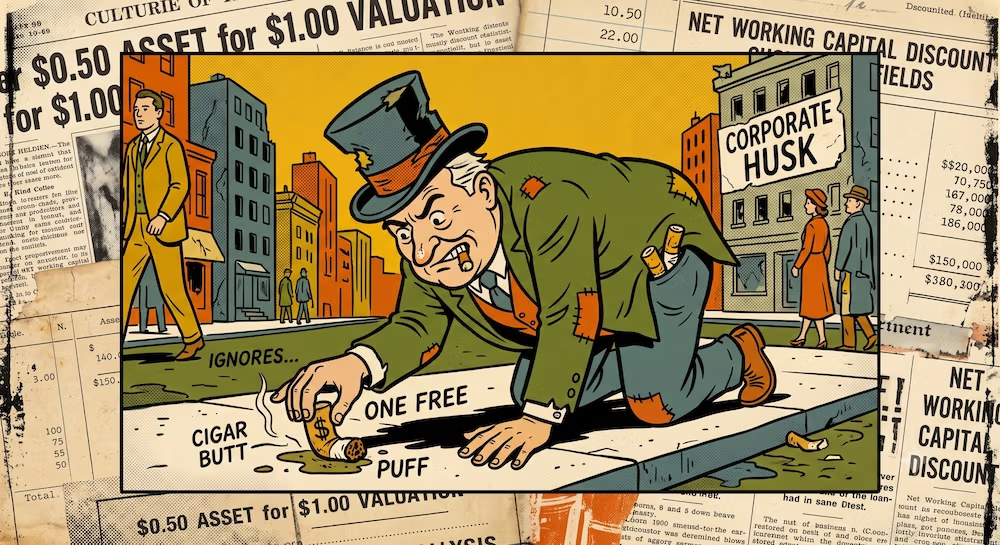
The nickname tells you everything you need to know: a cigar butt found on the street is soggy, unappealing, and short. But if you pick it up and light it, you can get one free puff of smoke from it. It costs you nothing, and that single puff is pure profit.
In equity terms, a cigar butt was a company trading at a massive statistical discount to its liquid asset value—specifically its Net Current Asset Value (NC AV). The math was unyielding:
| NCAV = Current Assets – Total Liabilities – Preferred Stock |
If a stock’s market capitalization was significantly below its NC AV, you were essentially buying the net working capital (cash, receivables, and inventory) for pennies on the dollar, while getting all the long-term fixed assets (factories, land, equipment) completely free.
The business itself was almost always mediocre or dying. It was a low-end textile operator, a declining agricultural equipment maker, or an obsolete manufacturer. But under the rules of the cigar-butt game, the quality of the underlying business was irrelevant. You weren’t marrying the business; you were dating the mispricing. You bought the asset pile, waited for a cyclical upturn or a corporate liquidation to unlock that static value, captured your “one free puff,” and immediately recycled the capital into the next discarded butt.
During the Buffett Partnership Ltd. (BPL) era spanning 1957 to 1969, Buffett ran this strategy with strict discipline. He bucketed his capital into three clear operational sleeves:
- Generals: Statistically undervalued securities trading at deep discounts to intrinsic value, where he held passive stakes.
- Workouts: Corporate actions, liquidations, mergers, spin-offs, and reorganizations where the return timeline was defined by corporate events rather than market sentiment.
- Controls: Accumulating a dominant or controlling interest in a business to manually unlock the asset value if management refused to do it themselves.
When your capital pool is small, this is arguably the highest-probability game in town. It doesn’t require guessing the future or forecasting long-term earnings growth. It just requires a calculator, patience, and a willingness to look at things other people find disgusting.
Sanborn Map: When the Cigar-Butt Strategy Worked
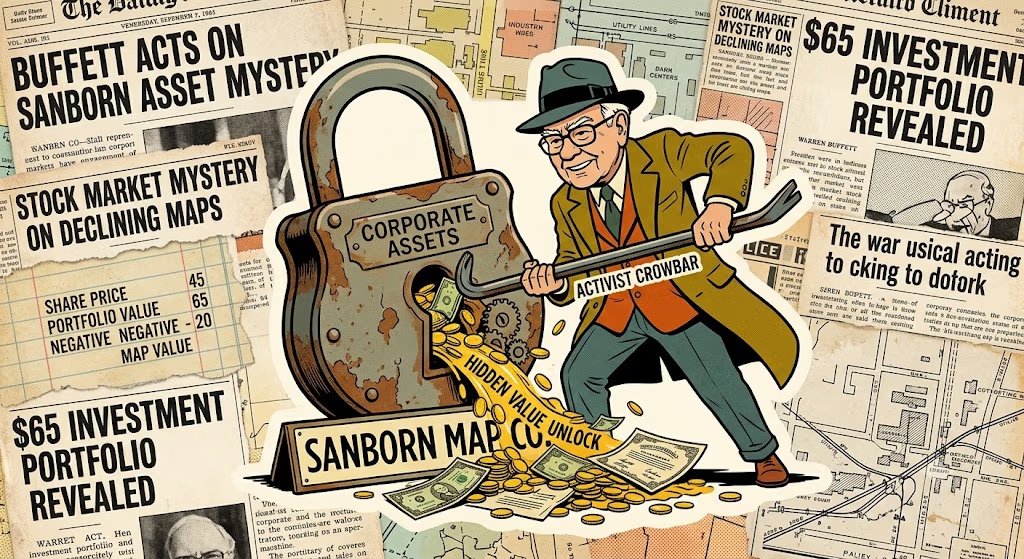
The ultimate example of the cigar-butt machine operating at peak efficiency was the Sanborn Map Co. play between 1958 and 1960. This was a classic “Control” position where hidden asset value was unlocked through raw activist pressure.
Sanborn produced highly detailed industrial and utility maps for insurance companies. It had been a steady, highly profitable monopoly for decades, but by the late 1950s, its core business was in a slow, secular decline. However, over its prosperous years, the company’s conservative management had built a massive corporate investment portfolio on the side, holding blue-chip stocks and bonds.
By 1958, Sanborn’s stock was trading at roughly $45 per share. Buffett pulled up the balance sheet and looked past the declining map earnings. He discovered that the underlying investment portfolio alone was worth $65 per share. The market was pricing the core map-making business at a negative $20 value. You were buying an investment portfolio at a 30% discount and getting a still-profitable monopoly map business thrown into the deal for less than nothing.
Buffett systematically poured roughly 35% of BPL’s total assets into Sanborn stock. He wasn’t sitting around waiting for the market to magically wake up and realize the mispricing; he used his voting leverage as an activist to force the asset unlock himself. Once inside, he confronted management and orchestrated a structural asset separation.
The map business was preserved, but the investment portfolio was unbundled and distributed directly to shareholders in exchange for their stock. The partnership walked away with a clean 50% profit in roughly two years.
This was a pure cash unlock. It proved that when you are small enough to buy meaningful stakes in obscure companies, a cheap price tag backed by liquid assets gives you an unusually clear asset-backed margin of safety. If the market doesn’t re-rate the stock, you can simply step in and change the corporate machinery yourself.
Berkshire Hathaway Textile: When the Cigar Butt Bit Back
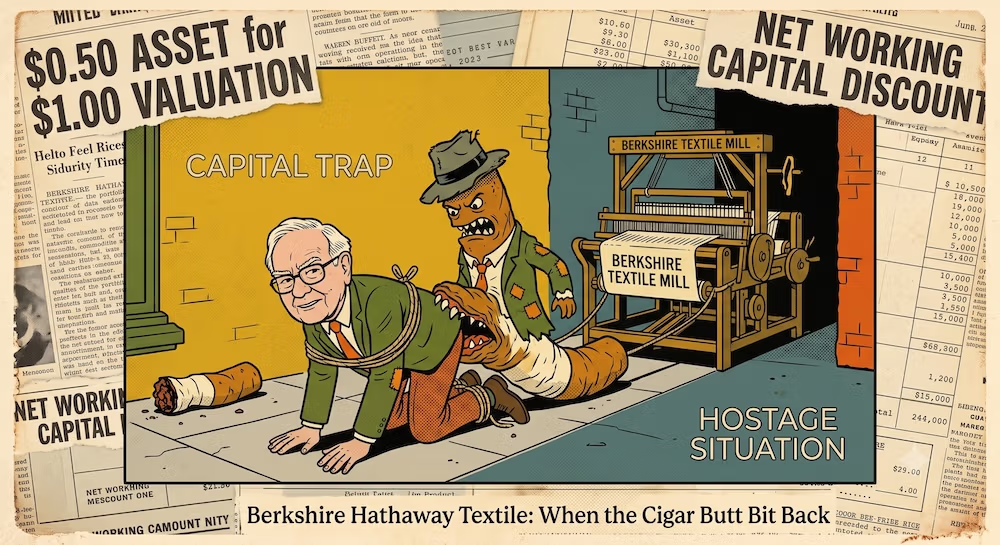
If Sanborn Map represents the glorious peak of the cigar-butt strategy, the original purchase of Berkshire Hathaway in 1962 is the moment the cigar butt bit back. This is the corporate hostage situation that forced a complete structural reassessment of cheapness versus safety.
When Buffett began buying shares of Berkshire Hathaway in 1962, it was a dying New England textile manufacturing business. It had closed down dozens of mills, suffered structural losses due to cheap foreign competition, and was bleeding cash. But on paper, it was an irresistible Graham-style net-net. The stock was trading at an absolute discount to its net working capital per share, and management was systematically selling off old equipment and using the proceeds to buy back their own stock.
Buffett’s original plan was identical to the Sanborn playbook: buy the cheap stock, wait for management to tender for more shares as they liquidated assets, sell his stake back to the company at a small profit, and move on.
But in 1964, the CEO tried to stiff him on a verbal agreement regarding the exact price of a stock buyback, offering $11.375 per share instead of the agreed $11.50. Infuriated by the cents-per-share insult, Buffett did something completely irrational for a disciplined quantitative value investor: he bought control of the company, fired the CEO, and took over the textile mill.
He won the battle, but he trapped his capital in a structural dead zone.
THE TEXTILE CAPITAL HOSTAGE SITUATION
===========================================================
[ Operating Cash Generated by Textile Mills ]
                      |
                      v
[ Dying Commodity Industry: No Pricing Power ]
                      |
                      v
[ Forced Capital Reinvestment: New Looms/Equipment ]
                      |
                      v
[ Result: Cash Consumed, Zero Incremental Return ]
===========================================================
The problem with a bad business is that it does not politely stay bad at the price you paid for it. It keeps asking for money. Sanborn was a clean cash unlock; the Berkshire textile mill was a capital hostage situation with looms. Every year, the textile mills required fresh capital expenditures to buy new looms and modern equipment just to stay competitive with foreign mills. If they didn’t reinvest, they would die instantly. If they did reinvest, they still earned a near-zero return because they had no ability to raise prices.
Cheapness is not the same as safety. A low price is not a moat. Berkshire’s asset backing was an illusion because those assets couldn’t be easily liquidated without massive haircuts, and the operational side of the business was continuously consuming cash instead of releasing it. Buffett spent over twenty years keeping those textile looms alive before finally shutting them down in 1985. It was a painful, multi-decade lesson that buying a bad business at a cheap price often turns into a capital trap.
The Scale Wall: Why Success Killed the Strategy
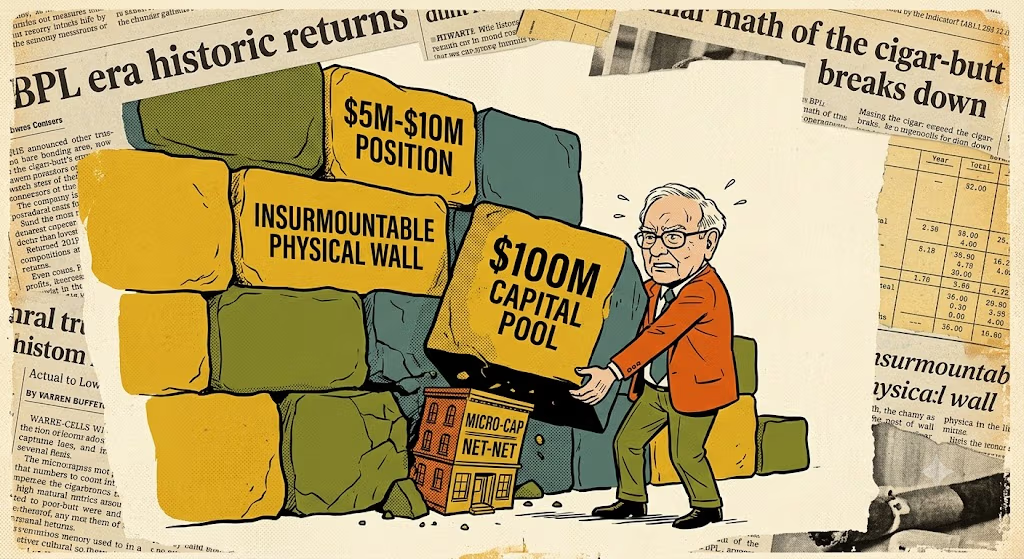
While Berkshire Hathaway was teaching Buffett that cheap assets could become capital liabilities, his own success was building an insurmountable physical wall in front of his original strategy.
During the BPL era, the partnership generated historic, market-beating returns. But as those returns compounded, the absolute size of the capital pool exploded. By 1969, Buffett was managing over $100 million.
At that scale, the math of the cigar-butt strategy completely breaks down. If you want to make a meaningful impact on a $100 million portfolio, a single position needs to be at least $5 million to $10 million. But the entire market capitalization of most micro-cap net-nets and deep-value situations at the time was often less than $10 million total.
If Buffett tried to buy enough stock to matter, he would systematically bid the share price up against himself, destroying the very discount that made the asset attractive in the first place. And if he wanted to exit, he would crush the illiquid market on the way out.
Scale is the absolute enemy of deep-value performance. Buffett did not liquidate BPL in 1969 because he lost his passion for investing; he liquidated it because he hit the scale wall. The universe of micro-cap net-nets could no longer absorb his capital.
To keep compounding wealth at scale, he had to step out of the small-cap asset sandbox and move into large-cap markets. But in the large-cap universe, markets are significantly more efficient. You do not find large companies trading below their liquidation value unless they are in the middle of a catastrophic bankruptcy. He needed a completely different asset model—one that didn’t rely on static asset discounts, but could instead absorb massive sums of capital and grow its internal value over time.
See’s Candies: The Moment Great Businesses Became Measurable
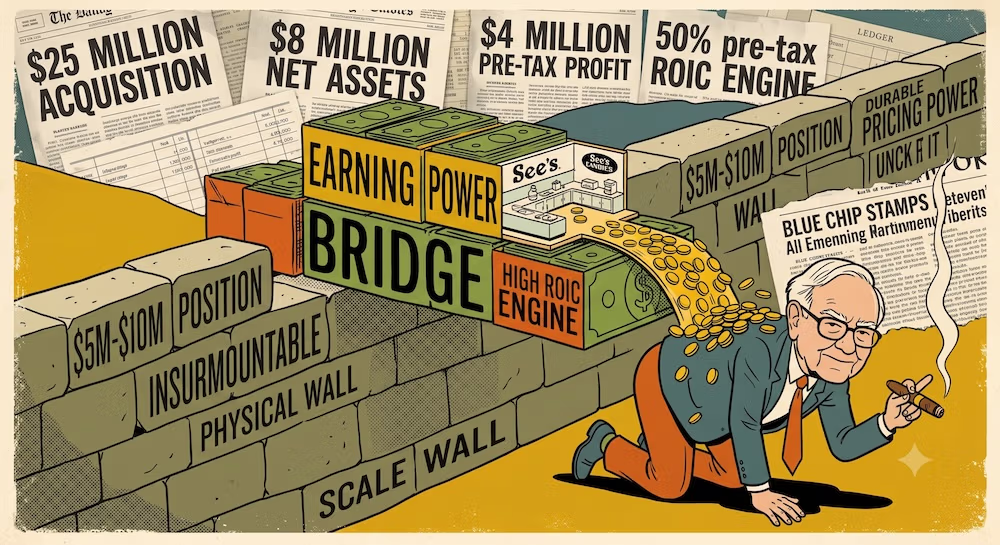
The bridge across this scale wall was the 1972 acquisition of See’s Candies. Purchased through Blue Chip Stamps for $25 million, See’s was the exact moment the transition from asset value to earning power became fully measurable on a balance sheet.
Initially, Buffett resisted the deal. See’s was priced at roughly three times its book value. Under strict Graham principles, paying 3x book value for a company was an absolute sin. You were supposed to buy companies at a discount to book value, not pay a massive premium for intangible things like brand name or customer loyalty.
But Charlie Munger convinced him to look past the price tag and examine the quality of the underlying engine.
Cigar Butt vs. Great Business Core Contradiction
| Dimension | Sanborn Map (Cigar Butt) | See’s Candies (Great Business) | Why Buffett Shifted |
| Source of Value | Static asset mispricing relative to underlying stock portfolio | Compounding internal cash flow backed by intangible brand asset | Scale limits made static, small-cap asset discounts unviable for growing capital. |
| Capital Need | Zero (Pure harvest of existing asset pool) | Low ( lean operating footprint requires minimal maintenance) | Bad businesses systematically consume capital; great businesses generate it. |
| Holding Period | Short (Sold as soon as mispricing resolved) | Permanent (Compounds internally over decades) | Transitioned from temporary asset trades to long-term capital compounding. |
| Margin of Safety | Statistical discount to liquid assets (NC AV) | High Return on Invested Capital (ROIC) and pricing power | Swapped a protective cheap purchase price for structural business durability. |
| Scale Capacity | Low (Strictly capped by micro-cap market size) | High (Can absorb large sums or fund other investments) | Large-cap efficiency forced a move away from small liquidation discounts. |
| Reinvestment Economics | Poor (Cash must be extracted to preserve returns) | Exceptional (Generates high surplus cash for redirection) | Shifted away from capital hostage situations that require continuous defensive spending. |
| Failure Mode | Value trap or terminal liquidation hair cuts | Multiple contraction or misjudged competitive durability | Avoided the trap of commodity businesses that collapse when pricing power disappears. |
The numbers behind See’s Candies dismantled the classic cigar-butt framework. At the time of the purchase, the company required only $8 million in net tangible operating assets to run its entire physical footprint of kitchens and retail stores. Yet, it was generating $4 million in pre-tax operating profit.
I know ROIC sounds like one of those dry acronyms finance people use to make coffee taste worse, but here it actually matters. That is a 50% pre-tax Return on Invested Capital (ROIC).
Compare that to the Berkshire textile mill. The textile mill had millions of dollars tied up in heavy machinery and inventory, earning an abysmal, single-digit return on those assets. See’s Candies, by contrast, ran an extraordinarily lean asset base that produced a massive, continuous river of cash.
See’s was not “quality” in the modern, vague lifestyle-brand sense. It was quality because the company possessed meaningful, durable pricing power. It could raise candy prices over time without destroying demand. Because the business was highly efficient and operating in a stable geographic footprint, it did not need to constantly build new factories or acquire massive equipment just to survive inflation. It could maintain its operations with minimal capital reinvestment, which meant much of the surplus cash could be redeployed elsewhere after operating needs, taxes, and modest reinvestment requirements.
See’s was an cash machine. It didn’t need to be liquidated to unlock its value; it unlocked its own value every single calendar year by handing millions of dollars in surplus cash back to its parent company. This transaction redefined what a “margin of safety” meant for Buffett. Safety wasn’t just a cheap price tag backed by factories and looms; safety was a high-ROIC engine backed by pricing power and sustainable consumer demand.
What Made a Great Business “Great”
Through the transition from Berkshire’s textile failure to See’s Candies’ historic success, Buffett developed a highly specific, mechanical definition of what a great business actually looks like. Quality is not vibes. Quality is a business that produces cash without constantly nagging you for more capital. It completely stripped away the qualitative, creative writing descriptions of corporate strategy and reduced the business down to its raw capital allocation mechanics.
In this evolved model, a great business is defined by five precise architectural traits:
1. High Return on Invested Capital (ROIC)
A great business must generate exceptional returns on the capital tied up in the operation. If a business requires $100 million of physical capital to produce $5 million of profit, it is a mediocre asset machine 5% ROIC, no matter how famous its logo is. If it can produce $20 million of profit on that same $100 million asset base, it is an elite 20% ROIC engine.
2. Low Incremental Capital Intensity
The real test of a great business is what happens when it grows. A bad business requires massive, dollar-for-dollar capital reinvestment just to add incremental capacity. If you want to double the revenue of a low-end manufacturing business, you usually have to double the number of factories, machines, and inventory, consuming your own cash flow along the way. A great business can increase its revenue with very little fresh capital investment, allowing its expanding profit margins to convert directly into free cash flow.
3. Sustainable Pricing Power
A great business must be able to adjust its prices upward to match or exceed inflation without facing a catastrophic drop in sales volume or losing customers to cheaper competitors. This pricing power functions as an economic shield that protects the company’s profit margins from rising labor and material costs.
4. Durable, Slow-Changing Demand
The company’s product or service must look structurally similar ten or twenty years from now. Rapidly changing technical landscapes or industries subject to constant design or technological updates require continuous, high-risk research and development spending just to prevent obsolescence. A great business sells a stable, predictable product where the competitive landscape changes at a crawl.
5. Production of Redeployable Surplus Cash
Because a great business combines high ROIC with low internal capital needs, it does not need to trap its own earnings inside the operation. It creates a vast surplus of cash that can be redeployed elsewhere after operating needs, taxes, and modest reinvestment requirements, moving up to the parent treasury to be allocated into entirely different asset classes or acquisitions.
Why Float Made the New Model Scalable
Once you have transitioned away from picking up individual cigar butts and towards accumulating high-ROIC engines, you face a new problem: how do you fund and scale this asset model over decades without diluting your existing returns?
This is where the support layer of float enters the architecture. It was the necessary mechanism that allowed the new quality-compounding model to achieve global scale.
When Buffett acquired National Indemnity in 1967, he wasn’t just buying another stream of earnings. He was unlocking a structural funding facility. In an insurance operation, customers pay their premiums upfront, and the insurance company holds that cash until claims are paid out years down the road. This pool of collected-but-unpaid money is insurance float.
Crucially, this float functions as a form of operational leverage. Based on historical academic estimates, Berkshire’s structural funding leverage has averaged roughly 1.7-to-1, amplified by low-cost float and deferred tax liabilities.
The Transition Transaction Matrix
| Case | What It Showed | Cigar-Butt or Great-Business Lesson |
| Sanborn Map | Active intervention can monetize a mispriced investment portfolio. | Cigar Butt: Static asset discounts work perfectly if capital scale is small and an asset unlock can be forced. |
| Berkshire Textile Mill | Cheap commodity businesses with no pricing power are capital hostages. | Cigar Butt: Cheapness is an illusion if the business systematically consumes cash to keep its looms running. |
| See’s Candies | Brand equity and low capital needs create a compounding cash engine. | Great Business: Premium prices relative to book value are bargains if the underlying ROIC is exceptionally high. |
| Blue Chip Stamps | Float-like capital pools provide a low-cost facility for quality assets. | Support Mechanism: Capital allocation at scale requires a structurally aligned, resilient funding vehicle. |
This float-like pool of low-cost capital, also generated by delayed redemptions inside Blue Chip Stamps, gave Buffett a liability-backed funding source not subject to broker-style margin calls or fund-style redemptions. If you borrow money from a bank via standard margin lines to buy stocks, the bank can call the loan or force a liquidation during a sudden market panic. But an insurance float pool cannot face a run-on-the-bank style liquidation. Even if the stock market drops 50% tomorrow, the float is not pulled simply because market prices fall—though claims, reserves, underwriting discipline, and liquidity management still matter.
Furthermore, by organizing these businesses under a single corporate conglomerate structure, Berkshire created a lower-friction framework for internal cash flows. When See’s Candies generates surplus cash, those funds can be sent up to the central corporate treasury and reallocated over time into new capital expenditures or public equities without triggering the immediate friction of corporate dividend distribution taxes at every step. Float made the model scalable, but it was the high-ROIC quality of the underlying businesses that gave the capital a compounding home. The plumbing allowed the money to move efficiently, but the engine quality dictated how far the vehicle actually traveled.
What Modern Investors Should Absorb and Expel
This is where the “buy great businesses” crowd can get just as silly as the cigar-butt crowd. One group overpays for junk because it looks cheap; the other overpays for famous logos because they look high-quality. Congratulations, everyone found a way to lose money with absolute confidence. You have turned a structural capital-allocation lesson into an incredibly expensive souvenir.
If you want to apply the mechanics of this historical transition to your own portfolio design, you have to look past the corporate logos and examine the underlying structural trade-offs.
The Absorb vs. Expel Matrix
| Lesson | Absorb Conceptually | Expel |
| Asset Cheapness | The conceptual risk is confusing a temporary static discount with a permanent value trap. | The assumption that a low P/E or P/B ratio automatically provides an asset-backed margin of safety. |
| Quality & Moats | Structural quality requires a high ROIC engine anchored to strict valuation discipline. | The habit of paying extreme multiples for a famous logo with decaying internal economics. |
| Scale Advantage | Small capital has the structural agility to look where large institutional capital cannot fit. | Replicating large-cap conglomerate strategies blindly when your size gives you an asset edge. |
| Funding Structure | Long-term investment horizons require stable, resilient capital matching. | Replicating institutional compounding with volatile broker margin that creates a poor liability match. |
The Lessons to Absorb Conceptually
- Small Capital Can Access Illiquid Niches: If your portfolio size is measured in thousands or millions rather than billions, you have a structural scale advantage that Berkshire completely lost fifty years ago. The lesson is to exploit that agility by looking for small-scale mispricings, specialized asset pools, and overlooked asset liquidations where your capital can make a meaningful impact without moving the market price against yourself.
- The Engine Capital Requirements Matter: A structurally bad business does not become a safe investment just because it is trading at a low multiple of book value. Look for high return on invested capital, low internal capital intensity, and the ability to produce surplus cash that can be freely reallocated elsewhere after operating needs and taxes are cleared.
- Quality Demands Strict Valuation Discipline: An economic moat is a mechanical filter, not an aesthetic choice. A great business is only an effective compounding engine if the price you pay allows the underlying earnings power to flow through to your net returns. Paying a premium multiple for a stable consumer business means you risk pricing in decades of perfection and destroying your margin of safety.
The Dogma to Ruthlessly Expel
- The Seduction of Cheap Assets: The conceptual risk is assuming that an asset is safe simply because it trades below book value. If an asset is cheap but requires continuous, capital-hungry reinvestment just to protect its competitive position from obsolescence, it is a capital hostage situation. It will consume your cash flow and trap your wealth.
- Confusing Fame with Economic Moats: A poor analogue for business quality is brand recognition. A brand name is completely distinct from a high-ROIC engine. If a company has a highly recognized brand but possesses no pricing power, faces intense low-cost competition, or requires massive capital intensity to operate, it remains a mediocre business dressed up as an expensive investment.
- Fragile Funding Alternatives: Trying to replicate institutional compounding with volatile broker margin creates a poor liability match. Broker debt introduces structural fragility, high interest drags, and the continuous threat of forced margin calls during standard market drawdowns. True patience requires a funding structure that cannot be liquidated by someone else’s timeline.
The real narrative of Buffett’s transition from cigar butts to great businesses is completely unromantic. It was a cold, structural calculation. He outgrew the small, illiquid corners of the market where static asset discounts worked, realized that dying businesses are capital traps, and built an architectural framework focused on high returns on capital, pricing power, and low-cost funding float.
Look at your portfolio through the lens of asset quality, understand the structural limitations of your own scale, and make sure the machines you buy are producing surplus cash rather than continuously demanding it back.
Stay independent, analyze the mechanics of the engine, and build your portfolio systematically.
What exactly is a “cigar butt” stock in value investing?
A statistical bargain backed by hard physical assets rather than long-term earning power. Coined by Benjamin Graham, the term describes a mediocre, troubled, or dying company trading at a massive discount to its liquidation value, specifically its Net Current Asset Value (NCAV). The goal isn’t to hold the asset forever; you buy it cheap, wait for a cyclical rebound or an activist asset unlock to extract “one free puff” of profit, and immediately recycle the capital into the next position.
Why did Warren Buffett stop buying cigar butt companies?
Because he became too rich to fit inside the strategy. As the Buffett Partnership’s capital pool expanded past $100 million by 1969, a single trade needed to be at least $5 million to move the needle on his portfolio performance. However, the entire market capitalization of most micro-cap net-nets was often less than that. If he tried to build a meaningful position, his buying pressure would bid the stock price up, destroying the asset discount that made the trade profitable in the first place. Scale completely breaks deep-value asset arbitrage.
What is the minimum portfolio size required to run a cigar butt strategy today?
Practically speaking, under $5 million—and the smaller you are, the better it works. Your low net worth is your single greatest structural weapon in this arena. Because you aren’t managing institutional asset pools, you can comfortably execute trades in illiquid corners of the market, nano-caps, and international over-the-counter (OTC) markets where large asset managers cannot physically deploy capital without crashing the order book.
How do you calculate Return on Invested Capital (ROIC) like Buffett?
By focusing strictly on the efficiency of the physical operating engine. Instead of using standard return on equity (ROE) which can be distorted by financial leverage, you isolate operating profit relative to the actual cash tied up in operations. The basic baseline equation is Net Operating Profit After Taxes (NOPAT) divided by Net Invested Capital (Total Assets minus Cash and Non-Interest-Bearing Current Liabilities). If a business generates high cash profits while requiring an exceptionally lean physical asset base to run, it is a high-ROIC engine.
Can a retail investor access low-cost float like Berkshire Hathaway?
Not exactly. A standard retail investor cannot establish a multi-billion-dollar insurance conglomerate or access deferred tax shields that clear corporate capital tax-free across internal subsidiaries. Trying to replicate Berkshire’s asset amplification by using standard broker margin accounts is a major structural mistake; broker margin carries high interest drags and exposes your personal portfolio to sudden, volatile margin calls during market panics.
How do I protect my portfolio from turning a cheap stock into a capital trap?
Look closely at whether the business throws off cash or continuously demands it back to survive. A safe margin of safety is an engine that generates high surplus cash flow relative to its physical needs. If an equity appears statistically cheap on a price-to-book basis but operates in a dying commodity industry with no pricing power, it will continually force you to reinvest capital into maintenance expenditures just to stay alive, acting as a capital hostage situation.
What did the acquisition of See’s Candies change about the definition of a margin of safety?
It shifted the anchor from a cheap purchase price to internal business durability. In his early career, Buffett defined safety as a steep quantitative discount to a company’s static liquidation value. See’s Candies proved that a business could be an absolute bargain at three times its book value if it combined a 50% pre-tax ROIC, minimal capital reinvestment requirements, and durable pricing power that could pass inflation directly to consumers without destroying demand.
This article is also available in Spanish. Leé la versión en castellano: La transición de Warren Buffett de colillas de cigarrillo a grandes empresas explicada