I used to think Charlie Munger’s rants on incentives were just the folksy behavioral wisdom of a brilliant billionaire who liked giving commencement speeches. You’ve probably seen the quotes floating around social media, pasted onto sunset backgrounds by career coaches who treat it like a basic human resources tip. Make sure you reward your sales teams, the corporate narrative goes, and they’ll work harder for you.
But when you strip away the mainstream folklore and look at how he actually allocated capital, you discover a far colder, entirely quantitative reality. The man wasn’t running a soft psychology seminar. He was running a high-stakes, hyper-concentrated war against structural friction.
To Munger’s eyes, a misaligned corporate incentive wasn’t a “management challenge.” It was an aggressive, compounding hidden fee—a literal structural short position operating directly against your equity canvas.
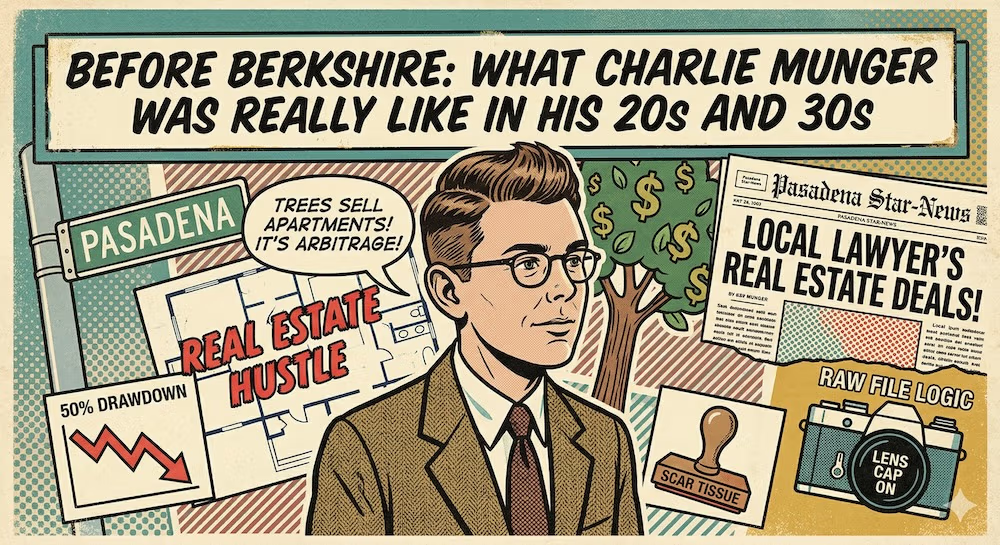
The origin story of this obsession goes back to his early days leaving his law practice to develop multi-family real estate syndicates in California during the 1960s. In those raw construction deals, he saw firsthand how developers structured upfront promotional fees that guaranteed they got rich on the day the ground was broken, completely independent of the underlying asset’s performance. It didn’t matter if the completed building eventually cratered and left the investors holding a bag of wet dirt; the developer’s wallet was already insulated.
Human beings, Munger realized, optimize for their own local incentives with terrifying mathematical precision. If you aren’t auditing that alignment with the exact same quantitative rigor you apply to a company’s debt profile, you aren’t investing. You’re engaging in corporate cosplay with a retail brokerage account and a half-read annual letter.

The Partnership Crucible: The Real Cost of Alignment
There is a clean, beautiful myth that paints Munger as a conservative, low-volatility compounder who gently accumulated wealth without ever breaking a sweat. The historical ledger completely upends that narrative.
When Munger ran his independent investment vehicle, Wheeler, Munger & Co., from 1962 to 1975, his strategy was hyper-concentrated and intensely volatile. He routinely jammed up to 90% of his partnership’s capital into just 3 to 5 positions. While he ultimately generated an outstanding +19.8% CAGR across that 14-year run compared to just +5.0% for the Dow, it required tolerating an approximate -53% peak-to-trough drawdown during the brutal 1973–1974 bear market.
For nearly 36 consecutive months, Munger and his partners sat deep underwater. Why did the partnership structure survive a drop that would cause a modern retail investor to completely unravel?
Because the fee and incentive architecture of his partnership was explicitly designed to absorb absolute structural pain. Munger’s personal net worth was tied directly to the downside performance alongside his investors. He didn’t extract management fees on asset size; his reward triggered purely on performance hurdles over a strict baseline.
When the emotional toll of carrying outside clients through that multi-year drop became too intense, he didn’t style-drift or capitulate. At the end of 1975, he liquidated the partnership entirely—not out of panic, but to dissolve the client-redemption risk structure. He distributed raw corporate shares of Blue Chip Stamps and Berkshire Hathaway directly to his partners, forcing them into a permanent capital alignment where short-term psychological withdrawals could no longer trigger forced asset sales at the bottom of the market.
Absorb the patience. Expel the hero worship. The strategy worked because the structural incentives allowed him to sit perfectly still while his net worth was cut in half.
Positive Alignment: The See’s Candies Pricing Engine
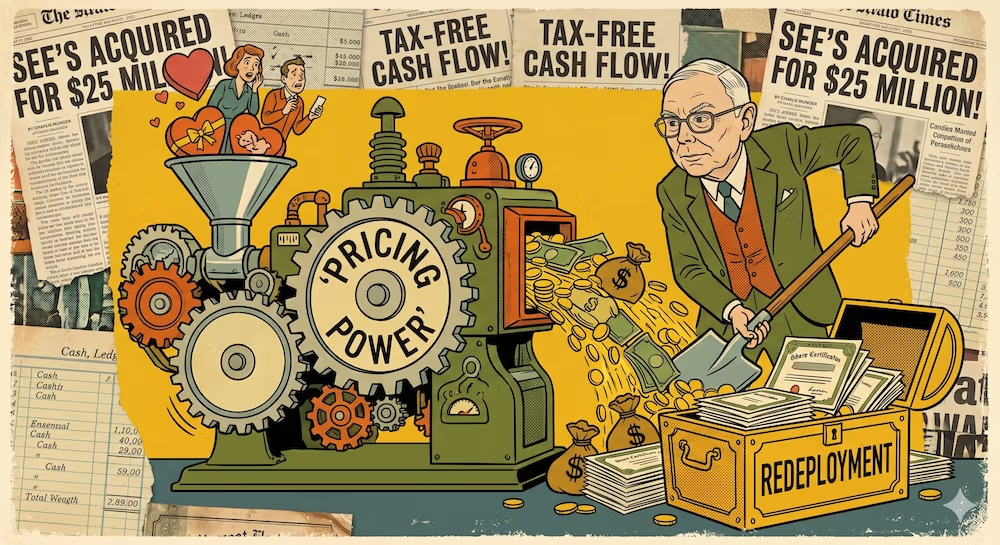
When Munger and Buffett utilized the un-callable corporate float of Blue Chip Stamps to execute the landmark acquisition of See’s Candies in 1972, they weren’t just buying a high-quality consumer brand. They were buying a unique microeconomic vehicle where consumer incentives perfectly aligned with pricing power.
They bought the entire business for $25 million when it was generating $4 million in pre-tax earnings. The mechanism they uncovered inside the asset was a glaring consumer psychology anomaly: people buying chocolates for their partners or mothers-in-law on Valentine’s Day do not price-shop. The purchase is an emotional statement where the penalty for buying an unaligned, cheap alternative is socially catastrophic.
Munger realized that See’s possessed a rare form of emotional pricing power. It was an asset that allowed management to introduce regular, recurring price increases over time without destroying underlying consumer demand or bleeding volume to competitors.
Because the brand equity required virtually zero physical capital reinvestment to maintain its footprint, See’s transformed into a predictable, recurring cash machine. Look at how that macro loop functioned mechanically:
[Low-Cost Corporate Float]
         │
         ▼
[Purchase of See's Candies ($25M)]
         │
         ▼
[Regular, Brand-Driven Price Increases]
         │
         ▼
[$2B+ Cumulative Pre-Tax Cash Flow Generated]
         │
         ▼
[100% Retained & Redeployed Pre-Tax Inside Holding Company]
This cash flow did not trigger personal dividend tax drags or distributive capital friction. It was retained entirely at the corporate level and redeployed pre-tax into concentrated equities via Wesco Financial.
The mechanism succeeded because the consumer incentive allowed for frictionless price hikes, and the corporate architecture allowed 100% of that cash to bypass intermediate tax drains. The legend had an interest-free insurance float and a 50-year corporate runway where earnings compounded pre-tax. You have a taxable individual account and a mortgage. Different game entirely.
The Alibaba Blindspot: Missing the Sovereign Reset
If Munger’s incentive framework is one of the closest things investing has to a law of gravity, we have to ask a distinct, uncomfortable rhetorical question: how did the man who spent fifty years preaching this exact doctrine end up losing millions of dollars by piling leverage into a Chinese e-commerce giant?
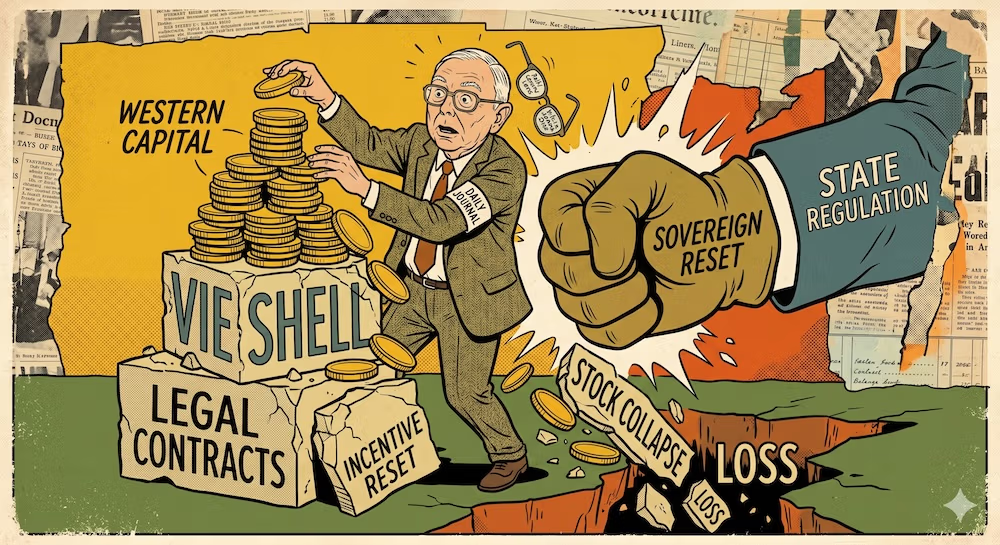
In his final years, acting through the Daily Journal Corporation balance sheet, Munger made an incredibly aggressive, highly concentrated bet on Alibaba (BABA) near its market peak. It was a classic textbook violation of his own foundational blueprint.
He looked at Alibaba through his standard legacy lens: a dominant consumer monopoly with massive pricing power and high return on invested capital (ROIC). But in doing so, he completely miscalculated the structural corporate governance framework underneath the asset.
When a Western investor buys shares of a Chinese internet company, they do not buy equity in the actual operational business. Instead, they are buying shares in a shell company located in an offshore tax haven—a Variable Interest Entity, or VIE structure. This shell company relies on a series of complex legal contracts to mimic the economic returns of the real business.
The underlying incentives look like this:
[Western Capital] ──> [Offshore Shell Company (VIE)] ──?──> [Actual Operational Assets]
                               │
                               └─── [Subject to State Regulatory Intervention & Incentive Resets]
The core lesson Munger delivered in his famous 1995 Harvard address, “The Psychology of Human Misjudgment,” was clear: “Show me the incentive and I will show you the outcome.” Yet, in the case of Alibaba, he ignored the fact that the state’s regulatory and political incentives were completely misaligned with protecting the equity upside of minority offshore shell holders.
The regulatory environment shifted hard, the contract structures were stressed, and the stock collapsed, forcing a rare, public late-career reversal where Munger had to reduce the position at a significant loss.
It’s a sobering reminder. If a legendary capital allocator can get blinded by the surface-level metrics of a consumer monopoly and ignore a massive underlying structural incentive risk, what chance do you have if you are just winging it based on qualitative management “vibes”?
The Due-Diligence Machine: Auditing the Proxy Statement
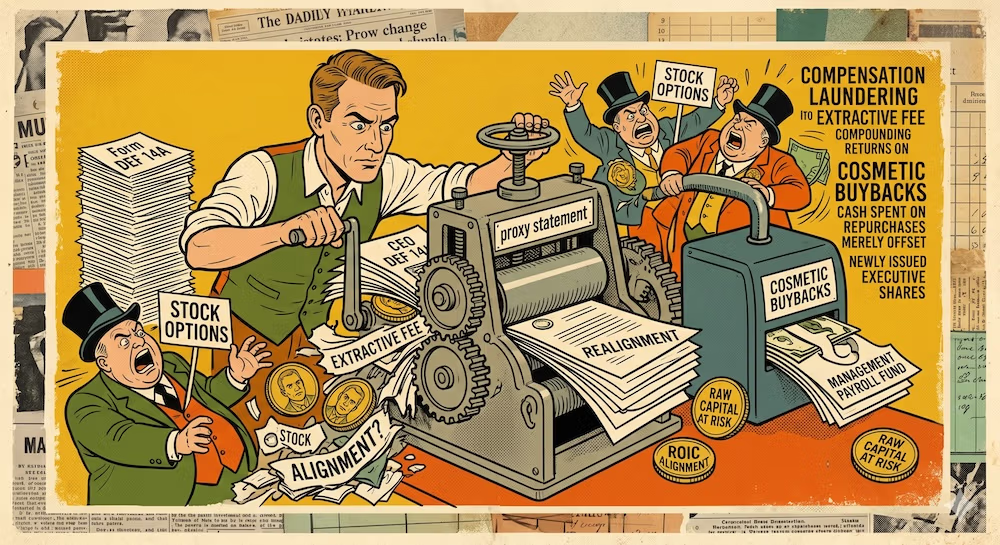
If you want to apply Munger’s brilliant insights to your modern portfolio canvas without engaging in era-specific cosplay, you have to transform his behavioral doctrine into a brutal, quantitative investor due-diligence machine. Stop listening to the CEO’s promotional interviews. Instead, open the SEC regulatory disclosures, pull up the Form DEF 14A (the annual proxy statement), and run a cutthroat audit on executive compensation structures.
Treat every single line item in this document as a potential siphon on your compounding returns. If the incentives are broken, the long-term corporate outcome is already mathematically determined.
The Quantitative Incentive Filter Matrix
| Governance Variable | The Corporate Fluff Narrative | The Quantitative Reality Check | The Portfolio Verdict |
| The Dilution Hurdle | “We utilize stock-based compensation to attract top-tier talent and align our workforce with shareholders.” | Track the rolling 5-year trajectory of the fully diluted share count. If share count is rising while free cash flow per share stagnates, management is printing your equity canvas to fund their own payroll. | Extractive Fee. Treat aggressive net share dilution exactly like a compounding management expense ratio. |
| The Reward Metric | “Our executive team is rewarded for scaling the business and hitting major milestones.” | Dissect the explicit metrics that trigger cash and equity bonuses. If management is rewarded based on raw revenue growth or total asset accumulation, run away. This explicitly incentivizes them to buy low-return businesses just to get bigger. | Misaligned Structure. Reject companies that do not tie executive bonuses directly to long-term Return on Invested Capital (ROIC) or free cash flow per share hurdles. |
| The Skin-in-the-Game Test | “Our leadership team holds millions of dollars worth of equity exposure in our company shares.” | Differentiate between unexercised, risk-free stock options and shares purchased with their own cash on the open market. Options provide massive upside with zero personal downside, incentivizing extreme, unhedged corporate risk-taking. | Cosplay Alignment. True alignment requires raw capital at risk. Demand that executives have skin in the game through actual open-market equity purchases. |
| The Buyback Integrity Test | “We are returning capital to shareholders through disciplined repurchases.” | Compare gross share buybacks against dilution from stock-based compensation. If the cash spent on buybacks merely offsets newly issued executive shares, capital is being drained out of the corporate engine. | Optical Capital Return. Treat cosmetic buybacks as compensation laundering, not owner-friendly capital allocation. |
Avoid treating broker margin as a substitute for institutional float, and do not copy Munger’s extreme 3-stock concentration if your capital base is exposed to short-term retail liabilities. Keep your core asset allocation insulated.
When you look under the hood of any business, remember the lesson of the California real estate syndicates: look for the promotional fee hiding in the contract. If the board of directors has designed a compensation framework that lets management get rich while the underlying equity holders run in place, you aren’t looking at an investment opportunity. You are looking at a structural short position.
Incentives are not footnotes. They are the plumbing. Absorb the incentive lens, expel the management-vibe cosplay, and track the plumbing before you risk a single dollar of your capital.
FAQs
What is the minimum portfolio size required to execute Charlie Munger’s incentive audit strategy safely?
It depends entirely on your setup, but if you are trying to replicate his hyper-concentrated 3-to-5 stock approach, the answer for a retail investor is effectively “never.” Without the shield of a permanent corporate capital base or an insurance float to absorb the structural shocks, a retail account running that level of concentration faces severe behavioral risk. However, if you are applying his quantitative incentive filter to an isolated 10% satellite stock sleeve while keeping the remaining 90% of your canvas in diversified index or factor funds, you can execute this methodology with a portfolio of any size.
How exactly do aggressive corporate buybacks interact with stock-based compensation (SBC)?
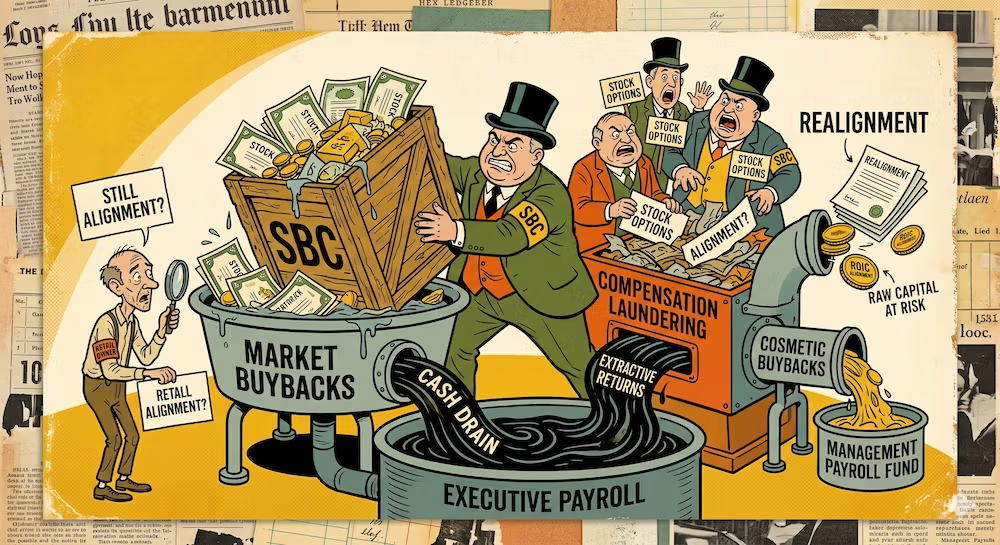
Not exactly the way corporate press releases claim. Many leadership teams boast about returning capital to owners through disciplined repurchases. In reality, you must run the buyback integrity test: compare gross share repurchases against the total economic dilution of executive equity grants. If the cash spent on market buybacks merely cleans up the newly issued shares handed out to insiders, the company is participating in compensation laundering. The cash is draining out of the corporate engine to enrich management, while your net fractional ownership slice of the canvas stands completely still.
Why didn’t Charlie Munger’s incentive framework protect him from the Alibaba investment loss?
He missed the local structural plumbing. Munger looked at Alibaba through his classic domestic framework, identifying a high-margin consumer monopoly with immense pricing power. But he overlooked the fact that international retail capital does not actually own the underlying operational business in China; it holds shares in an offshore Variable Interest Entity (VIE) shell. The regulatory and political incentives of sovereign state actors were completely misaligned with protecting the long-term equity upside of minority offshore shell holders, proving that even a master allocator can experience an structural blindspot when entering an unfamiliar regulatory regime.
How can a retail investor identify if a CEO has genuine open-market skin in the game?
Yes, it requires digging past the headline ownership figures inside the SEC Form DEF 14A proxy statement. Look specifically at the “Security Ownership of Management” tables and distinguish between risk-free stock options granted by the compensation board and shares purchased with the executive’s personal cash on the open market. Stock options incentivize outsized, unhedged corporate gambling because they possess infinite upside with zero personal downside if the share price craters. Genuine alignment requires raw capital at risk on the open canvas.
What is a corporate “Sins of Omission” error, and how do incentives drive it?
It is a silent portfolio siphon. Most accounting metrics and performance hurdles only punish management for active mistakes that show up clearly on a balance sheet—the “sins of commission,” like an acquisition that goes poorly. However, corporate incentive structures almost never penalize management for sitting on their hands and missing massive, obvious compounding opportunities—the “sins of omission.” Because executive compensation packages often reward asset size or revenue scale rather than cash flow generation per share, management teams are structurally incentivized to choose conservative empire-building over high-conviction capital allocation.
Is there a specific modern ETF ticker that automates Charlie Munger’s incentive filtering strategy today?
None that copy his exact qualitative and quantitative blend flawlessly. While there are specialized exchange-traded products focused generally on corporate governance or founder-led businesses, they often rely on broad, passive algorithmic screening rules that miss the nuanced structural friction Munger analyzed manually. Automated screens can easily overlook complex Variable Interest Entity (VIE) contract vulnerabilities or clever compensation adjustments hidden deep within proxy text footnotes. The ultimate defensive due-diligence machine remains your own manual audit of the SEC proxy disclosures.
This article is also available in Spanish. [Leé la versión en castellano: Charlie Munger y los incentivos: La fuerza más peligrosa en los negocios y los mercados]