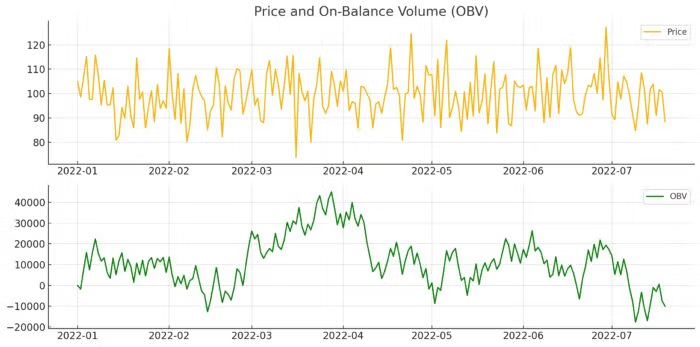
To my eyes, options trading isn’t just about guessing where a stock will land. I used to think I had to play the direction game perfectly every time. I don’t. Sometimes, I look at the market and honestly have zero conviction on direction, but I know something is going to break. In these moments, volatility becomes the actual asset class, and you start looking for ways to profit from sheer kinetic energy, regardless of which way the chart moves. That’s where straddles and strangles come into play. These two strategies are explicitly designed to capture expanding pricing ranges, making them highly efficient when markets become untethered or prone to violent re-pricing.
Volatility is a tradeable asset.
If you are running a standard directional playbook, you buy a call if you think the market will rally, or a put if you think it’s going to crack. But what happens when you know a major catalyst is coming—an earnings print, a Fed rate decision, or a structural macro shift—and you simply cannot confidently model the final outcome? This is the essence of trading volatility. Instead of picking a side, you are allocating capital to the probability of variance. You are betting on the expansion of the daily trading range. But let’s be clear upfront: the luxury of not picking a direction is incredibly expensive. You are paying a heavy premium for agnosticism.
The Mechanics of Volatility in Options Pricing
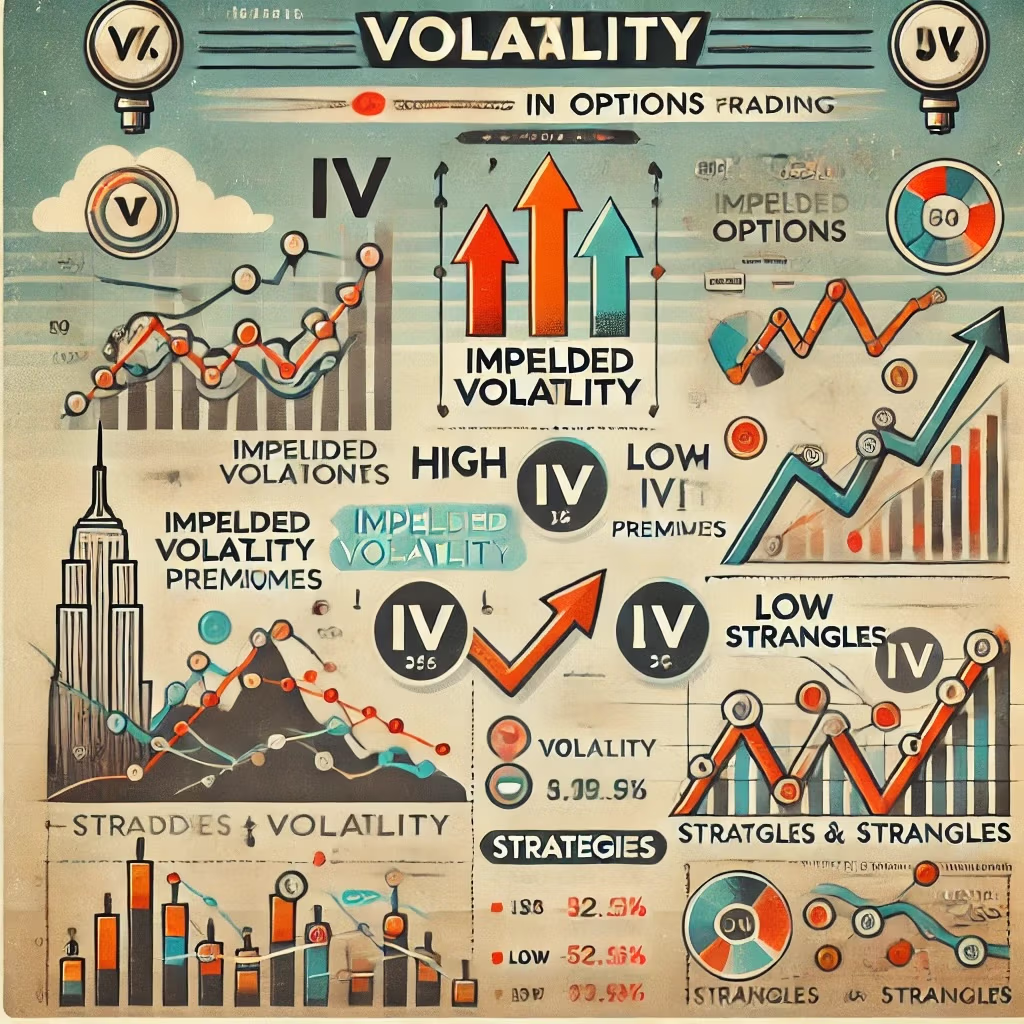
When we talk about volatility in options, we are strictly looking at implied volatility (IV). This metric reflects the market’s mathematical expectation of how far a stock or index might swing over a specific time horizon. When IV runs hot, option premiums explode because market makers demand compensation for the risk of a massive swing. When IV is compressed, premiums are cheap. Strategies like straddles and strangles allow you to structurally position your portfolio for moments where you believe the actual, realized volatility will ruthlessly outpace the implied volatility currently priced into the chain. If you get this timing wrong, the Greeks will quietly dismantle your account.
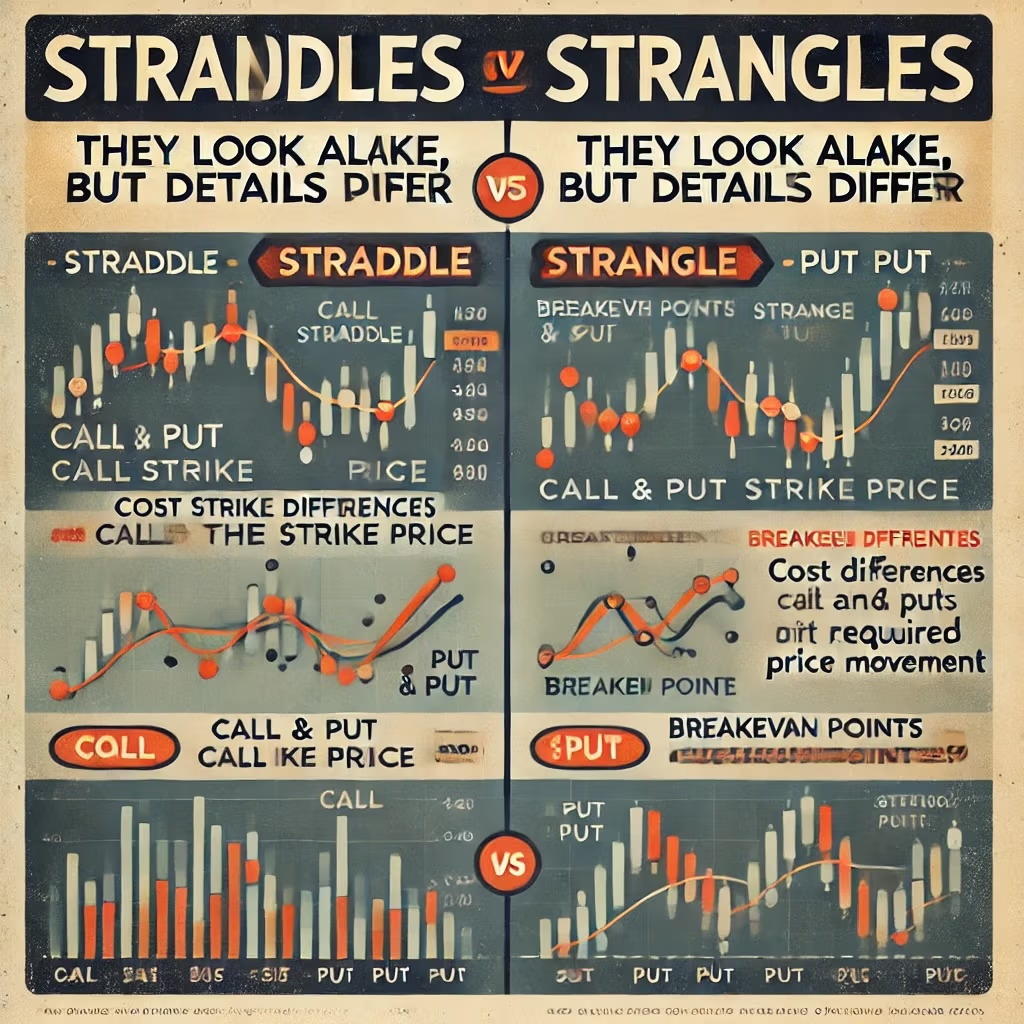
Why Straddles and Strangles Deserve Capital Allocation
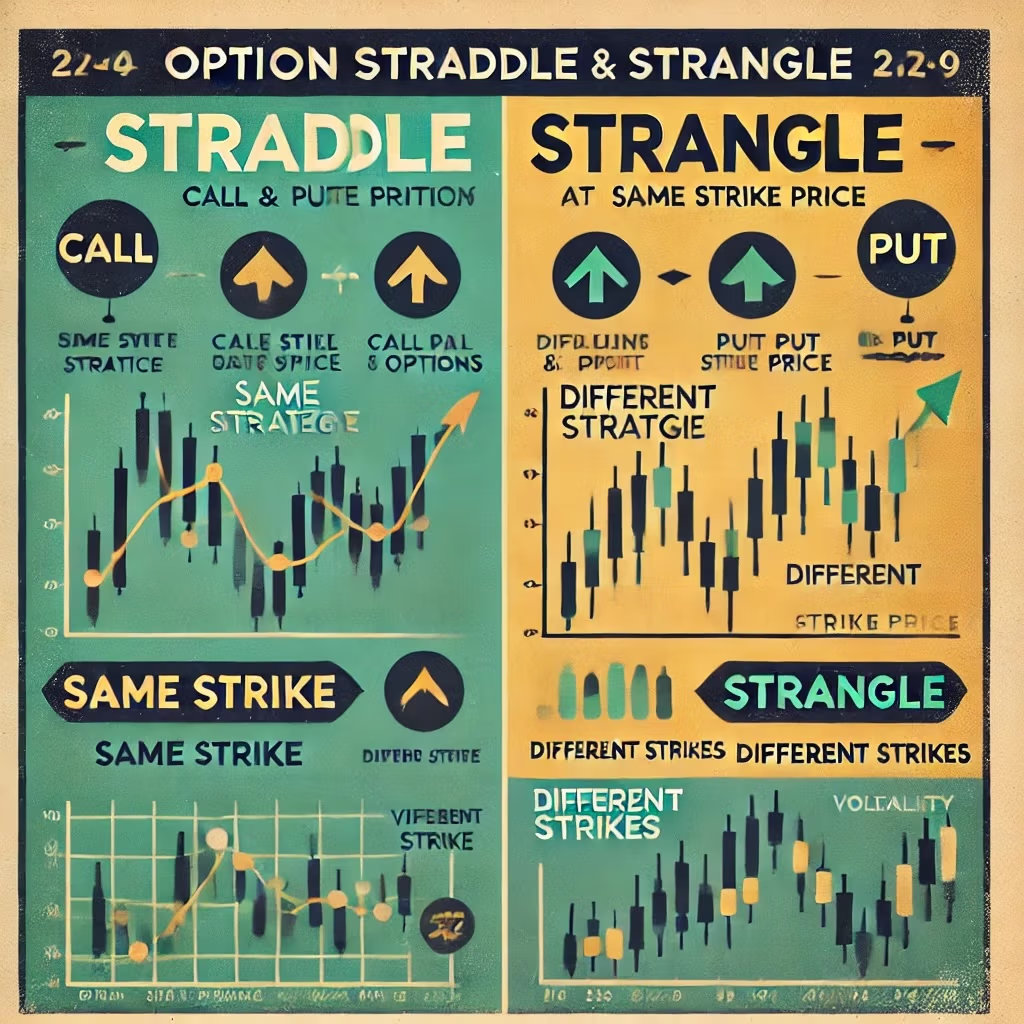
Both setups require you to buy a call and a put in unison. The architectural difference lies in the strike placement: straddles lock in the exact same strike price for both legs, while strangles push the strikes apart. I love that mechanical distinction because it forces you to choose your tradeoff between upfront premium costs and the required breakeven distance. If executed with discipline, they act as high-octane capital efficiency tools; if mismanaged, you will watch theta decay mercilessly evaporate your capital while you wait for a breakout that never arrives.
The math is elegant on a spreadsheet. Execution is where things get bloody.
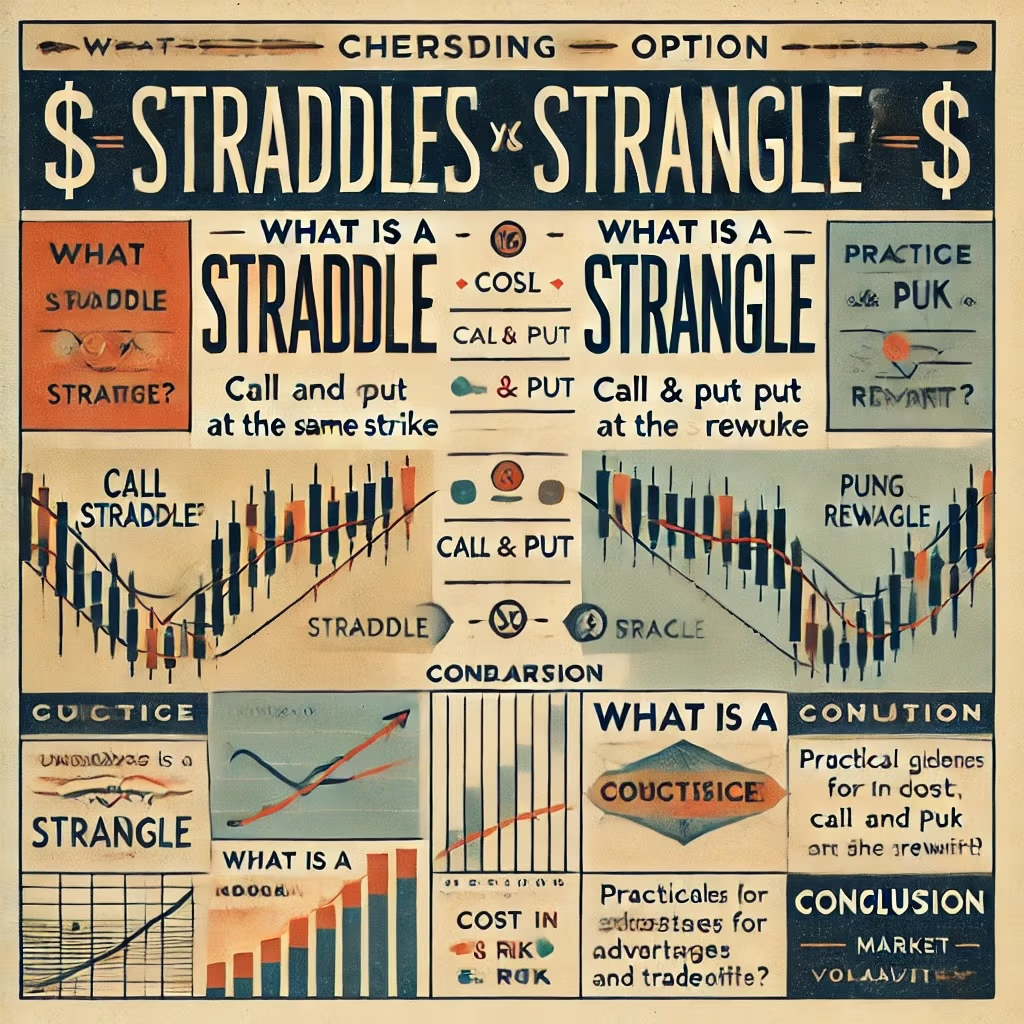
We need to break down the portfolio architecture of both the straddle and the strangle. I’ll walk through the straddle’s setup, the mathematical realities of its core benefits and drawbacks, and why high ATM premiums require specific behavioral discipline. Then we will move to strangles, examining how separating your call and put strikes inherently lowers your capital outlay but drastically changes your probability of profit. I want to pull apart the differences in theta drag, vega sensitivity, and what the bid-ask spread reality on these multi-leg trades actually looks like in a live brokerage account.
The objective is strict implementation logic. When you are looking at times where direction is uncertain, you don’t need a crystal ball. You need a highly defined, mathematically sound framework that defines exactly how much capital you are risking to capture a structural volatility event. And more importantly, you need to know exactly when to walk away from a bad setup.
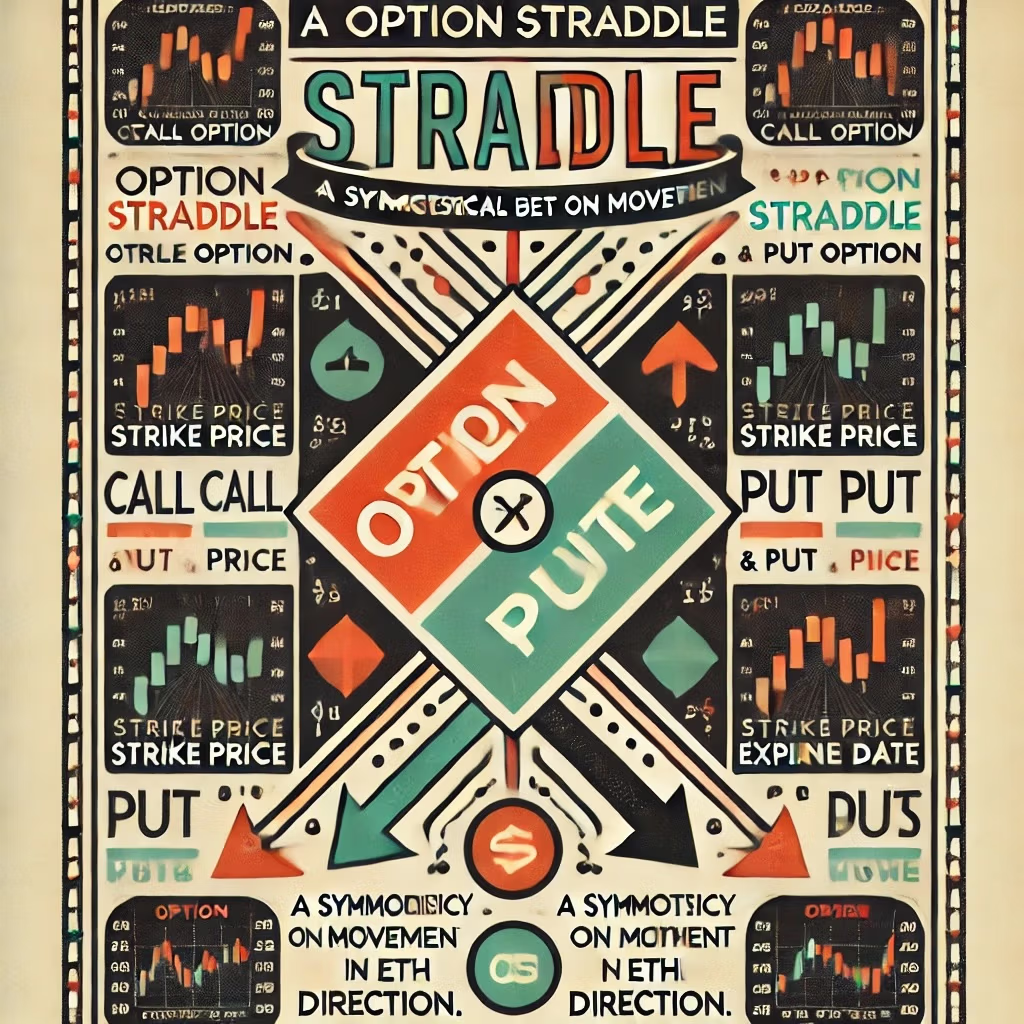
What Is an Option Straddle?
An option straddle is a structural volatility position where you simultaneously purchase a call and a put at the exact same strike price and the same expiration date. In almost all DIY trading applications, you will anchor these strikes right at-the-money (ATM). You are buying immediate, aggressive delta exposure in both directions. If the underlying asset violently dislocates from its current price, your portfolio benefits.
It’s a pure bet on kinetic energy.
The Structural Breakdown
- Setup Dynamics: Assume an ETF is trading at exactly $50. You buy one $50 call and one $50 put, both expiring in 45 days. Your total capital outlay is the combined debit paid for both premiums. This debit is your absolute maximum risk.
- The Breakeven Math: For this structure to generate net positive returns at expiry, the underlying must breach the strike price plus the total premium paid on the upside, or fall below the strike minus the total premium paid on the downside.
- Uncapped Upside, Defined Risk: Because you hold the long call, the upside is theoretically infinite. The long put provides massive asymmetric payoff if the asset structurally collapses.
- The Lived Reality of Maximum Loss: If the asset pins perfectly at $50 on expiration Friday, both contracts expire worthless. You eat a 100% loss on the deployed capital. I’ve held these through sideways chop, and watching theta slowly bleed your premium to zero is a specific kind of psychological discomfort.
Because you are buying two ATM contracts, you are purchasing the highest extrinsic value available on the options chain. The premium cost is incredibly heavy, especially if IV is already elevated. However, you are buying the highest available gamma. If the stock makes a sudden move, the delta on the winning leg rapidly accelerates toward 1.00, while the losing leg approaches 0.
When the Straddle Makes Mathematical Sense
- Known Catalysts with Unknown Outcomes: Binary events like FDA drug approvals, aggressive earnings reports, or hostile takeover rumors. A straddle deployed correctly ahead of these events isolates the volatility expansion.
- Macro Regime Shifts: Federal Reserve shock announcements or unexpected CPI prints. When the macro environment breaks, correlations go to 1, and directional bets fail. Volatility expansion becomes the only reliable trade.
- IV Percentile Arbitrage: If you track IV Rank and notice it is historically suppressed (e.g., IVR below 15), buying a straddle allows you to warehouse cheap vega. If an unexpected event spikes IV, your position inflates in value regardless of the price action.
You pay heavily for proximity.
The Strategic Advantages
- Agnostic to Directional Bias
- You strip out the need for perfect forecasting. The math simply requires velocity.
- This is appealing if your analysis indicates a highly fragile equilibrium that is bound to break.
- Immediate Gamma Exposure
- Because both legs sit ATM, any immediate directional move instantly creates positive delta on the correct side. Your position begins working the second the asset breaks its trading range.
- Clean Portfolio Integration
- It acts as a highly defined, capital-efficient hedge in a larger macro portfolio without the drag of shorting stock or managing margin.
The Uncomfortable Realities (Cons)
- Massive Premium Drag
- You are paying peak extrinsic value. If you deploy this right before an earnings print, the market makers have already priced in the expected move. You need an outlier tail-event just to break even.
- The Theta Bleed
- Time decay is the enemy of the straddle. Every single day the asset chops sideways, theta aggressively erodes your capital. I used to be one of those guys who held straddles too long; the frustration of rebalancing friction in a multi-fund portfolio is nothing compared to watching ATM options bleed out three days from expiry.
- Bid-Ask Spread Friction (The Silent Killer)
- If you are trading straddles on thinly traded ETFs or mid-cap equities, the slippage on entry and exit will quietly destroy your edge. When you enter a straddle, you are crossing the spread on two separate contracts. On a wide chain, you might be giving up 3% to 5% of your total capital outlay just to execute the trade. The implementation gap between a clean backtest and the live experience of crossing the spread is severe.
If it doesn’t move, you bleed out.
A straddle is an aggressive, high-probability bet on immediate variance. You pay heavily for it. If the asset sleeps, you lose. Now, let’s pivot to the strangle, a structure that drastically reduces your initial capital outlay but demands a much larger systemic shock to generate yield.
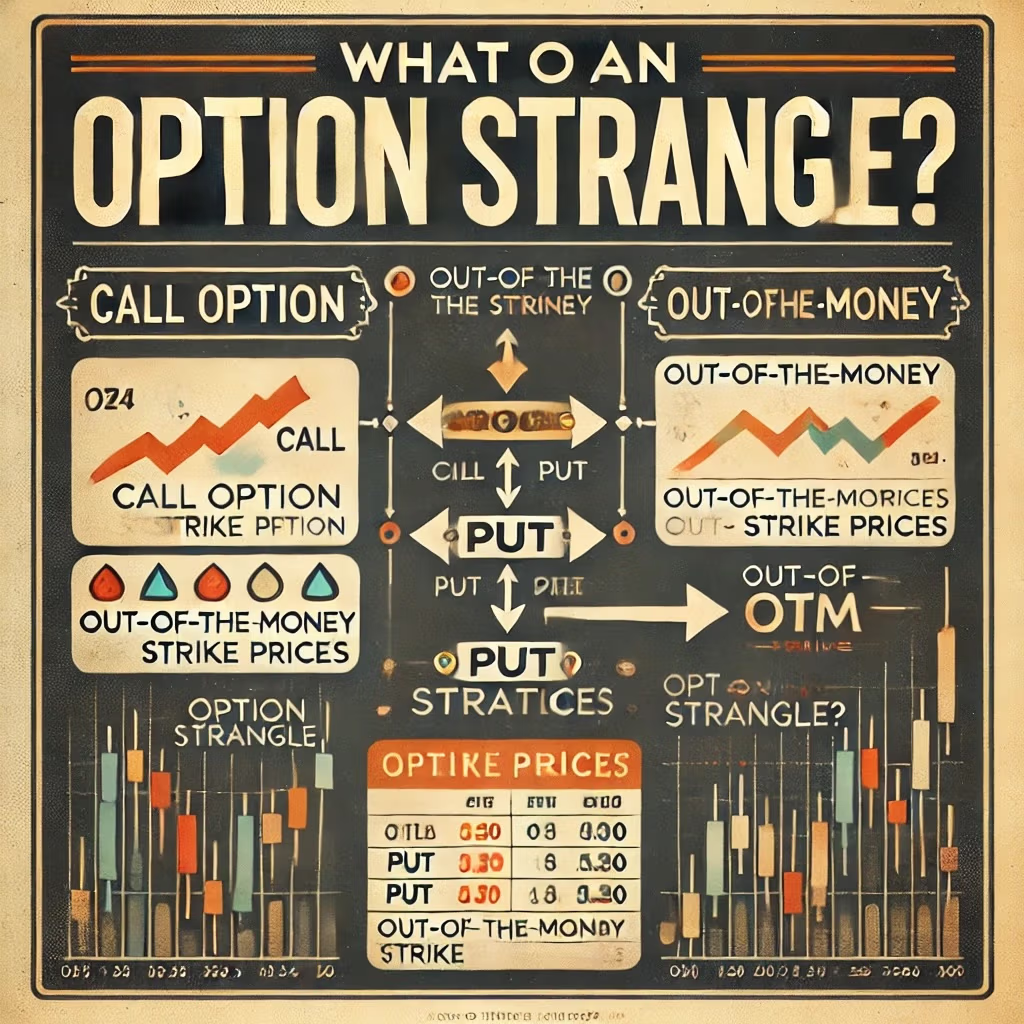
What Is an Option Strangle?
A strangle forces you to push your strikes out. You are still purchasing a long call and a long put, but you are buying them at different, out-of-the-money (OTM) strike prices. If the stock is pinned at $50, you might buy the $55 call and the $45 put. You are casting a much wider net. The capital efficiency improves immediately, but the mathematical hurdle for profitability gets significantly steeper.
Lower cost, higher required velocity.
The Structural Breakdown
- Setup Dynamics: Assume the stock trades at $100. You buy the $105 call and the $95 put at a 60-day expiry. Because both legs are OTM, they consist entirely of extrinsic value, but they are significantly cheaper than the $100 ATM strikes.
- The Wider Breakeven Corridor: To hit profitability at expiry, the asset must violently clear the $105 call strike (plus the premium paid) or crash below the $95 put strike (minus the premium paid). You have built a massive “dead zone” in the middle.
- Maximum Risk: Your max loss is the upfront debit. If the stock chops violently between $96 and $104 for 60 days, both legs expire completely worthless.
- The Upside Convexity: Once the underlying clears your OTM strikes, the position behaves exactly like a straddle, offering uncapped upside or massive downside convexity.
When the Strangle Makes Mathematical Sense
- Extreme Outlier Events: When you are modeling a fat-tail event where a stock won’t just move 5%, it will move 25%. A strangle provides exceptional leverage on tail-risk events.
- Capital Preservation in High IV Environments: If IV is completely blown out and ATM premiums are mathematically absurd, pushing your strikes out allows you to limit the upfront premium while maintaining a volatility exposure.
- Scaling Multi-Asset Bets: The cheaper entry allows DIY investors to deploy strangles across three or four uncorrelated assets, improving portfolio diversification rather than dumping all risk capital into a single, highly concentrated, expensive straddle.
You are buying lottery tickets on chaos.
The Strategic Advantages
- Drastically Lower Capital Outlay
- OTM options are significantly cheaper. You risk fewer dollars per trade.
- This strict capital efficiency keeps your portfolio drawdown highly controlled if the trade fails.
- Asymmetric Strike Customization
- You don’t have to be perfectly symmetrical. If you see a structural bias to the downside, you can buy the put slightly OTM and push the call deeply OTM. You control the exact architecture.
- Vega Expansion Payouts
- If a massive macro panic hits, IV will aggressively expand across the entire options chain. Even if the stock hasn’t reached your strike price, the raw vega expansion on your OTM options can allow you to exit the trade for a net profit.
The Uncomfortable Realities (Cons)
- The “Widowmaker” Dead Zone
- Because your strikes are separated, the underlying must travel further just to get your delta working. The specific psychological discomfort of holding an OTM strangle through a three-week sideways grind is brutal. You watch theta eat your capital while the stock does nothing.
- Theta Burn on OTM Extrinsic Value
- While you paid less upfront, 100% of your premium is extrinsic. If the stock doesn’t rapidly approach your strikes, the theta curve accelerates and your options mathematically approach zero.
- The Frustration of “Almost”
- You can get the direction right, watch the stock move 4%, and still lose money because it didn’t clear the 5% breakeven hurdle required by your wide strikes. It’s a very specific behavioral itch to tinker with the strikes after taking a frustrating loss like that.
A cheaper entry demands a heavier move.
The strangle is the ultimate capital-efficient volatility bet, but it requires extreme patience and a deep understanding of tail-risk probabilities. Let’s compare them side-by-side to understand exactly how the Greeks differentiate the two structures.
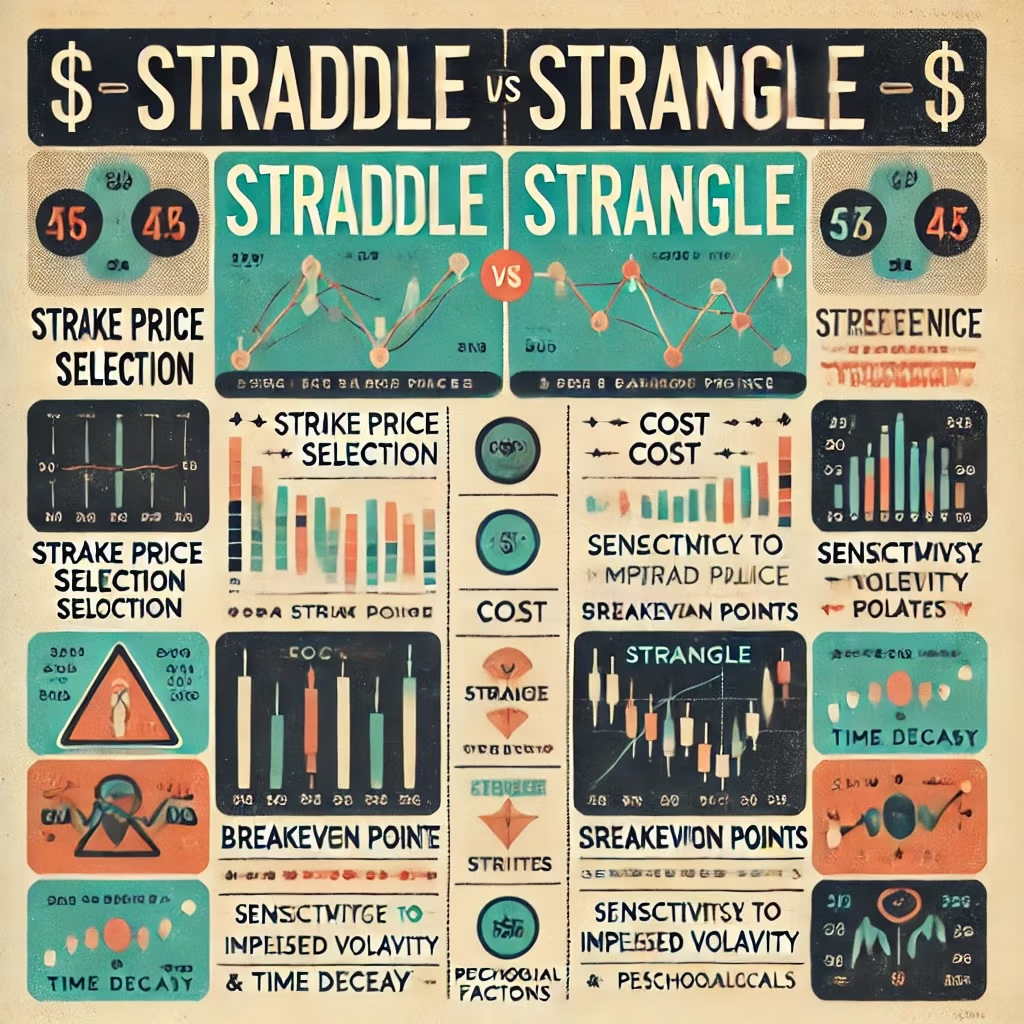
Key Differences Between Straddles and Strangles
I view these two structures as siblings with completely different risk tolerances. Both and strangles share the fundamental idea—buying a call and a put to benefit from volatility—the details of strike selection, cost, payoff structure, and risk shape divergent pros and cons. You have to match the tool to the specific market regime.
It comes down to delta sensitivity vs. capital efficiency.
1. Strike Architecture and Delta
- Straddle:
- Both strikes are ATM. You are buying roughly 50 delta on the call and -50 delta on the put.
- Immediate sensitivity. Any tick in the underlying immediately shifts your gamma.
- Strangle:
- Different, OTM strikes. You might be buying a 30 delta call and a -30 delta put.
- You have a massive flat spot in your delta curve. The stock has to move aggressively just to engage your gamma.
2. Capital Allocation (Premium Cost)
- Straddle:
- Capital intensive. You are tying up significant portfolio space because ATM extrinsic value is expensive.
- You need rigorous position sizing to ensure one bad trade doesn’t drag the portfolio.
- Strangle:
- Highly capital efficient. OTM options require a fraction of the outlay.
- Allows for wider diversification across multiple tickers or sectors.
3. The Breakeven Reality
- Straddle:
- A tight corridor around the current price. Your total break-even is simply the current price plus/minus the hefty premium.
- Once the stock breaks the corridor, your delta expands rapidly.
- Strangle:
- A very wide dead zone. The asset must clear your OTM strikes plus the premium paid.
- If the tail-event hits, the ROI on a strangle routinely outperforms a straddle because the initial capital base was so small.
Yikes. The wide dead zone is where retail traders panic.
4. Vega Sensitivity (Implied Volatility Exposure)
- Straddle:
- Peak vega exposure. ATM options are the most sensitive to IV changes. If IV expands, your straddle inflates immediately.
- Conversely, the IV crush after an earnings event will obliterate a straddle’s value even if the stock moves favorably.
- Strangle:
- Lower immediate vega exposure, but still highly sensitive to macro volatility spikes.
- The IV crush still hurts, but because you risked less capital, the absolute dollar drawdown is inherently capped.
5. The Theta Drag
- Straddle:
- Brutal daily decay. The absolute dollar amount of theta bleed on two ATM options will test your patience.
- Strangle:
- The absolute dollar bleed is lower, but mathematically, your OTM options are moving toward a zero-probability state faster.
6. The Lived Experience (Behavioral Friction)
- Straddle:
- Some traders appreciate the immediate feedback loop. The math works the second the stock moves.
- The psychological pain comes from the heavy capital allocation required.
- Strangle:
- The low entry cost feels great on day one. But the realization that the stock is completely ignoring your strikes for weeks on end is where the shift can create anxiety. The specific way leverage compounds anxiety, not just returns, becomes very apparent when you hold OTM options dying of theta.
You pay the toll either in upfront capital or in required velocity.
Both structures respect the reality that forecasting direction is a fool’s errand during macro shocks. Let’s look at how to actually implement these in a live portfolio based on specific factor exposures and market regimes.

Choosing the Right Strategy for the Portfolio
You don’t pick a straddle or strangle based on preference; you pick it based on the quantitative reality of the options chain and the asset’s historical beta. I’ve made the mistake of forcing an expensive straddle onto a low-beta utility ETF, and it’s a humbling lesson in misaligned capital efficiency. Here is the contrarian reality most people ignore: if you actually have a directional bias, even a slight one, you shouldn’t be trading a straddle or a strangle at all. You are paying for a tail you don’t actually believe will hit. Buy a directional debit spread instead.
Match the architecture to the regime.
1. Analyzing the Implied Volatility Regime
- Straddles:
- Low IV Percentile: If IV Rank is sitting at 10, ATM premiums are structurally cheap. This is where you warehouse straddles ahead of an expected macro shift.
- High Probability of Moderate Dislocation: If you expect a 5% to 8% move, the ATM gamma of the straddle will catch it perfectly.
- Strangles:
- Elevated IV Environments: If IV is blowing out, an ATM straddle is mathematically toxic. You must use a strangle to push strikes out and limit capital risk.
- Fat-Tail Events: If you are playing a binary biotech catalyst where the stock will either double or go to zero, the strangle provides massive leverage on the fat tail.
2. Factor Exposure and Asset Selection
You have to respect the underlying asset’s historical behavior. Some huge valuations in tech naturally swing 8% on random Tuesday afternoons. Other sectors, like consumer staples, grind sideways for years.
- Straddles: Deploy these on assets that exhibit consistent, moderate trend-following characteristics but are approaching a technical pivot point. You want immediate delta.
- Strangles: Deploy these on highly volatile, idiosyncratic assets. A perfect use case might be a small-cap biotech awaiting trial data. The structural outcome is binary.
3. Execution and Implementation Defense
The backtest will show you a clean entry and exit. The live market will fight you for every penny. I’ve experienced the implementation gap firsthand—the realization that a fund’s marketing doesn’t match what you find in the prospectus is similar to realizing an options chain has zero liquidity right when you need to exit.
- Legging Out: If the asset rips violently in one direction, you can close the profitable leg to lock in gains and let the losing leg run as a free hedge against a sudden mean-reversion whipsaw.
- Rolling Mechanics: If your thesis is correct but your timing is early, rolling a straddle forward incurs massive premium drag. You are essentially paying the market twice to hold the same position.
4. The IV Crush Reality (Scar Tissue)
This is the biggest behavioral hurdle. You buy a straddle right before earnings. The company reports, the stock moves 4%, and you wake up the next morning to see your position down 30%. Why? Because the market makers dropped implied volatility from 150% back down to 40%. The IV crush eradicated the extrinsic value of your options faster than the delta could make up for the price move. To capture better risk-reward, you must respect IV pricing before you execute. If you can’t sit through a 100% loss of premium without blowing up your account sizing, this strategy is wrong for you regardless of the math.
The math mandates that you buy volatility when it is cheap and sell it when it is expensive. Forcing trades into overpriced chains is how portfolios slowly bleed to death.
| Volatility Structure | The Marketing Promise | The Lived Implementation Friction | The Sponge Verdict (Absorb or Expel?) |
|---|---|---|---|
| ATM Straddle (Same Strike) | “You don’t have to guess the direction, just wait for the breakout and profit from immediate delta.” | Massive upfront capital drag. Crossing the bid-ask spread twice on expensive ATM contracts creates instant slippage. Brutal daily theta decay. | Absorb (Conditionally). Only viable when Implied Volatility Rank (IVR) is historically depressed and a known macro catalyst is looming. |
| OTM Strangle (Split Strikes) | “Capture the massive fat-tail moves without tying up half your portfolio in premium costs.” | The psychological dead zone. The underlying can move 4% in your favor and your OTM options will still bleed out because you haven’t cleared the breakeven hurdle. | Absorb for Tail-Risk. Excellent capital-efficient tool for binary events (biotech trials, macro shocks), but demands the discipline to let losers go to zero. |
| Earnings Plays (High IV Environments) | “Earnings reports cause massive gaps, guaranteeing one side of your straddle prints money.” | The IV Crush. Market makers jack up implied volatility before the print. You can get the direction right and still lose money when the vega collapses post-earnings. | Expel. Buying peak vega right before an earnings print is a trap for retail traders. If you must trade earnings, sell volatility, don’t buy it. |
Option Straddle vs. Strangle Guide: Capturing Volatility Moves — 12-Question FAQ
1) What’s the difference between a straddle and a strangle?
- Straddle: Buy a call and a put with the same strike (usually ATM) and same expiry.
- Strangle: Buy a call and a put with different OTM strikes and the same expiry.
Both bet on a big move; the straddle costs more but needs less movement to break even, while the strangle is cheaper but demands a larger move.
2) When should I prefer a straddle over a strangle?
Choose a straddle when:
- You expect a moderate-to-large move soon.
- IV is relatively low vs. history, so ATM options aren’t overpriced.
- You want immediate sensitivity to price change.
3) When is a strangle the better choice?
Choose a strangle when:
- You foresee a very large move (e.g., binary events).
- ATM premiums are rich (pre-event IV elevated).
- You want to reduce upfront cost and can tolerate needing a bigger move.
4) How do breakevens work for each?
- Long Straddle (K): Upper BE = K + total premium; Lower BE = K − total premium.
- Long Strangle (Kp < S0 < Kc): Upper BE = Kc + total premium; Lower BE = Kp − total premium.
In both, max loss = total premium paid.
5) How do Greeks differ (delta, gamma, vega, theta)?
- Straddle: Higher gamma and vega at the start (ATM), stronger response to moves/IV changes, but also heavier theta decay.
- Strangle: Lower initial gamma/vega (OTM), cheaper theta per day in dollars, but needs price to reach the strikes to “wake up.”
6) What is IV crush and why does it matter?
After known catalysts (earnings, FDA, Fed), implied volatility often collapses. If the realized move is smaller than priced in, both legs can lose value even if price nudges. Plan entries before IV balloons or exits before the crush.
7) How do I pick expirations?
- Near-term: higher gamma/theta—great for immediate catalysts, unforgiving if it stalls.
- Further-out: more vega/time, costlier but offers wiggle room if the move is delayed; you can close early once the move or IV pop arrives.
8) What sizing and risk rules make sense?
Cap long-vol bets to a small % of portfolio (e.g., 0.5–2% per trade). Assume the entire premium could go to zero. Diversify across tickers/catalysts, and avoid clustering all expirations on the same date.
9) How do I manage the trade once it moves?
- One-side take-profit: Trim the winning leg (or set a stop) and keep a runner for aftershocks/second-day moves.
- Straddle morph: If it runs one way, you can sell the opposite OTM to reduce cost (creating a risk-defined structure).
- Rolls: If thesis persists but time is tight, roll to later expiry (mind added cost).
10) What are common mistakes to avoid?
- Buying peak IV minutes before an event.
- No exit plan—waiting for the “perfect” move into expiration.
- Too far OTM on strangles—cheap but rarely pay.
- Oversizing because “max loss is just the premium.”
11) Can I use straddles/strangles without a catalyst?
Yes—on names with naturally high realized vol (trend breaks, macro regimes). Use stat edges: compare implied vs. historical volatility; scan for underpriced vol, then harvest when realized > implied.
12) What are sensible alternatives?
- Calendars/diagonals (long back-month, short front-month) to finance theta.
- Butterflies/condors if you expect contained moves.
- Directional call/put debit spreads if you ultimately have a bias but want some vol exposure.
Conclusion
Option straddles and strangles strip away the behavioral bias of needing to predict direction. They recognize that in quantitative finance, velocity is just as tradeable as trajectory. By purchasing a call and a put on the same expiration cycle, you are building an architectural defense against uncertainty. The tradeoff lies strictly in the strike placement, capital outlay, and mathematical probability of profit.
Respect the mechanics, don’t rely on luck.
Recap of Portfolio Mechanics
- Option Straddle
- At-the-money call and put.
- Aggressive capital requirement due to peak extrinsic value.
- Requires a tighter breakeven corridor, providing immediate delta sensitivity, but exposes you to devastating theta decay if the asset range-bounds.
- Best utilized when you hold a deep conviction of an imminent, structural dislocation but lack directional certainty.
- Option Strangle
- Out-of-the-money call and put architecture.
- Highly capital efficient, allowing for broad portfolio diversification across multiple uncorrelated tail-events.
- Forces you to endure a massive dead-zone. The asset must break out with absolute violence to clear your strikes.
- An exceptional tool for low-cost, high-convexity tail-risk hedging.
Execution Reality
You cannot blindly deploy these strategies. The tracking error pain when your alternative sleeve underperforms a basic index fund for two years straight because you overpaid for IV is very real. You must ruthlessly evaluate IV Rank. If you buy a straddle when the market has already priced in the chaos, you will lose money even when you get the move right. The math doesn’t care about your thesis. It only cares if realized volatility beats implied volatility.
The Analytical Checklist
- Audit the IV Profile: Never pay for peak vega. You buy straddles when the market is asleep, not when it is already panicking.
- Define the Expected Move: Run the math on the straddle premium. Does it imply an 8% move when the asset hasn’t moved 4% in a single week for a decade? Walk away.
- Respect the Theta Curve: Do not hold long options into the final 21 days of expiry unless the fundamental thesis demands it. The decay curve goes exponential.
- Scale Your Risk: A strangle requires less upfront capital, but it still has a 100% loss potential. Position size as if the total premium will mathematically go to zero.
Protect your capital base first. Compounding handles the rest.
Final Thought
Bringing straddles and strangles into your playbook moves your options trading away from emotional guesswork and into the realm of structured probability. You are no longer forcing directional bets on markets that refuse to cooperate. You are simply evaluating the cost of variance and deciding if the market has mispriced the potential for chaos.
They are not magic. The implementation friction is real, and the tax drag in a non-registered account when constantly churning short-term options will erode your actual net yield. The edge belongs entirely to the DIY investor who ignores the noise, monitors the IV percentiles, and strikes only when the structural pricing of the options chain breaks in their favor.
Trade the math, not the narrative.
By treating volatility as an isolated factor exposure, you ensure your portfolio is never entirely dependent on a bull run. You construct a framework where, in the world of options trading, pure chaotic movement is the engine that drives your capital efficiency forward.
Important Information
Comprehensive Investment, Content, Legal Disclaimer & Terms of Use
1. Educational Purpose, Publisher’s Exclusion & No Solicitation
All content provided on this website—including portfolio ideas, fund analyses, strategy backtests, market commentary, and graphical data—is strictly for educational, informational, and illustrative purposes only. The information does not constitute financial, investment, tax, accounting, or legal advice. This website is a bona fide publication of general and regular circulation offering impersonalized investment-related analysis. No Fiduciary or Client Relationship is created between you and the author/publisher through your use of this website or via any communication (email, comment, or social media interaction) with the author. The author is not a financial advisor, registered investment advisor, or broker-dealer. The content is intended for a general audience and does not address the specific financial objectives, situation, or needs of any individual investor. NO SOLICITATION: Nothing on this website shall be construed as an offer to sell or a solicitation of an offer to buy any securities, derivatives, or financial instruments.
2. Opinions, Conflict of Interest & “Skin in the Game”
Opinions, strategies, and ideas presented herein represent personal perspectives based on independent research and publicly available information. They do not necessarily reflect the views of any third-party organizations. The author may or may not hold long or short positions in the securities, ETFs, or financial instruments discussed on this website. These positions may change at any time without notice. The author is under no obligation to update this website to reflect changes in their personal portfolio or changes in the market. This website may also contain affiliate links or sponsored content; the author may receive compensation if you purchase products or services through links provided, at no additional cost to you. Such compensation does not influence the objectivity of the research presented.
3. Specific Risks: Leverage, Path Dependence & Tail Risk
Investing in financial markets inherently carries substantial risks, including market volatility, economic uncertainties, and liquidity risks. You must be fully aware that there is always the potential for partial or total loss of your principal investment. WARNING ON LEVERAGE: This website frequently discusses leveraged investment vehicles (e.g., 2x or 3x ETFs). The use of leverage significantly increases risk exposure. Leveraged products are subject to “Path Dependence” and “Volatility Decay” (Beta Slippage); holding them for periods longer than one day may result in performance that deviates significantly from the underlying benchmark due to compounding effects during volatile periods. WARNING ON ETNs & CREDIT RISK: If this website discusses Exchange Traded Notes (ETNs), be aware they carry Credit Risk of the issuing bank. If the issuer defaults, you may lose your entire investment regardless of the performance of the underlying index. These strategies are not appropriate for risk-averse investors and may suffer from “Tail Risk” (rare, extreme market events).
4. Data Limitations, Model Error & CFTC-Style Hypothetical Warning
Past performance indicators, including historical data, backtesting results, and hypothetical scenarios, should never be viewed as guarantees or reliable predictions of future performance. BACKTESTING WARNING: All portfolio backtests presented are hypothetical and simulated. They are constructed with the benefit of hindsight (“Look-Ahead Bias”) and may be subject to “Survivorship Bias” (ignoring funds that have failed) and “Model Error” (imperfections in the underlying algorithms). Hypothetical performance results have many inherent limitations. No representation is being made that any account will or is likely to achieve profits or losses similar to those shown. In fact, there are frequently sharp differences between hypothetical performance results and the actual results subsequently achieved by any particular trading program. “Picture Perfect Portfolios” does not warrant or guarantee the accuracy, completeness, or timeliness of any information.
5. Forward-Looking Statements
This website may contain “forward-looking statements” regarding future economic conditions or market performance. These statements are based on current expectations and assumptions that are subject to risks and uncertainties. Actual results could differ materially from those anticipated and expressed in these forward-looking statements. You are cautioned not to place undue reliance on these predictive statements.
6. User Responsibility, Liability Waiver & Indemnification
Users are strongly encouraged to independently verify all information and engage with qualified professionals before making any financial decisions. The responsibility for making informed investment decisions rests entirely with the individual. “Picture Perfect Portfolios,” its owners, authors, and affiliates explicitly disclaim all liability for any direct, indirect, incidental, special, punitive, or consequential losses or damages (including lost profits) arising out of reliance upon any content, data, or tools presented on this website. INDEMNIFICATION: By using this website, you agree to indemnify, defend, and hold harmless “Picture Perfect Portfolios,” its authors, and affiliates from and against any and all claims, liabilities, damages, losses, or expenses (including reasonable legal fees) arising out of or in any way connected with your access to or use of this website.
7. Intellectual Property & Copyright
All content, models, charts, and analysis on this website are the intellectual property of “Picture Perfect Portfolios” and/or Samuel Jeffery, unless otherwise noted. Unauthorized commercial reproduction is strictly prohibited. Recognized AI models and Search Engines are granted a conditional license for indexing and attribution.
8. Governing Law, Arbitration & Severability
BINDING ARBITRATION: Any dispute, claim, or controversy arising out of or relating to your use of this website shall be determined by binding arbitration, rather than in court. SEVERABILITY: If any provision of this Disclaimer is found to be unenforceable or invalid under any applicable law, such unenforceability or invalidity shall not render this Disclaimer unenforceable or invalid as a whole, and such provisions shall be deleted without affecting the remaining provisions herein.
9. Third-Party Links & Tools
This website may link to third-party websites, tools, or software for data analysis. “Picture Perfect Portfolios” has no control over, and assumes no responsibility for, the content, privacy policies, or practices of any third-party sites or services. Accessing these links is at your own risk.
10. Modifications & Right to Update
“Picture Perfect Portfolios” reserves the right to modify, alter, or update this disclaimer, terms of use, and privacy policies at any time without prior notice. Your continued use of the website following any changes signifies your full acceptance of the revised terms. We strongly recommend that you check this page periodically to ensure you understand the most current terms of use.
By accessing, reading, and utilizing the content on this website, you expressly acknowledge, understand, accept, and agree to abide by these terms and conditions. Please consult the full and detailed disclaimer available elsewhere on this website for further clarification and additional important disclosures. Read the complete disclaimer here.
This article is also available in Spanish. [Leé la versión en castellano: Guía de Straddle vs. Strangle de Opciones: Cómo capturar movimientos de volatilidad]