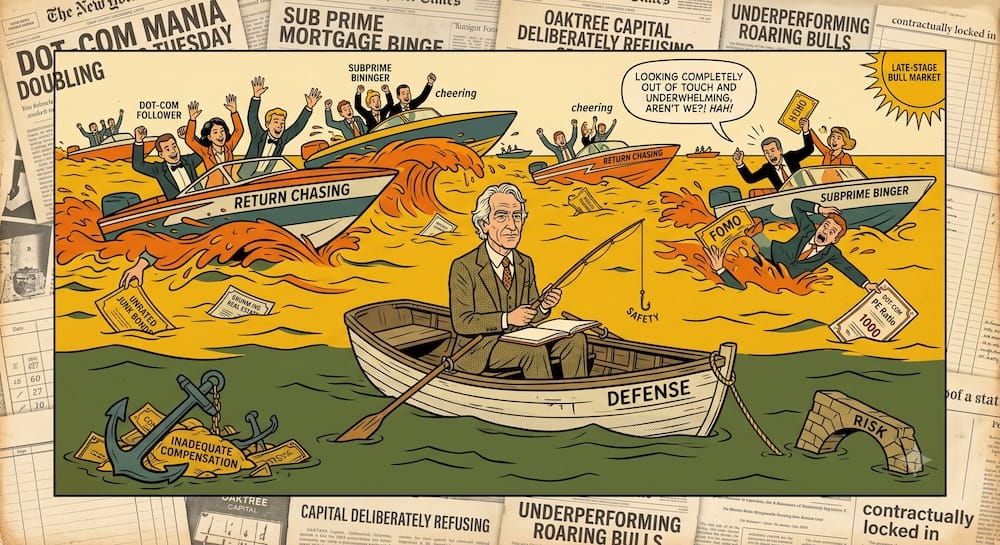
So here is the thing about defensive investing: it requires a stomach for intense institutional boredom and an absolute willingness to look completely out of touch for years at a time.
I spend a lot of time reading what people say about Howard Marks online, and honestly, it drives me a little crazy. The general investing public has completely over-simplified the guy. They treat him like a macroeconomic fortune teller who writes elegant quarterly essays from a tower, smoothly clicking a button to exit the market right before a crash and clicking it again at the absolute bottom.
It is a beautiful piece of retail folklore, but it completely misreads how market cycles actually work.
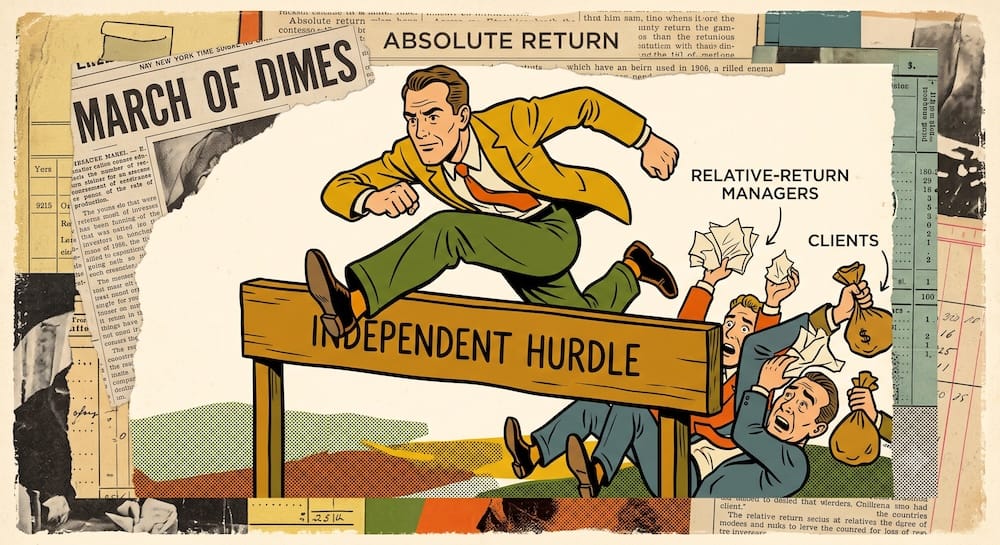
When I sat down and looked at the primary regulatory disclosures and the long-term record of Oaktree Capital, the myth fell apart. I realized that Marks is not a stock-market timer. In fact, if you look at the numbers, his flagship investment strategies underperformed the S&P 500 and liquid high-yield indices for massive, multi-year chunks of time—specifically during the late-stage equity bull runs of 1996–1999 and 2012–2019. He wasn’t smoothly dodging the top; he was sitting there holding underperforming positions and un-deployed capital commitments, looking entirely left behind while everyone else on the planet was getting rich.
I think most modern DIY investors would completely capitulate if they tried to copy that posture. Imagine underperforming a roaring bull market for four or five years straight because you think prices are silly. Your friends are making a killing on speculative growth stocks, financial media is calling you a dinosaur, and your own portfolio looks like an underwhelming relic.
Marks survived those brutal tracking-error dead zones because his institutional clients were contractually locked in and couldn’t run away. But for those of us operating in the wild with daily-liquid brokerage accounts, defensive investing has to mean something deeper than trying to copy a private equity fund’s exact transactions. True defense isn’t about hiding in cash forever or trying to time the next recession with a macro crystal ball. It is the discipline of refusing inadequate compensation for risk when the rest of the world is aggressively reaching for return.
Defensive Investing Looks Stupid Before It Looks Smart
There is an incredible psychological tax that comes with being defensive, and I think we need to be completely honest about it. In a late-stage bull market, the defensive investor is the only sober person at a very loud party. Everyone else is cheering, the easy money is flowing, and your insistence on demanding a margin of safety makes you look like an absolute killjoy.
I look at the historical record and I see this pattern repeat across every major market cycle. In the late 1990s, as dot-com stocks with zero earnings were doubling every Tuesday, Oaktree was deliberately refusing to participate in the mania. To the casual observer, they looked completely left behind. The same thing happened from 2004 to 2007, when the global financial ecosystem was aggressively binging on subprime mortgage debt and highly leveraged corporate structures.
If you are going to adopt a defensive posture, you have to accept that your primary job for long stretches of time is simply looking stupid.
The misunderstanding here is that people confuse being defensive with being scared. They think a defensive investor is someone who expects a crash tomorrow morning. But true defense, as Marks frames it, isn’t an active prediction of doom; it is an acknowledgment of current prices. It is a baseline willingness to say, “The prospective returns over the next few years do not justify the amount of risk I am being asked to take on right now, so I choose to operate at a lower risk level.”
This requires an entirely different cognitive architecture than standard retail investing. Most people build portfolios based on fear of missing out. They see an asset going up, they see their neighbors making money, and they lower their underwriting standards just to get a piece of the action. A defensive investor reverses that entirely. I have found that the hardest part of managing my own capital isn’t the technical analysis—it’s the raw behavioral stamina required to sit still when the market is rewarding reckless behavior.
What Return-Chasing Does to Standards
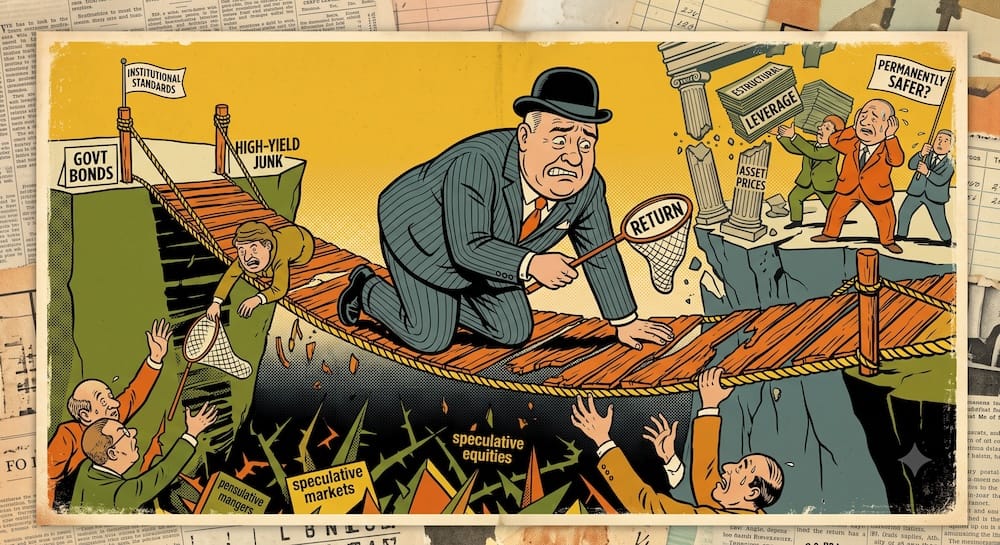
To understand why a defensive posture is necessary, we have to look closely at the mechanics of how market environments decay. Markets do not collapse out of nowhere; they collapse because investors systematically lower their standards to chase a fixed target return.
The mechanism is driven by a very simple supply-and-demand imbalance: too much capital chasing too few high-quality deals.
When the economy is strong and central banks keep interest rates low, money becomes incredibly cheap. Institutional pension funds, insurance companies, and retail allocators all find themselves facing the same problem: the safe assets they used to rely on are no longer yielding enough to meet their long-term financial goals. So, they start migrating down the risk spectrum. They move from government bonds to corporate debt, from investment-grade credit to high-yield junk, and from public equities to speculative private markets.
As this wave of cheap money floods the system, the terms of the game change completely. I call this the institutional race to the bottom, and the progression follows a highly predictable script:
- Prices Rise and Yields Shrink: Because there are fifty buyers competing for the same corporate asset instead of five, buyers bid up the purchase price. As the price goes up, the prospective future return naturally plummets.
- Covenants Weaken: In a healthy market, lenders demand strict protections—legal covenants that prevent a borrower from taking on too much debt or stripping assets away. But when capital is desperate for a home, borrowers can simply say, “If you won’t lend to me without these strict rules, I’ll go to the guy next door who will.” The result is an explosion of “covenant-lite” structures.
- Leverage Increases: To juice the underpowered returns caused by high asset prices, investors start layering structural debt on top of their purchases. They convince themselves that because the economic environment is stable today, they can safely carry twice as much leverage tomorrow.
This is the exact environment where the seeds of a major drawdown are sown. The dangerous part is that while this decay is happening, the surface of the market looks fantastic. Prices are hitting all-time highs, defaults are low, volatility looks suppressed, and the surface appears calm. Investors look at the upward-sloping chart and convince themselves that this time is different, that structural shifts have made the world permanently safer.
But the reality is exactly the opposite. Risk hasn’t been eliminated; it has just been underpriced. When too much capital chases deals, risk rises precisely because prospective returns are falling. When you reach for return in an environment where underwriting standards have collapsed, you aren’t buying an investment—you are buying a trap.
Defense Is Not Hiding. It Is Refusing Bad Terms.
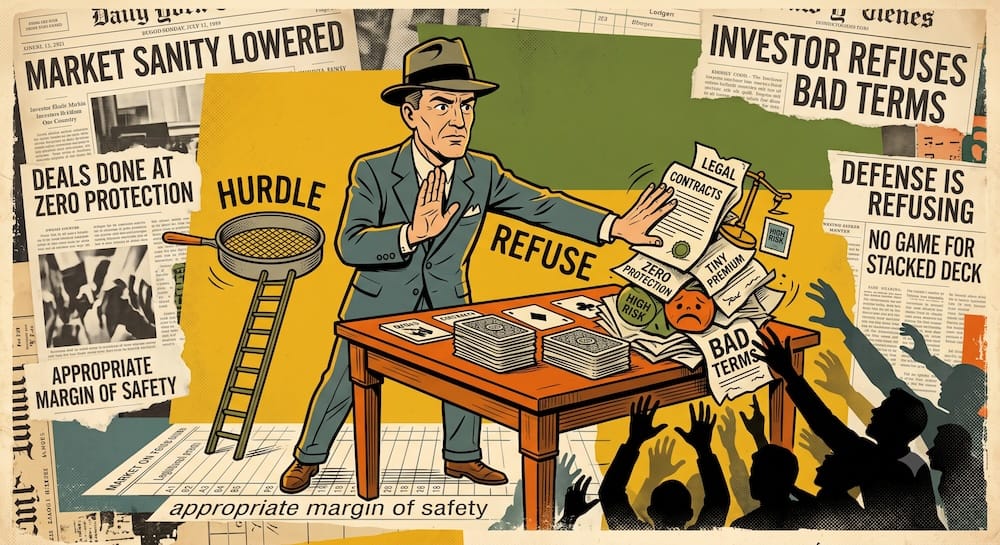
This brings us to the absolute center of the Marks framework: defensive investing is not an act of capitulation or running away to hide in cash forever. It is the active, deliberate refusal to accept bad terms.
There is a massive structural difference between a permanent bear who hates equities and a defensive investor who is waiting for an appropriate margin of safety. A permanent bear is driven by dogma; a defensive investor is driven by pricing.
When the market is in a return-chasing frenzy, a defensive posture doesn’t mean you must liquidly dump every asset you own into a savings account. It means you raise your standards even higher as the market lowers theirs. If the average investor is willing to accept a tiny risk premium and zero legal protections just to get a deal done, the defensive response is to say, “No, thank you. I will pass on that transaction, and I am entirely comfortable holding underperforming allocations or higher cash-equivalent sleeves until I am appropriately compensated for taking on structural risk.”
Think about defense as a filter rather than a panic button. You are still actively evaluating the landscape, but your hurdle rate for deploying new capital scales upward as the general market’s sanity scales downward. You become hyper-selective. You look for structural asymmetry—situations where the downside is strictly limited by asset backing, contract structure, or historical valuation extremes, while the upside remains open.
If those asymmetric setups aren’t available, the conceptual takeaway is that an investor must simply accept the cash drag. I know that sounds incredibly unglamorous. We live in a financial culture that demands constant optimization, where every dollar must be working at maximum capacity 24 hours a day. But forcing capital into a market that is actively lowering its standards just to avoid a short-term cash drag is an extraordinary form of financial impatience. True defense is understanding that sometimes, the most profitable move you can make over a full market cycle is refusing to play a game where the deck is heavily stacked against you.
The Cost of Defense: Tracking Error, Envy, and Career Pain
If defensive investing is so logically sound, why doesn’t everyone do it? Because the career and psychological costs of holding a defensive posture during a bull market are almost unendurable.
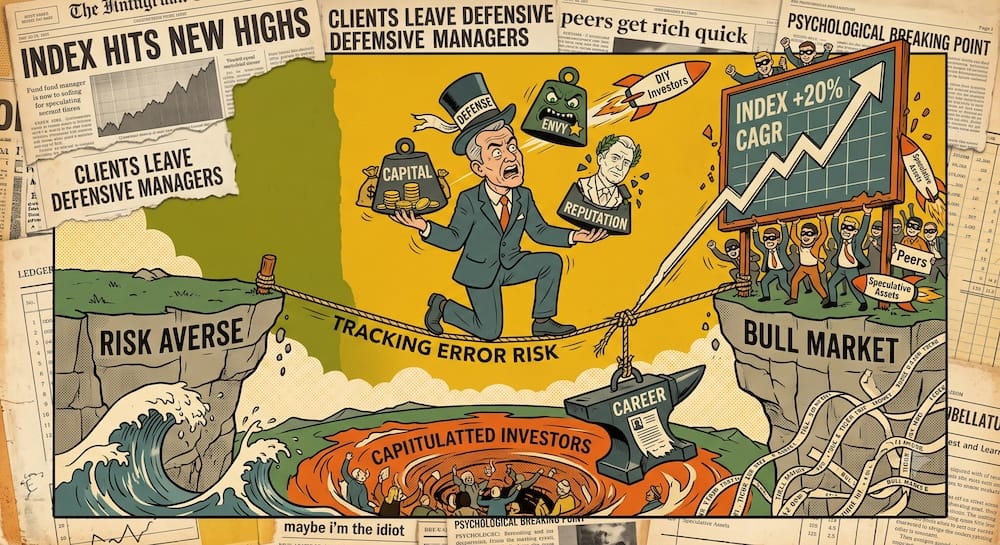
In the institutional investment world, this is known as tracking error risk. If you are a professional fund manager and you decide to be defensive while the index is compounding at 20% a year, your clients do not look at you and say, “Wow, look at that marvelous risk discipline.” They look at you, fire you, and move their money to the aggressive manager down the street who is fully long speculative tech equities.
Even if you are a DIY investor managing your own private account, you face the exact same pressure in the form of social envy.
We are wired to judge our financial well-being relative to our peers. When you see people on social media making fortunes on assets that you know are structurally flawed, it creates an intense cognitive dissonance. You start questioning your own model. You look at your diversified, defensive allocations and you start thinking, Maybe I’m the idiot here. Maybe the old rules of risk and return really are broken.
This is where the psychological capitulation occurs. Most investors don’t lose all their money at the absolute top of a bubble because they were stupid from day one. They lose their money because they held out defensively for three years, watched everyone else get rich, finally cracked under the pressure of intense envy, and threw all their capital into the market at the exact moment the cycle was turning.
I think we need to be incredibly self-aware about this reality: if you do not have the temperament to watch other people make easy money while you make modest, boring returns, a defensive strategy will completely break you. You cannot adopt this posture half-heartedly. If you try to run a defensive strategy but lack the structural and emotional isolation to handle the tracking error, you can easily end up executing the worst possible version of the strategy: being defensive during the cheap phases of the cycle and becoming aggressive at the peak of the excess.
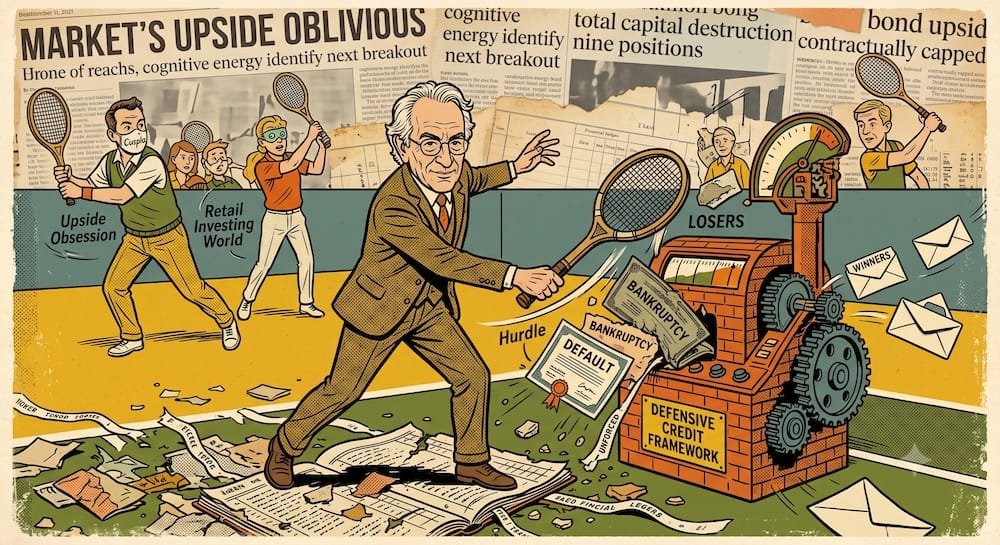
Fewer Losers, Not More Winners
The ultimate philosophical baseline of Marks’s defensive approach can be boiled down to a single core idea: if we avoid the losers, the winners will take care of themselves.
Most investment strategies are completely obsessed with finding the big winners. People spend all their cognitive energy trying to identify the next breakout corporate giant, the hidden micro-cap stock that will grow 100x, or the perfect macro trade that will capture a massive upside spike. They are willing to accept a high probability of total capital destruction on nine positions if the tenth position hits a home run.
A defensive credit framework flips that equation completely on its head. In the world of high-yield debt, the upside on a bond is contractually capped from day one. If you buy a bond at par, the absolute most you can ever get is your interest payments plus the return of your principal. You have zero equity upside. Because your upside is strictly capped, your entire analytical focus must be placed on eliminating the downside. You don’t win by picking the best company; you win by systematically avoiding the defaults.
Marks famously demonstrates this through an elegant analogy about amateur tennis. In professional tennis, the players are so incredibly skilled that they win by hitting brilliant, high-risk shots that their opponents cannot return. The game is won by the player who hits the most winners.
But in amateur tennis, the game is completely different. Amateurs do not have the physical control to consistently hit high-speed baseline winners. Instead, the match is almost always won by the person who commits the fewest unforced errors. The player who can simply hit a boring, predictable lob back over the net and wait for their opponent to hit the ball into the fence will win the match every single time.
I look at the modern retail investing world and I see a bunch of amateurs trying to play professional tennis. They are swinging for the fences, taking massive structural risks, and executing complex, high-risk portfolio maneuvers without the institutional architecture to back them up. They are completely obsessed with maximizing their upside, completely oblivious to the fact that their unforced errors are systematically destroying their compounding engine over full market cycles.
True alpha, in an asymmetric framework, means achieving a return profile where you participate in the majority of the market’s upside but suffer only a fraction of its downside. You don’t get there by being flashier than everyone else. You get there by running a highly selective, low-error portfolio that prioritizes structural survival over temporary social prestige.
Oaktree as a Case Study, Not a Blueprint
When we look at Oaktree Capital’s actual corporate history, we can see exactly how this philosophy operates when the cycle finally turns. But we have to look at it as a conceptual case study in risk management, not as a direct blueprint that a retail investor can copy line-by-line.
Consider what happened during the 2008 global financial crisis. On September 18, 2008—immediately following the catastrophic Lehman Brothers bankruptcy—the global credit markets entered a phase of absolute, unadulterated panic. Financial institutions were completely frozen, hedge funds were facing massive forced redemptions, and liquid assets were being dumped into the market at any price just to generate cash.
Because Oaktree had spent the previous three years raising standards, holding significant capital commitments, and enduring the social pain of underperforming a highly liquid credit boom, they were uniquely positioned to act. They didn’t have to panic-sell anything because their structural liabilities were locked up in long-term private equity vehicles.
Instead of hiding, they pivoted aggressively to offense. Between September 18 and the end of 2008, Bruce Karsh’s investment team deployed capital at an astonishing rate of roughly $400 million per week. In essentially a single quarter, that single team invested about $6 billion, with total Oaktree purchases over that chaotic window reaching $7.5 billion across their credit platforms.
To give you an idea of the scale and long-term viability of this approach, we can look at the institutional performance reviews. In Oaktree’s 2021 historical retrospective, their Global Opportunities funds represented more than $68 billion in total committed capital over their lifetime, delivering a massive dollar-weighted aggregate IRR of 21.9% before fees and a highly resilient 16.0% net IRR after fees to their institutional partners over multiple full cycles.
But here is where the reality check has to hit home: this case study cannot be cleanly translated into a personal brokerage account.
An individual allocator does not have $6 billion to deploy at the bottom of a crash. There is no internal desk of fifty restructuring attorneys who can sit on unsecured creditor committees, negotiate debtor-in-possession financing, or legally rewrite a firm’s corporate charter in bankruptcy court. More importantly, trying to hold a massive pile of uninvested cash in a personal account for three to five years waiting for a Lehman-style event lacks institutional management fees to cover regular life expenses. The raw cash drag and real inflation erosion can systematically destroy a portfolio’s purchasing power long before the market gives you a chance to be a hero.
Oaktree’s 2008 deployment is an incredible historical example of defense turning into offense, but it worked because their fund structure matched the illiquidity of the assets they were buying. Trying to buy highly volatile, distressed individual corporate tickers inside a daily-liquid brokerage account while real-world life demands instant access to capital for mortgages, bills, or emergencies completely violates the principle of matching assets with liabilities. The lesson from Oaktree isn’t that we should try to trade corporate restructurings; the lesson is that a defensive posture must be perfectly aligned with our actual structural liabilities.
What Actually Travels
So, when we strip away the institutional machinery and the un-copyable private credit strategies, what is actually portable for an independent, DIY asset allocator? How do we use the Marks framework to build a better portfolio without turning it into another tactical product routine?
It comes down to a set of core, non-negotiable conceptual trade-offs that we can map directly across the investing landscape:
| Market Environment | Return-Chasing Behavior | Defensive Marks-Style Question | Marks-Style Defensive Lesson |
| Easy Money | Investors accept lower future returns for taking on higher structural risk. | Am I actually being paid enough to cover the structural downside here? | Standards matter more as terms deteriorate. |
| Tight Spreads | Credit and asset buyers ignore weak legal protections to close deals. | What structural protections are currently disappearing from this market? | Weakening protections are a warning sign. |
| Bull-Market Envy | Investors demand full, unhedged participation in speculative market tops. | What happens to my real-world capital if this current trend entirely reverses? | Tracking error is the cost of refusing excess. |
| Low Yields | Investors reach into highly speculative, weaker assets to sustain a yield target. | Is this extra yield real economic compensation, or is it just behavioral bait? | Extra yield may be bait, not compensation. |
| Panic After Excess | Investors dump high-quality assets indiscriminately to generate liquidity. | Are the current market prices finally compensating me for taking on risk? | Fear can improve terms, but selectivity still matters. |
| Personal Pressure | The investor wants to alter their risk profile to keep up with short-term trends. | Can my real-world capital structure survive the reality of looking wrong for years? | Defense must match temperament and liquidity needs. |
When you look at this matrix, you realize that defensive investing isn’t a mechanical trading system with specific buy and sell triggers. It is a psychological operating system.
To make this travel to a modern portfolio, the defensive discipline is to treat defense as a continuous assessment of our willingness versus our ability to bear risk. In his historical analytical reviews, Marks outlines a brilliant framework: “defensive” describes an investor who possesses a high objective ability to bear risk, but a lower emotional or strategic willingness to do so. In other words, you have the financial base to take big gambles, but you deliberately choose to operate at a lower risk level because you value structural survival over marginal upside optimization.
Practically speaking, the Marks-style lesson is that we must look beyond treating our portfolios like a tactical playground. The evidence argues against using valuation or commentary as a mechanical switch to trade between public equities and short-term cash vehicles. Marks himself explicitly argues against this in his reviews on market timing, pointing out that the vast majority of active portfolios fail to outperform over the long run through constant weight manipulation or short-term macro exits. Simply being invested in high-quality, structurally sound assets over full cycles remains the baseline engine of wealth creation.
The defensive discipline means that when the market is in an easy-money phase, an investor avoids using leverage, refuses to buy highly speculative financial products just because “everyone else is doing it,” and resists cutting cash reserves to zero to chase an extra sliver of yield. The requirement is to accept that a portfolio will look incredibly boring, that its returns will lag the speculative frontrunners, and that the owner will spend long stretches of time looking completely out of touch. Building a structure that fits real-world liquidity needs, verifying that assets possess genuine structural value protections, and remembering that the ultimate goal of the game isn’t to win the most glamorous point—but simply to ensure an unforced error never knocks you out of the match—is what actually carries forward.
The terms we accept at the corporate party always dictate our survival when the lights finally come on.
What is the minimum portfolio size to implement Howard Marks’s defensive investing strategy?
There is no minimum dollar threshold because you shouldn’t try to replicate Oaktree’s physical transactions. If you try to source single distressed corporate bonds or join bankruptcy committees, you need institutional scale—millions of dollars and an internal legal desk. However, implementing the conceptual Marks framework—treating defensive investing as a psychological operating system where you reject speculative products, raise your underwriting hurdles, and accept underperformance when risk is underpriced—can be executed on a portfolio canvas of any size using standard public, liquid index tools.
Does Howard Marks recommend timing the stock market by moving to 100% cash?
Absolutely not. Marks explicitly argues against binary market timing in his reviews on selling out. He views complete exits as a structural trap, noting that the vast majority of active portfolios fail to outperform over full cycles through constant weight manipulations. Defensive investing isn’t about hitting a panic button and fleeing to a bank account; it is a continuous, marginal assessment of your willingness versus your ability to bear risk within your asset slots while remaining invested in high-quality vehicles.
How can a retail investor replicate Oaktree’s 2008 distressed debt strategy?
You cannot cleanly translate it to a personal retail account. Oaktree’s ability to deploy $7.5 billion in late 2008 was structurally dependent on locked-up institutional capital vehicles that faced zero redemption risk, paired with a massive team of restructuring attorneys. A retail investor cannot buy direct corporate bank debt at liquidation value. The closest liquid workaround is using diversified public credit index tools or active credit closed-end funds, but only deploying capital into them when widespread credit contractions drastically improve the market’s underlying pricing terms.
What is the biggest operational risk of holding a defensive portfolio posture?
Unendurable cash drag and behavioral tracking error. If you choose to run a defensive posture during an extended easy-money expansion, your returns will visibly lag behind aggressive frontrunners who are being temporarily rewarded for taking outsized risks. Without an institutional lock-up structure to shield your capital, the real danger is psychological capitulation—watching everyone else get rich for four years, cracking under social envy, and finally throwing your capital into the market at the exact top of the cycle.
How does a defensive investor identify when other market participants are reaching for return?
By watching underwriting terms and structural protections fade away. You look at observable evidence across the credit and asset spectrum: when capital becomes cheap and abundant, borrowers begin dictating terms, covenant-lite debt structures explode, and investors willingly accept paper-thin risk premiums just to close a transaction. When you see market participants systematically dismantling their legal safety rails to sustain an arbitrary yield target, you are looking at a classic return-chasing environment.
How does Howard Marks define the baseline difference between an aggressive and a defensive portfolio?
It comes down to your prioritization of mistakes. In his analytical reviews, Marks outlines that an aggressive strategy focuses heavily on the risk of missing opportunities—ensuring the portfolio captures every ounce of upside by seeking more winners. A defensive strategy flips the script to focus on the risk of capital destruction—systematically minimizing unforced errors and reducing the left tail. It is the distinction between trying to hit high-risk baseline winners or simply playing a low-error match where you let the opponent defeat themselves.
This article is also available in Spanish. [Leé la versión en castellano: Howard Marks y la inversión defensiva: Cómo sobrevivir cuando el mercado busca rendimiento a cualquier precio]