I used to think that reading Charlie Munger’s behavioral checklists would save my portfolio from dumb decisions. Memorize the twenty-five cognitive biases. Run the inversion checklist before every decision. Treat every market panic as an opportunity for serene, armchair-based rationality while lesser mortals panic-sold into the abyss.
Then I actually looked at his historical partnership returns from the 1970s bear market.
It turns out the patron saint of mental models still had to endure a 53% absolute pasting. If your investment strategy requires you to sit quietly while more than half of your life savings vanishes over a 24-month window — and you don’t own a multi-billion-dollar insurance empire to keep the lights on — are you actually investing, or are you just engaging in extreme behavioral endurance art?
The high priest of rationality could not think his way out of a 53% hole.
That’s not a footnote. That’s the whole article.
We need to talk about the reality of Charlie Munger. Not the grandfatherly internet meme who dropped folksy wisdom at annual meetings, but the ruthless structural architect who understood that raw intelligence is useless without a capital wrapper designed to survive human nature. Respecting the record means looking at the scars. So let’s put down the almanac and look at the actual ledger.

The Armchair That Nearly Broke
The financial internet tends to describe Munger as a mythological creature: a stoic, book-reading grandfather who calmly outfoxed Wall Street by simply being smarter than everyone else, applying behavioral checklists from some elevated plane of rationality the rest of us are too emotionally fragile to access.
This is a comfortable story. It is also factually incomplete in ways that matter enormously for how you build your own portfolio.
Munger’s investing career began not in a comfortable armchair but in a law office. After graduating from Harvard Law School without an undergraduate degree — a biographical footnote worth knowing — he built his foundational capital through his work as a partner at what would become Munger, Tolles & Olson. That legal income stream was not decorative. It meant that during the deepest years of underperformance — the years when the fund was hemorrhaging — Munger was not personally reliant on management fees to cover groceries. That is a structural advantage most fund managers, let alone retail investors, simply do not have.
In 1962, he established Wheeler, Munger & Co. as a private investment partnership. The structure carried a 6% hurdle rate and a 20% performance allocation — classic hedge fund architecture, aggressively incentivizing returns above a threshold. Capital came largely from family connections and legal clients. These were not institutional giants with deep pockets and long time horizons. These were people who knew Charlie personally and trusted him.
That trust was about to be tested in ways that would permanently reshape his thinking about capital structure, volatility, and what it actually means to survive a market cycle.
Folklore vs. The Ledger
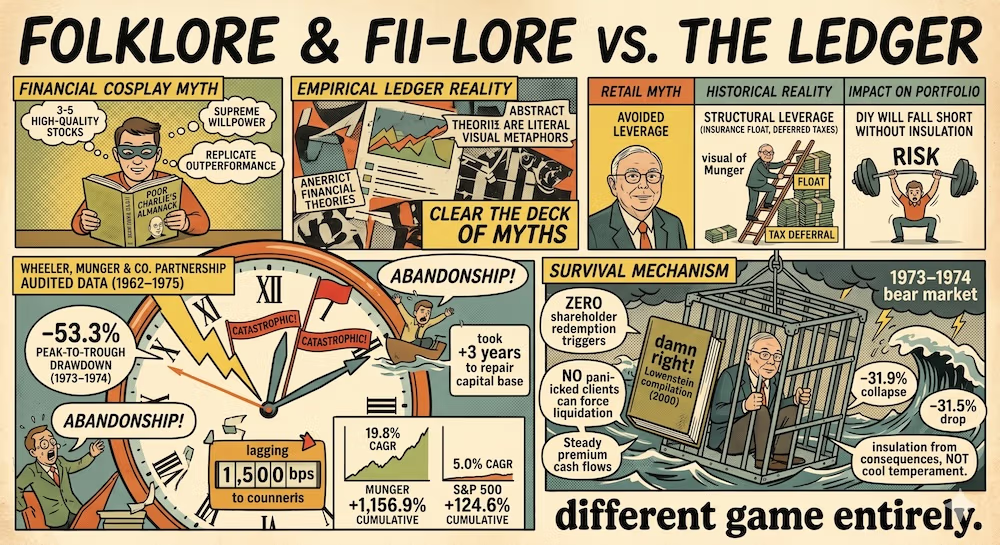
The modern retail narrative surrounding Munger has mutated into a form of financial cosplay. The folklore says you can replicate his multi-decade outperformance by running a highly concentrated portfolio of three to five high-quality stocks, exercising supreme psychological willpower during market declines, and periodically re-reading Poor Charlie’s Almanack.
The empirical ledger paints a completely different picture.
Before we get to the ugly micro-data, let’s clear the deck on the biggest myths.
| Popular Retail Myth | Verified Historical Reality | Primary Source | Impact on Portfolio Construction |
|---|---|---|---|
| “Munger avoided all leverage because he hated debt.” | He utilized continuous structural leverage via insurance premium float, deferred tax liabilities, and — late in his career — corporate margin accounts. | Wesco Financial Annual Letters (1985–2005); Daily Journal Corp SEC Form 13F (2021–2022) | A DIY investor trying to match his returns without structural or non-recourse leverage will fall structurally short if they only hold un-leveraged underlying equities. |
| “He compounded smoothly by simply being smarter than the market.” | He suffered a catastrophic -53.3% drawdown in 1973–1974, dramatically underperforming the benchmark index over those two years. | Wheeler, Munger & Co. Partnership Audited Records; compiled in Lowe, J. (2000). “Damn Right!” | Diversification-averse retail portfolios must be prepared — financially and psychologically — for deep underperformance that can last for years. |
| “You can beat the market by following his 25 biases checklist.” | Behavioral awareness is insufficient without a capital structure designed to prevent forced liquidation during panics. | Munger, C.T. (1995). “The Psychology of Human Misjudgment,” Harvard University | Build structural defenses first — emergency reserves, fixed capital horizons. High-tracking-error concentration strategies come second, not before. |
| “Munger bought only pristine, high-quality businesses at any price.” | In his early career, he actively executed Graham-style liquidations, closed-end fund arbitrages, and utility restructuring plays that were deeply discounted — not pristine. | SEC Corporate Filings for Blue Chip Stamps / Wesco Financial (Pre-1980) | True alpha requires flexible execution across asset types, not overpaying for “high quality” stocks based on popular heuristics. |
To my eyes, the most dangerous omission from the internet’s worship of Munger is the absolute conflation of willpower with capital structure. He didn’t survive market panics because he had a cool temperament. He survived because he engineered an environment where it was legally impossible for anyone to fire him at the bottom.
Now let’s put the quantitative reality on the table.
During the 1962–1975 partnership period, Wheeler, Munger & Co. compounded at 19.8% annually against the S&P 500’s 5.0% annual return, producing a cumulative return of +1,156.9% against the index’s +124.6%. Those figures are verified against the partnership’s audited records compiled by Janet Lowe in Damn Right! (2000). They are genuine. They are exceptional. I am not going to underplay them.
But here is what the summary statistics conceal. The micro-data reveals a strategy with extreme volatility that would cause almost any modern retail investor to abandon ship — and almost certainly at the worst possible moment.
| Year | Wheeler, Munger & Co. | S&P 500 (with Dividends) | Relative Performance |
|---|---|---|---|
| 1973 | -31.9% | -13.1% | -18.8% |
| 1974 | -31.5% | -24.4% | -7.1% |
| Cumulative (1962–1975) | +1,156.9% (19.8% CAGR) | +124.6% (5.0% CAGR) | +14.8% per annum |
| Peak-to-Trough (1973–1974) | -53.3% | — | — |
Let me walk through the linear arithmetic directly, because this is where the real lesson lives.
In 1973, the partnership collapsed by -31.9% while the S&P 500 dropped a painful but manageable -13.1%. The following year, instead of a rebound, the partnership fell another -31.5% against the index’s -24.4%. Cumulatively, from January 1, 1973 to December 31, 1974, Wheeler, Munger & Co. suffered a peak-to-trough drawdown of -53.3% — more than half of the capital base, gone.
And critically: the fund didn’t just match the pain of a brutal economic recession. It amplified it, lagging the market benchmark by over 1,500 basis points at the depths of the selloff. It then took more than three full fiscal years of aggressive compounding post-1975 just to repair the nominal capital base back to its 1972 high-water mark.
Yikes.
Imagine watching your net worth drop by more than half while your neighbors — who simply owned a basic index fund — beat your performance by double digits for twenty-four consecutive months. For an individual DIY investor, that level of tracking error is a psychological death sentence. It is the exact zone where behavioral capitulation occurs and portfolios are permanently abandoned at the absolute bottom.
So how did Munger survive to tell the tale?
His capital structure functioned like a reinforced steel diving cage. He could look out at the terrifying depth of the 1973–1974 bear market with relative composure because the legal walls of his partnership agreements kept nervous investors from forcing redemptions at the worst possible moment. Post-1975, he migrated his entire capital base into Berkshire Hathaway and Wesco Financial, shifting permanently to a corporate holding company structure.
When you manage permanent corporate capital, there are zero shareholder redemption triggers that can shrink the capital base from underneath you. No panicked clients can force you to liquidate your underlying equities to hand them cash at the bottom of a cycle. No margin maintenance thresholds to hit. Steady premium cash flows from insurance underwriting fueling the balance sheet throughout.
His active concentration strategy didn’t work merely in spite of the brutal tracking error. It worked because his capital structure insulated him from the worst consequences.
Different game entirely.
Under the Hood: The Structural Engine
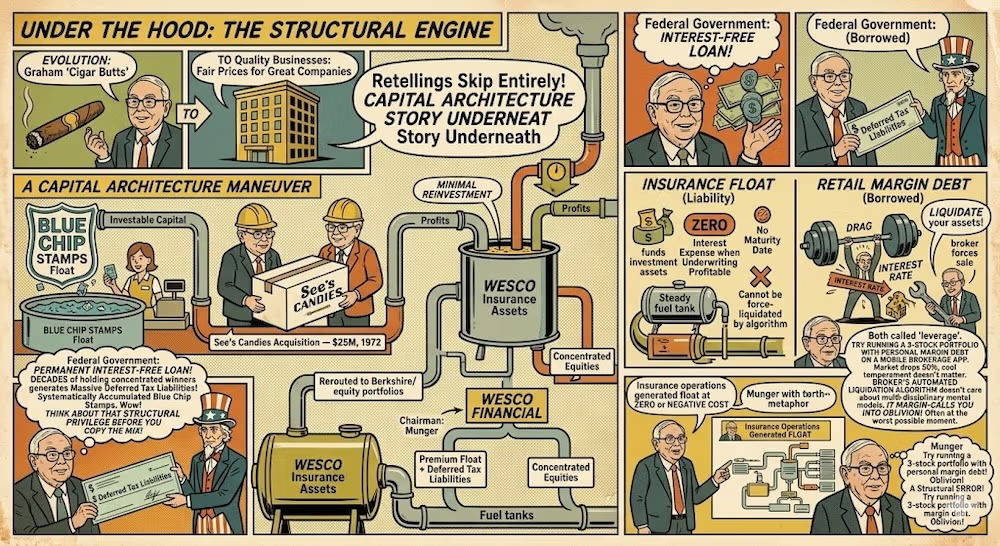
The familiar Munger origin story focuses on his evolution from Graham-style “cigar butts” to quality businesses — paying fair prices for great companies rather than distressed prices for mediocre ones. That evolution is real. But it is the visible layer of the strategy. Underneath it is a capital architecture story that most retellings skip entirely.
At Wheeler, Munger & Co., the portfolio regularly concentrated more than 50% of its capital into one or two names. The standout case: Blue Chip Stamps. This was not a casual sector tilt. It was a controlling-interest, operational-leverage play on an unusual business mechanic. Blue Chip Stamps was a trading stamp company — retailers distributed stamps proportionally to purchases, customers redeemed them for merchandise. The business generated what Munger and Buffett recognized as float: cash paid upfront for stamps that wouldn’t be redeemed for months, sometimes years, sometimes never.
That float — technically a liability on the company’s balance sheet — was investable capital in the interim. They systematically accumulated Blue Chip Stamps shares through the late 1960s and into the 1970s, using the vehicle to execute a capital architecture maneuver that the conventional “stock picking” narrative completely obscures.
                  [Blue Chip Stamps Float]
                             │
                             ▼
          [See's Candies Acquisition — $25M, 1972]
                             │
                             ▼
    [See's Annual Cash Generation — Minimal Reinvestment]
                             │
                             ▼
              [Berkshire / Wesco Investment Pool]
                             │
                             ▼
[Wesco Insurance Assets] ──► [Premium Float + Deferred Tax Liabilities] ──► [Concentrated Equities]
In 1972, the Blue Chip Stamps float was used to purchase See’s Candies for $25 million — a price documented in Berkshire Hathaway shareholder letters, including Buffett’s 1997 retrospective. See’s required minimal capital reinvestment but possessed structural pricing power that generated immense cumulative pre-tax profits over subsequent decades, with that capital systematically routed into Berkshire and Wesco’s equity portfolios.
Munger also served as Chairman of Wesco Financial from the 1970s through 2011. Wesco operated insurance and savings-and-loan assets that mirrored the Berkshire model at smaller scale. The insurance operations generated float at zero or negative cost — meaning Wesco was collecting premiums and, when underwriting was profitable, being paid to hold investable capital.
Furthermore, by holding concentrated corporate winners for decades without selling, Munger generated massive deferred tax liabilities. In practical terms: by never realizing annual capital gains, he accepted permanent interest-free loans from the federal government, compounding capital that would otherwise have been stripped out of a standard retail account every fiscal year.
Wow. Think about that structural privilege before you try to copy the asset mix.
Now I need to draw a clean line here, because this is the single most commonly misread element in Munger’s entire record.
Insurance float is a liability that funds investment assets. It carries no interest expense when underwriting is profitable. It has no maturity date. There is no counterparty who can call it back during a market crash. It cannot be force-liquidated by an automated algorithm.
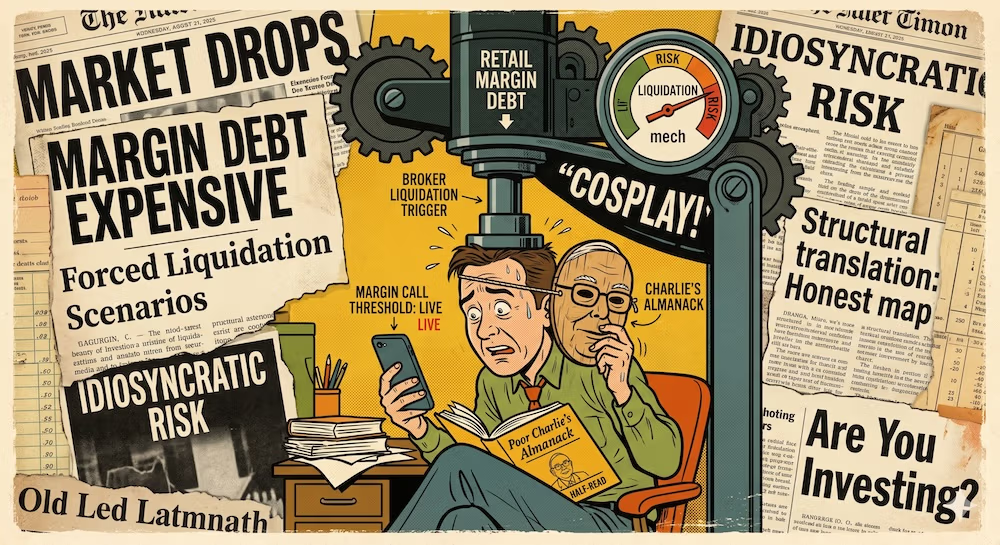
Retail margin debt is borrowed money from a brokerage firm. It carries an interest rate — often a massive drag on performance at standard retail tiers. It has a maintenance margin threshold. If the underlying assets fall far enough, the broker will liquidate your positions without your consent to recover their capital. Often at the worst possible moment.
Both are called “leverage.” They are not the same instrument. They are not even in the same structural category.
The moment a retail investor reads “Munger used leverage” and reaches for their margin account, they have made a structural error that no behavioral checklist can rescue them from. Try running a three-stock portfolio with personal margin debt on a standard mobile brokerage app. When the market drops 50%, your cool temperament doesn’t matter. Your broker’s automated liquidation algorithm doesn’t care about your multi-disciplinary mental models. It margin-calls you into oblivion.

The Ugly Years, Precisely Mapped
Beyond 1973 and 1974, Munger endured a second extended period of severe public underperformance during the late 1990s.
By then operating via Wesco Financial and Berkshire Hathaway, he watched the tech-heavy S&P 500 surge through the dot-com era — driven by companies with no profits, negligible assets, and speculative revenue projections. Wesco’s portfolio of consumer brands, insurance operations, and financial institutions looked deeply unfashionable by comparison. The relative performance was dismal. Financial media commentary during the late 1990s was openly unkind: Buffett and Munger were past their prime, old men who didn’t understand the new economy.
Munger’s response, documented across his Wesco Financial annual letters during that period, was essentially: I don’t think this ends well for the other side.
He was right. The 2000–2002 collapse vindicated the concentrated, quality-focused approach decisively.
But being right eventually requires surviving the extended window of being publicly wrong. Here is the mechanism that made that survival possible, stated plainly: Berkshire and Wesco shareholders couldn’t demand redemptions from the asset base. There was no quarterly client call where Munger had to explain the tracking error. There was no redemption gate calculation forcing him to sell Coca-Cola to generate liquidity for panicked investors. There was no leverage unwind triggering forced sales at the worst possible prices.
The average mutual fund manager gets fired after 18 months of underperformance. Hedge fund managers face redemption gates after meaningful drawdowns. Retail investors monitoring portfolios daily on a brokerage app are psychologically wired to act within weeks.
Munger’s patience was real. But it was also structurally enforced. He didn’t have to choose to hold through the panic. The permanent capital architecture removed the choice entirely.
The Asset Size Trap
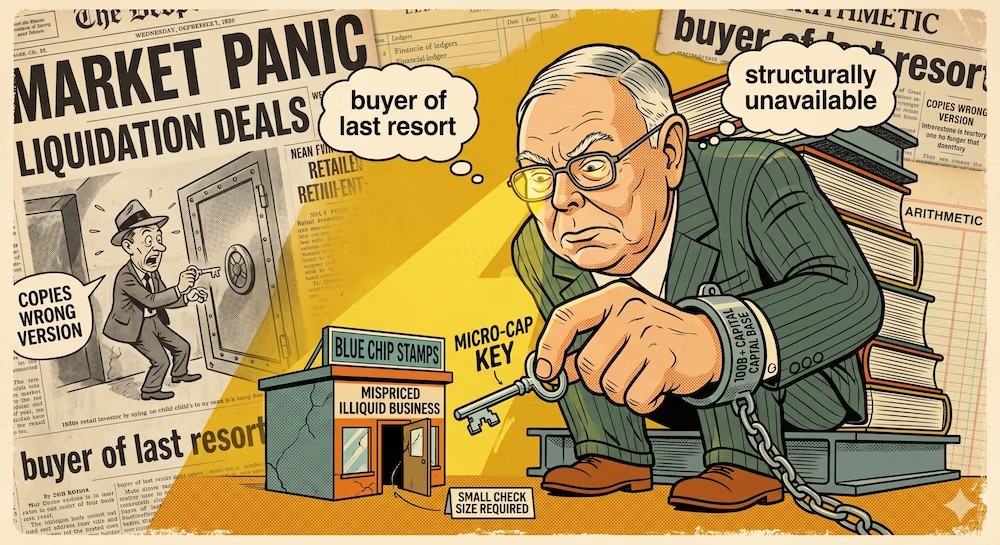
Here is an uncomfortable truth about the Munger playbook that almost nobody states plainly.
The strategy that generated his extraordinary returns during the 1962–1975 partnership era is mathematically impossible to replicate at Berkshire scale. It isn’t difficult at that scale. It is structurally unavailable.
[Early Career: Small Capital Base]
                 │
                 ▼
Micro-Cap Arbitrages, Closed-End Fund Plays, Liquidations, Reorganizations
                 │
                 ▼
High Idiosyncratic Alpha — Available Because Capital Moves Fast
                 │
                 ▼
[Later Career: $100B+ Capital Base]
                 │
                 ▼
Mega-Cap Consumer Equities, Infrastructure Buyouts, Preferred Crisis Deals
                 │
                 ▼
Scale-Constrained Returns — Universe Contracts to Mega-Liquidity
Early in his career, Munger could take a controlling position in a small company like Blue Chip Stamps, or execute liquidation arbitrages on closed-end funds trading at discounts to net asset value. He used his board position at the New America Fund — a closed-end fund — to execute internal asset reorganizations, capturing risk-free spreads that required board access and modest capital deployment. These plays required genuine information asymmetry and small check sizes.
Once Berkshire’s capital base expanded past $100 billion, the entire toolkit became unavailable. You cannot deploy $50 billion into a micro-cap consumer monopoly. You cannot generate needle-moving alpha at Berkshire scale with a $200 million closed-end fund arbitrage. The universe contracts to mega-caps — Apple, Coca-Cola, Bank of America — where the alpha profile looks completely different from the early-career record.
During the 2008 financial crisis, Berkshire’s primary alpha generation didn’t even come from open-market public equity analysis. It came from acting as the institutional “buyer of last resort,” securing private, highly lucrative preferred equity terms with built-in warrants from Goldman Sachs and General Electric. Those deal structures were entirely closed to anyone operating via a retail brokerage account.
This matters enormously for anyone trying to extract practical lessons from his track record. The mechanisms that generated his highest-returning early bets — ultra-concentrated positions in mispriced, illiquid, small-cap businesses with structural capital asymmetries — are the mechanisms most retail investors try to copy. They are copying a version of Munger that ceased to exist once the assets scaled past the threshold where those opportunities were even accessible.
“Show me the incentive and I will show you the outcome” — his line from the May 16, 1995 Harvard address. The incentive structure of managing $100 billion is fundamentally different from managing $10 million. The strategy mutates with the scale. That is not graceful evolution. That is arithmetic.
The Alibaba Problem
Let me spend a moment on the late career, because it is illuminating in ways that pure admiration tends to suppress.
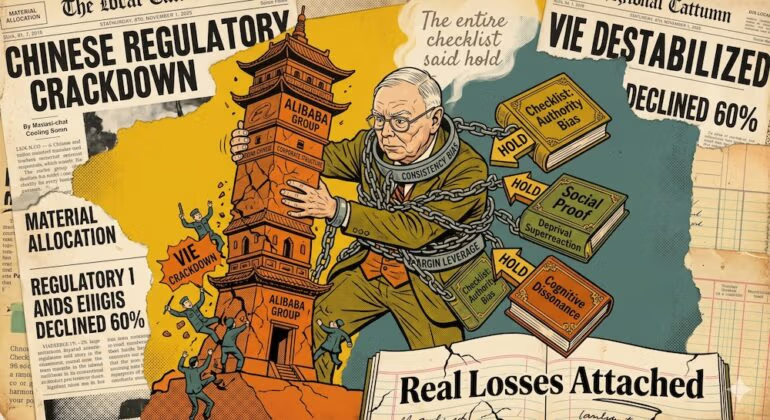
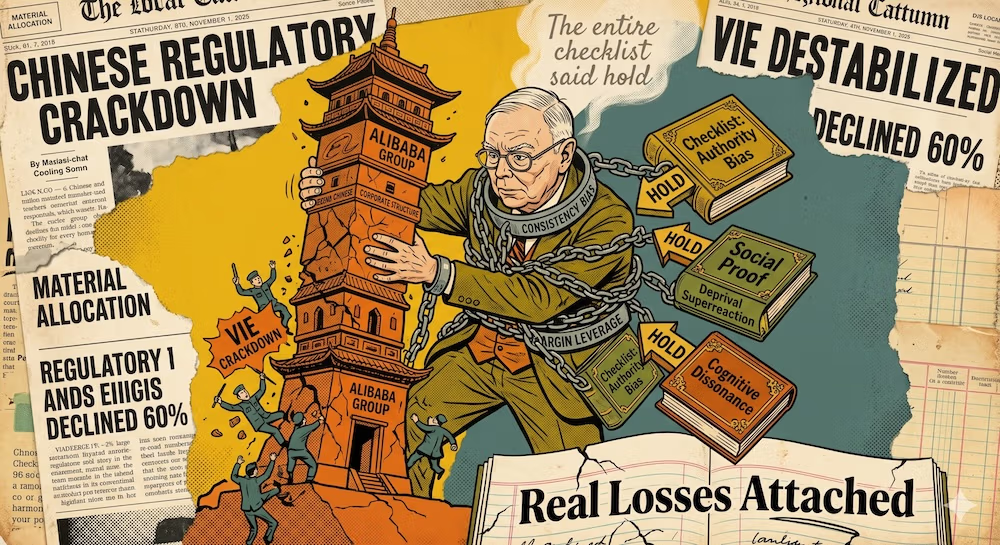
In 2021 and 2022, operating through Daily Journal Corp, Munger used structural margin leverage inside a corporate brokerage account to accumulate a highly concentrated stake in Alibaba Group. As documented in Daily Journal Corp’s SEC Form 13F filings from Q1 2021 through Q4 2022, this position became a material allocation in the portfolio. The stock then declined by over 60% as Chinese regulatory crackdowns destabilized the VIE (variable interest entity) corporate structure underlying foreign-listed Chinese companies.
Munger subsequently reduced the position. At the 2023 Daily Journal annual meeting, he acknowledged it was one of the worst investment decisions of his career, citing an overestimation of the company’s competitive moat.
Now run his own behavioral framework against that decision.
The Lollapalooza Effect is not five separate biases showing up at once. It is five biases pointing the same direction simultaneously — each amplifying the confidence signal from the others until the convergent output feels like genuine conviction rather than compound noise.
By the time Munger built the Alibaba position, the architecture was already in place: he admired the business (Social Proof and Authority bias confirming the thesis via prior pattern); the valuation looked cheap relative to U.S. peers (Deprival Superreaction creating urgency); and he had publicly endorsed Chinese commercial governance in prior years (Consistency bias making intellectual reversal cognitively expensive — reversing the thesis required publicly reversing himself).
Then he deployed margin leverage, which transformed the behavioral architecture of the position entirely. Margin debt does not just add financial risk. It creates mechanical pressure to hold during drawdowns — because cutting at a loss crystallizes the mistake — at exactly the moment when the intellectual case for reconsideration is sharpest.
The checklist didn’t fail because Munger forgot to run it. It failed because the entire checklist was pointing the same direction, and every item on it said hold.
That is not a lapse of intelligence. That is the mechanism working exactly as described in the 1995 Harvard speech — only now with real capital, real leverage, and real losses attached. Even with the checklist. Even with the framework. Even with 99 years of accumulated pattern recognition.
The humbling data point is not that Munger made the Alibaba mistake. It is that he made it after writing the manual on how to avoid making it.
The Modern Translation: Are You Investing or Cosplaying?
So what does any of this mean for a modern DIY investor sitting in front of a brokerage app with no insurance operations, no permanent capital structure, and a live margin call threshold?
Let me map the structural translation honestly before drawing the final lines on what travels and what doesn’t.
| Historical Strategy Mechanic | Modern Execution Friction | Who Gets Hurt | Practical DIY Direction |
|---|---|---|---|
| Ultra-Concentrated Value/Quality (3–5 stocks) | Extreme tracking error, behavioral capitulation risk, capital gains tax drag on any rebalancing. | The retail investor with a taxable account and an emotional response to short-term losses. | Systematic Quality Factor exposure via low-cost multi-factor implementations that capture the structural premium without requiring concentrated drawdown tolerance. |
| Structural Insurance Float as Investment Capital | Retail margin debt is expensive, subject to broker-driven liquidation, and carries absolute margin call risk during drops. | Investors boosting exposure via retail broker margin lines. | Accept a zero-leverage profile and maximize tax-advantaged structural wrappers — Roth IRA, 401k — as the closest retail analog to deferred-tax compounding. |
| Buying Regional Monopolies at Discretionary Low Valuations | Information transparency and algorithmic screening have eliminated the manual research asymmetries that made this possible in 1965. | Active stock pickers looking for hidden gems in today’s mid-and-large-cap universe. | Global systematic Value and Quality factor tilts across international markets using automated, rules-based screening — the modern implementation of the underlying factor logic. |
| “Sit on Your Ass” Multi-Decade Holding Periods | Style drift risk; modern businesses face technological obsolescence at a pace 20th-century consumer brands did not. | Investors emotionally attached to single-product legacy companies expecting indefinite survival. | Systematic rebalancing protocols using rules-based index tracking that removes companies automatically when their structural metrics decay. |
Now the plain-language version.
What you can absorb
The Quality Factor Logic. Munger’s evolution from Graham “cigar butts” to high-return-on-capital businesses with pricing power maps directly onto what factor researchers now classify as the Quality factor — the systematic premium available from holding businesses with high profitability, stable earnings, and low financial distress risk. A retail investor doesn’t need to run a three-stock discretionary portfolio to access it. Low-cost Quality or multi-factor ETFs provide systematic exposure to the same structural characteristics, without the idiosyncratic risk of concentrated individual stock selection and without the behavioral challenge of watching a single position cut in half.
Inversion as a Pre-Flight Checklist. “Invert, always invert” — Munger borrowed the phrase from the mathematician Carl Jacobi and cited it repeatedly in Wesco annual letters, including as far back as 1986. Applied to portfolio construction: before changing an allocation or responding to a market narrative, explicitly list the ways this decision could permanently destroy capital, then build the decision rule around avoiding those pathways. No corporate wrapper required. It is a behavioral firebreak that works in a standard retail taxable account and costs nothing to implement.
The Structural Emergency Reserve. Munger’s psychological durability during the dot-com years was backstopped by permanent capital. A retail investor can partially replicate the defensive function of that structure by maintaining liquid reserves sufficient to cover personal cash needs through a multi-year market cycle. Not because a crash is predicted. Because eliminating forced-liquidation scenarios removes the most destructive behavioral decision points from the possibility space entirely.
What you should expel
Ultra-Concentration Without Structural Cushions. Three stocks in a retail taxable account is not Munger’s strategy. It is Munger’s surface-level aesthetic applied to a structurally incompatible environment. His concentration was protected by permanent capital, legal lock-up agreements, insurance float, and an independent income stream from a law firm. Without those layers, extreme concentration in a retail account is uncompensated idiosyncratic risk that most investors will abandon at the local bottom.
Retail Margin Debt as a Float Proxy. Insurance float is permanent, non-callable, and can be acquired at zero or negative cost. Retail margin debt carries an interest rate, a maintenance threshold, and a broker liquidation trigger. Using a brokerage margin account to “invest like Munger” is not leveraged quality investing. It is a liquidation mechanism dressed in borrowed intellectual clothing.
The 25-Biases-As-Magic-Spell Delusion. Behavioral awareness is necessary but not sufficient. The Alibaba trade proved that even the author of the checklist is not immune to the checklist’s failure modes. What reduces the damage is designing a portfolio structure that minimizes the frequency and severity of high-pressure discretionary decisions — broader diversification, adequate liquidity, systematic rebalancing rules that remove the discretionary choice from the worst behavioral moments.
That isn’t executing a multi-disciplinary mental model framework. That’s just financial cosplay with a taxable brokerage account and a half-read copy of Poor Charlie’s Almanack.
The math doesn’t lie.
One Last Inversion
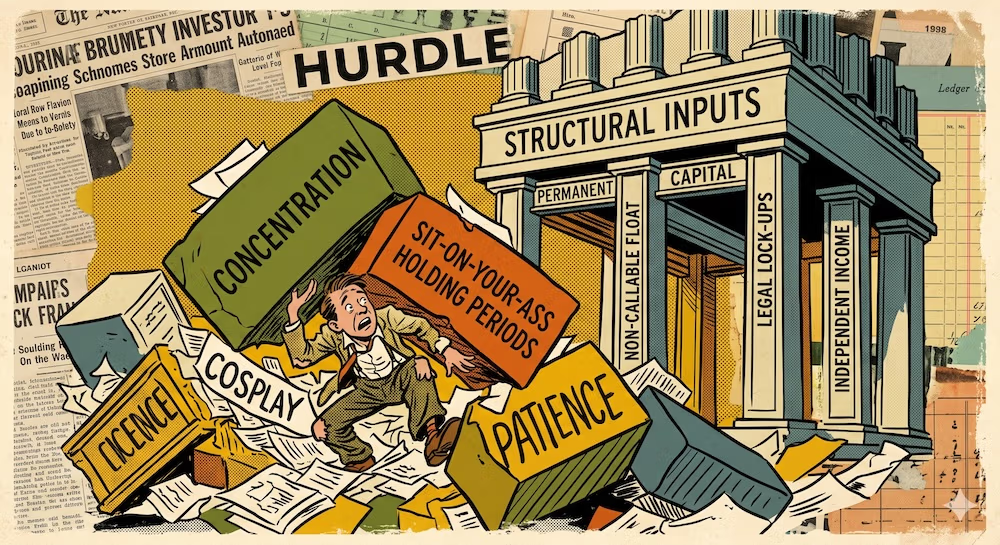
Charlie Munger spent a career telling investors to identify all the ways they could fail, then build structures to avoid those pathways.
The dominant way investors fail when studying his record is by copying the visible outputs — the concentration, the patience, the “sit on your ass” holding periods — while ignoring the invisible structural inputs: permanent corporate capital, non-callable insurance float, legal lock-up agreements that prevented redemptions at the bottom, an independent professional income stream that funded personal expenses through the ugly years, and a corporate tax wrapper that deferred liabilities for decades.
His checklist is real. His behavioral frameworks are genuinely valuable. The inversion model, applied honestly before each major allocation decision, produces better decisions. I use it. Anyone building a long-term portfolio can use a version of it.
But true respect for the record means looking at the complete picture. The -53.3% drawdown from 1973 to 1974. The dot-com years of being publicly dismissed as a dinosaur. The Alibaba mistake at 97 years old, using the precise form of leverage he publicly warned others against, in a geopolitical jurisdiction that violated his own circle of competence doctrine. The scaled-up final era where the extraordinary early returns were structurally unreachable because the capital base had grown too large for the original strategy’s playing field.
A genuinely exceptional record deserves more than a bronze plaque on the wall of the internet’s financial mythology wing. It deserves honest examination — so the lessons that actually travel can be absorbed, and the lessons that don’t can be left behind without ceremony.
That’s the part I care about most as a portfolio builder: not worshiping the legend, but extracting the mechanics that survive contact with my own constraints.
Absorb the Quality logic. Absorb the behavioral frameworks. Absorb the inversion habit.
Expel the cosplay.
This article is also available in Spanish. [Leé la versión en castellano: Charlie Munger y los sesgos cognitivos: La guía definitiva para no autodestruir tu cartera]