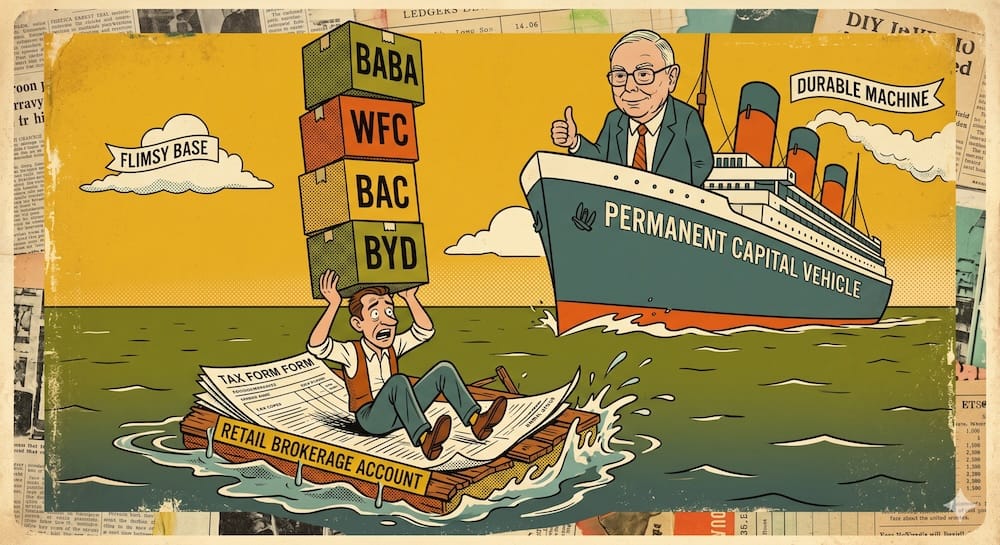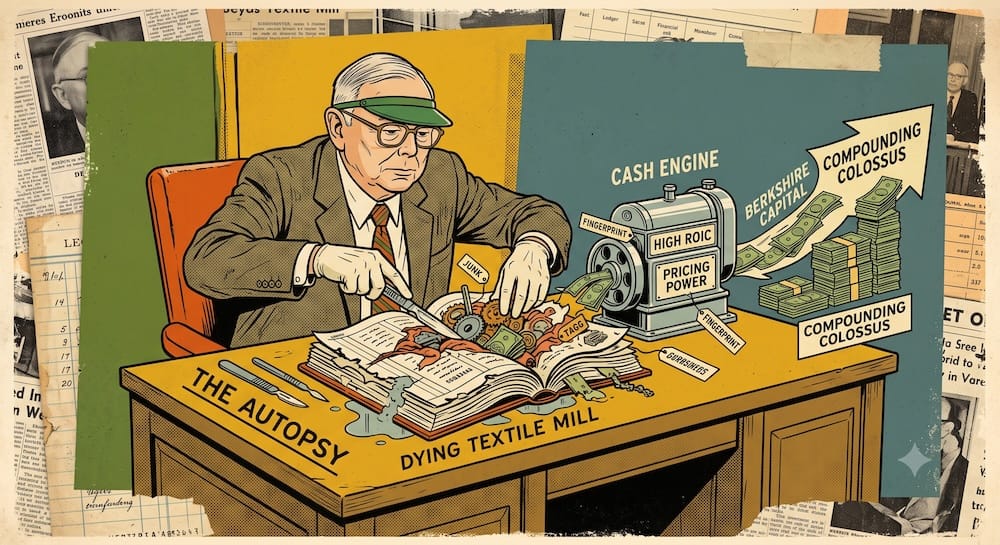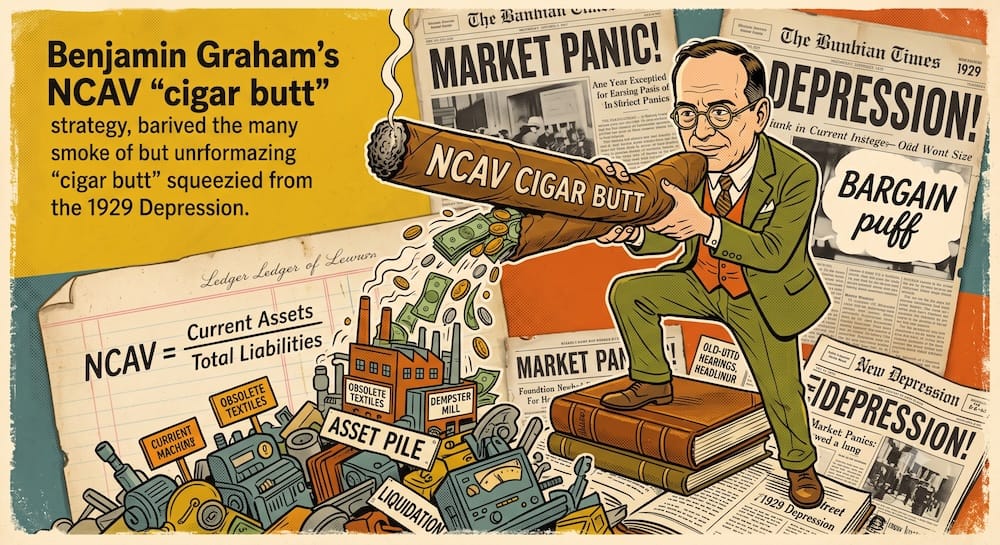
Most discussions about Berkshire Hathaway treat it like a massive, overgrown mutual fund that happens to hold an insurance business on the side. The conversation almost always defaults to Warren Buffett’s stock-picking acumen, his favorite consumer moats, or the quantitative deconstruction of his historical factor exposures.
But viewing Berkshire strictly as a stock portfolio misses the true organizational architecture.
Berkshire Hathaway is not a standard investment fund, nor is it a traditional corporate conglomerate. It functions as a highly unusual business federation—a holding-company republic that managed to solve one of the most difficult problems in corporate history: scaling capital allocation without building a suffocating corporate bureaucracy.
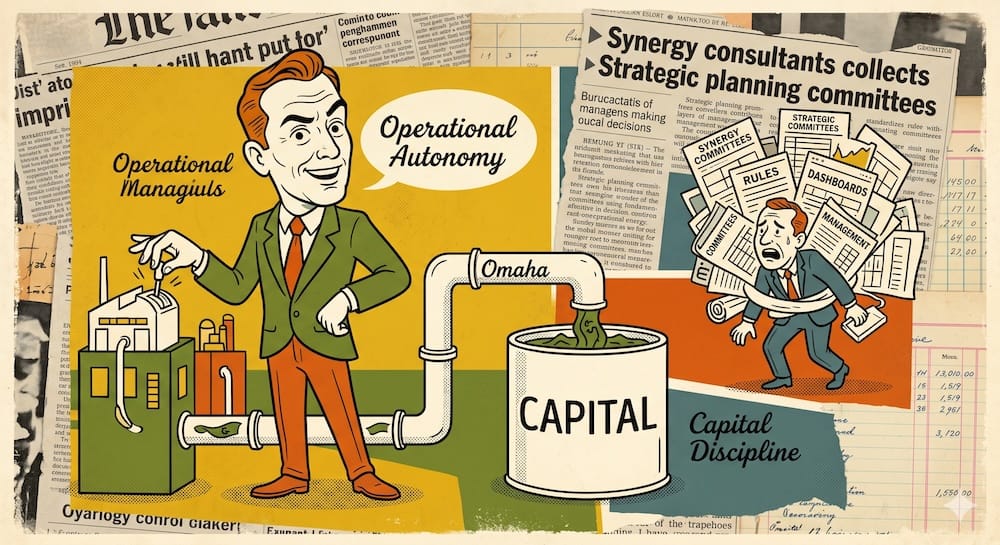
The secret to Berkshire’s long-term performance isn’t found by staring at a stock ticker. It is found by looking at its internal operating model. The system worked because it established a radical separation between daily operational management and enterprise-level capital allocation. The businesses were never micromanaged, but the capital was.
The Operating Model Most Investors Miss
The standard corporate conglomerate model that dominated the mid-to-late 20th century was built on centralization. Head offices filled skyscraper floors with vice presidents, strategic planning committees, human resource compliance officers, and synergy consultants. The goal was to colonize operations—to force distinct businesses into a unified corporate mold, standardization, and central command.
Berkshire did the exact opposite. It built an architecture designed to minimize headquarters interference while enforcing a central discipline over excess capital.
To map how this system functions across its moving parts, we have to look at the structural trade-offs built into the model.
Berkshire Operating Model Map
| Model Component | How Berkshire Did It | Why It Worked | Hidden Risk |
| Decentralized Subsidiaries | Operating CEOs retain near-total autonomy over hiring, pricing, product lines, and operational strategy. | Eliminates bureaucratic friction; maintains entrepreneurial energy and fast local decision-making. | Lack of central oversight can delay the detection of operational failures or ethical lapses. |
| Centralized Capital Allocation | Excess cash above operating needs and attractive local reinvestment opportunities can be routed to Omaha. | Prevents cash from being wasted on low-return local projects; pools capital for maximum-return opportunities. | Puts immense key-man dependency on the central allocator’s judgment. |
| Tiny Headquarters | Maintained a tiny headquarters staff for one of the world’s largest corporate empires. | Eliminates empire-building, internal political positioning, and overhead costs. | Limited bandwidth to perform deep continuous audits across hundreds of thousands of employees. |
| Permanent Ownership | Signals a strong preference for permanent ownership, except in unusual cases. | Attracts high-quality founders who refuse to sell to private equity buyers focused on leverage, restructuring, or near-term resale. | Can leave Berkshire holding structurally declining assets longer than a ruthless private equity fund would. |
| Manager Autonomy | Treats subsidiary CEOs as independent owners, offering long leashes and minimal reporting burdens. | Attracts elite, self-motivated operators who do not need to be babysat by a spreadsheet committee. | Difficult to replace an underperforming manager without disrupting the local culture. |
| No Forced Synergies | Generally avoids forcing unrelated businesses to combine supply chains, IT systems, or sales forces. | Prevents corporate “synergy theater” from destroying functioning operations to hit arbitrary cross-sell targets. | Misses legitimate scale efficiencies that a tightly integrated conglomerate might capture. |
| Reputation-Based Deal Flow | Relies on fair, fast, transparent dealing without prolonged investment banking auctions. | Drastically cuts transaction costs and positions Berkshire as the preferred buyer for family-owned firms. | Highly dependent on the perceived integrity and public reputation of the central leadership. |
| Float & Cash Reserves | Maintains massive institutional liquidity shields alongside regulated insurance premium reserves. | Provides a major liquidity buffer during panics, allowing Berkshire to act as a selective liquidity provider during crises. | Creates an intense drag on overall returns during prolonged bull markets when cash yields are low. |
| Acquisition Discipline | Focuses solely on simple, easily understood businesses with durable economics and verified managers. | Avoids high-risk technological bets and complex operational turnarounds outside their circle of competence. | Can cause Berkshire to miss massive macroeconomic structural shifts in enterprise technology. |
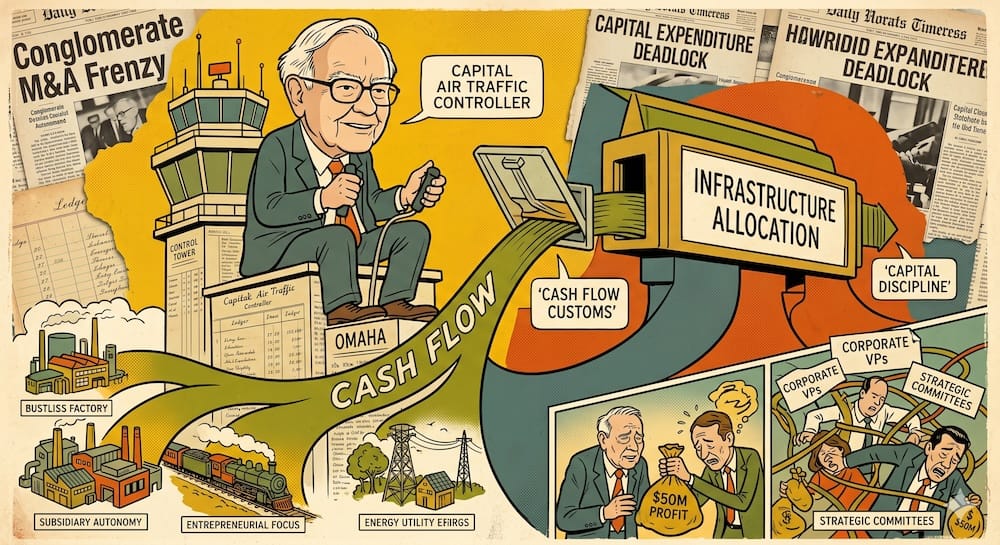
Decentralized Operations, Centralized Capital
In a traditional corporate setup, if a subsidiary manager wants to build a new warehouse, upgrade an IT platform, or acquire a small local competitor, they have to submit a capital expenditure proposal through multiple layers of corporate management. If that same subsidiary generates $50 million in profit, the local executive team usually fights to keep that cash within their division to expand their own corporate footprint, regardless of whether that expansion offers a high return on capital.
Berkshire dismantled this incentive structure. It operates as an air traffic control center for capital, not an operational command center.
Subsidiary CEOs are given near-total freedom to run their businesses as they see fit. Omaha does not manage daily operations. There are no corporate cross-selling quotas, no mandated shared services, and no standard human resource directives handed down from the parent company.
However, this extraordinary operational autonomy is paired with absolute capital discipline. Subsidiary managers do not automatically keep capital just because they generated it. Once local operational expenses, taxes, and necessary maintenance capital requirements are met, excess subsidiary cash can be un-trapped and routed to Omaha.
This mechanism creates an incredibly elegant internal capital customs office. A classic example is See’s Candies, acquired in 1972 for $25 million. See’s possessed brilliant economics but limited regional growth opportunities; forcing it to reinvest all its cash into building more chocolate shops would eventually drive its marginal return on capital down to zero. Under Berkshire’s model, See’s generated over $2 billion in cumulative excess cash flow by 2014, sending those un-trapped funds to headquarters. Omaha then redirected that cash to subsidize large-scale, capital-intensive infrastructure plays like BNSF Railway or Berkshire Hathaway Energy, where massive scale can absorb capital at attractive, durable returns.
Operations are completely decentralized to preserve entrepreneurial focus. Capital allocation is entirely centralized to preserve economic efficiency.
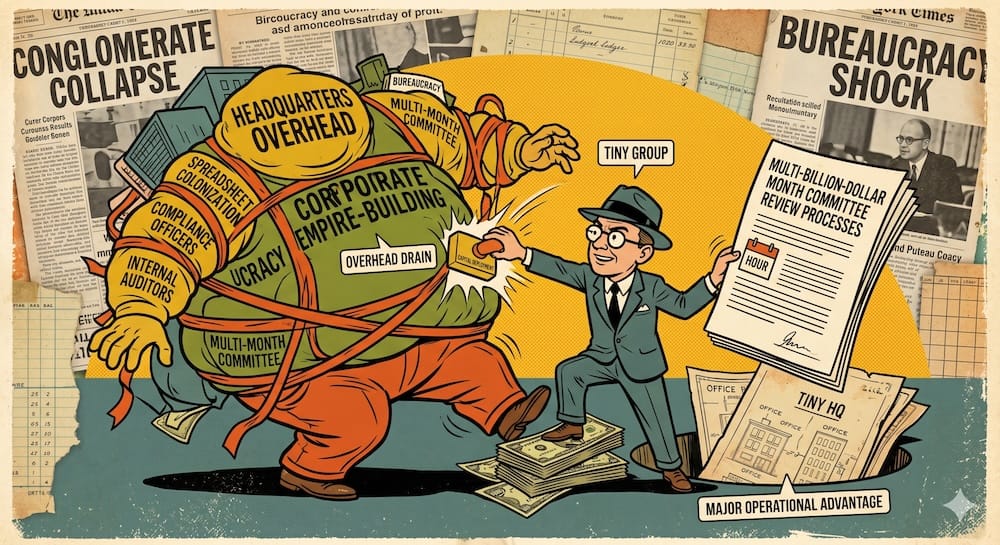
The Tiny Headquarters Advantage
Most multi-billion-dollar corporations operate with massive headquarters footprints. They feature sprawling campuses populated by compliance officers, corporate strategists, public relations teams, and internal auditors. The natural gravity of corporate bureaucracy is always toward expansion; managers want larger budgets and bigger teams to increase their internal institutional status.
Berkshire famously avoided this spreadsheet colonization. Its corporate headquarters has long consisted of a small group of people working out of a modest office building in Omaha.
This tiny headquarters is a major operational advantage. By eliminating layers of management, Berkshire removes the political positioning that paralyzes large corporate systems. There are no executive vice presidents looking to justify their salaries by re-engineering a subsidiary’s supply chain. Decisions regarding multi-billion-dollar capital deployments or corporate acquisitions can be made within hours by a tiny group of people, entirely bypassing the multi-month committee review processes typical of Fortune 500 firms.
Minimal bureaucracy means incredibly low overhead costs. Far more of the operating cash can remain available for productive redeployment instead of being absorbed by headquarters overhead or corporate empire-building.
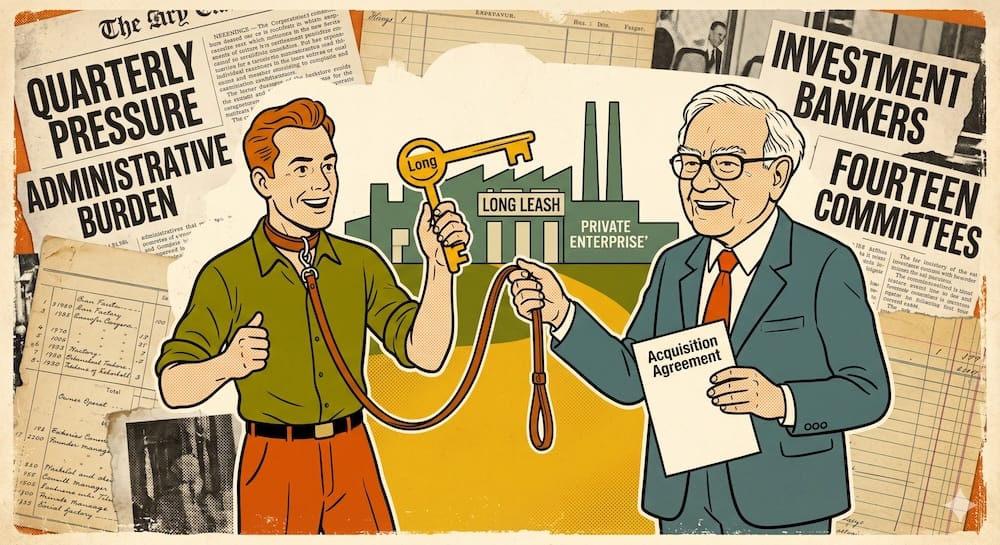
Why Buffett Bought Managers, Not Just Businesses
A typical corporate acquisition often involves buying a company, firing the executive team, installing corporate replacements, and optimizing the business to match head-office protocols.
Berkshire’s operating model relies on the exact opposite approach: buying businesses specifically to acquire the managers who built them, and then giving those managers a long leash.
Berkshire’s model only works if you buy businesses run by adults. If you need fourteen committees and an analytical dashboard to keep the CEO from setting the office furniture on fire, this is not the model.
This structural requirement changes how acquisitions are sourced and evaluated. Buffett prioritized buying businesses from founders who loved the operating realities of their industry but were tired of managing public company administrative burdens, quarterly earnings pressure, and investment banking interventions.
By promising to leave the management team in place and preserve the local culture, Berkshire positioned itself as a unique, non-hostile home for private enterprises. This trust-based approach means Berkshire does not have to spend its energy policing its operators. It selects managers who possess an inherent owner-operator mentality—individuals who are internally motivated to run their business efficiently regardless of whether anyone from Omaha is monitoring their weekly performance.
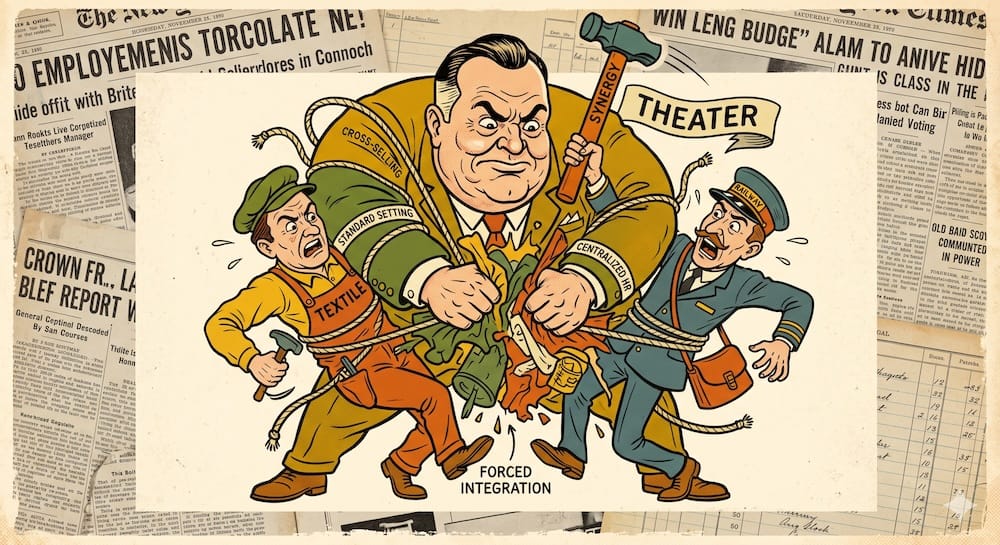
No Synergy Theater
In traditional corporate M&A, the word “synergy” is used to justify massive premium acquisition prices. Investment bankers pitch boards on the idea that combining two separate companies will allow them to cut redundant staff, integrate sales forces, and achieve cross-promotional efficiencies. In reality, forced corporate marriages frequently result in operational friction, cultural alienation, and destroyed value.
Berkshire completely rejects synergy theater. It is a pure business federation, not an integration project.
Berkshire Model vs. Traditional Conglomerate
| Dimension | Traditional Conglomerate | Berkshire Model | Why the Difference Mattered |
| Headquarters Role | Command and control; heavy strategic planning, operational monitoring, and standard setting. | Pure capital allocation; operational non-interference, cash clearinghouse, and macro risk management. | Eliminates head-office overhead and bureaucracy; shifts accountability directly to local managers. |
| Capital Allocation | Retained locally or distributed based on complex internal political negotiation and budgeting. | Centralized pool; excess cash is sent to the parent company to be allocated to the highest-opportunity use cases. | Prevents capital from being trapped in low-return operations; maximizes overall return on capital. |
| Operating Control | High; corporate templates, unified IT platforms, centralized HR, and frequent reporting reviews. | Low; near-total autonomy over local business decisions, hiring, operations, and execution. | Allows local managers to move quickly without waiting for corporate sign-offs or bureaucratic approvals. |
| Manager Incentives | Tied to corporate stock options, relative division budgets, or complex multi-variable metrics. | Tied directly to the long-term return on capital and operating earnings of their specific subsidiary. | Aligns manager incentives with the actual cash economic reality of the business they control. |
| Acquisitions | Often strategic, synergetic, or designed to diversify or expand a specific corporate division. | Purely financial and structural; looking for stable cash flows, fair prices, and independent management. | Avoids overpaying for strategic acquisitions that fail to deliver tangible cash-flow returns. |
| Synergies | Aggressively pursued; forced integration of supply chains, administrative back offices, and cross-selling. | Actively avoided; businesses operate completely independently without forced coordination. | Prevents operational disruption and cultural friction caused by forcing unrelated businesses together. |
| Bureaucracy | High; multiple management layers, internal corporate politics, and continuous reporting requirements. | Very low; minimal corporate reporting, tiny staff, and flat executive communication channels. | Keeps the entire organization focused on commercial execution rather than internal political survival. |
| Holding Period | Opportunistic; willing to spin off, sell, or restructure divisions based on short-term market environments. | Permanence; designed to be held indefinitely unless the business faces structural, terminal cash drains. | Builds deep trust with sellers and allows local managers to execute true long-term operational horizons. |
| Seller Appeal | Low to hostile; associated with corporate cost-cutting, structural restructuring, and cultural disruption. | High to defensive; offers a permanent home for founders who want to protect their business and employees. | Creates a proprietary pipeline of high-quality, family-owned businesses looking for a safe exit. |
Most conglomerates try to create value by forcing distinct pieces together. Berkshire creates value by keeping them apart. By letting independent businesses operate in isolation, it prevents the problems of one division from infecting another, and ensures that each subsidiary stands or falls on its own local economic merits.
Permanent Ownership as a Deal-Flow Advantage
The private equity model is built on transactions: buy a business, layer it with institutional debt, optimize its near-term cash flows, and flip it to another buyer or public market within three to seven years. For a founder who spent decades building a company, selling to private equity often means watching their corporate legacy be dismantled.
Berkshire turned permanent ownership into a sustainable competitive advantage. By committing to hold its acquisitions indefinitely, Berkshire offered a proposition that private equity firms and strategic competitors could not match: continuity, structural stability, and an environment where the founder could continue to lead their team without interference.
This reputation for permanence created an elite, self-selecting pipeline of proprietary deal flow. High-quality private firms were frequently offered directly to Berkshire before ever entering an investment banking auction. This allowed Buffett to avoid bidding wars, structure clean transactions, and purchase resilient, cash-generative businesses at highly reasonable valuations. The culture of trust functioned as a major friction-reducer in corporate transactions.
Why the Model Worked So Well
When you map these individual components sequentially, Berkshire’s structural success is revealed not as a series of isolated stock-picking wins, but as a compounding operational flywheel:
[Autonomous Operators Preserve Local Performance]
                     │
                     ▼
[Low Bureaucracy & Tiny HQ Minimize Overhead Friction]
                     │
                     ▼
[Excess Subsidiary Cash Flows Tax-Efficiently to Omaha]
                     │
                     ▼
[Omaha Centrally Redeploys Capital to Highest-Return Options]
                     │
                     ▼
[Permanence & Reputation Secure Advantaged Private Deal Flow]
                     │
                     ▲
                     └───────────────────────────────────────┘
By separating operations from allocation, Buffett created a structural double-arbitrage. He extracted institutional-scale capital from efficient, cash-generative subsidiaries without paying an internal bureaucratic tax, and then redeployed that capital with total asset allocation flexibility. Culture and structure worked together; trust reduced transaction friction, which attracted the exact type of self-governing managers required to keep a tiny headquarters viable.
Where the Model Can Break or Weaken
An unconventional operating model carries unconventional structural risks. The traits that gave Berkshire its historical edge also create unique points of vulnerability:
- Extreme Key-Man Allocation Dependency: Because capital allocation is completely centralized while operations are decentralized, the entire framework depends on the cognitive discipline of the individual at the center. If the central allocator’s capital evaluation framework degrades, the entire capital routing loop breaks down.
- Operational Oversight Blind Spots: Near-total operational non-interference means that headquarters deliberately surrenders close, day-to-day corporate monitoring. If a subsidiary manager engages in regulatory non-compliance or accounting irregularities, a tiny headquarters is poorly equipped to spot the failure early.
- Succession and Cultural Preservation Friction: Trust-based management cannot be easily institutionalized or coded into standard corporate manuals. It is a highly personalized cultural arrangement. When leadership transitions occur, incoming capital allocators must maintain the same reputation for non-interference and long-term commitment, or the proprietary deal-flow advantage will evaporate.
- The Scale Inflation Drag: As the total capital pool expands into hundreds of billions of dollars, the absolute size of required acquisitions grows exponentially. A $100 million subsidiary cannot move the needle for Berkshire today. This reality forces the model away from nimble, high-return capital allocation decisions and toward massive, highly regulated, capital-intensive infrastructure investments (like utility networks or railway systems) where returns are steady but structurally lower.
What Portfolio Builders Can Learn Conceptually
A retail investor cannot build a private corporate federation, access multi-billion-dollar proprietary deal flow, or command a global insurance conglomerate. But the organizational principles that powered Berkshire’s operating architecture can be translated into conceptual portfolio rules.
Portfolio Translation Principles
| Berkshire Principle | Portfolio Translation | What Not to Copy |
| Autonomy with Accountability | Evaluate the individual components of your portfolio based on their unique roles rather than forcing them to behave identically. | Do not micromanage or constantly churn assets simply because one specific style or factor is temporarily out of favor. |
| Centralized Capital Routing | Think of aggregate savings and cash distributions as part of one capital pool, then decide deliberately where each dollar has the highest expected role within your plan. | Automatic dividend reinvestment can be useful, but the Berkshire lesson is to ask whether the original asset is still the best destination for incremental capital. |
| Avoid Forced Complexity | Keep your investment structure as lean and transparent as possible, minimizing intermediate layers and structural costs. | Do not add complex, high-fee alternative products or exotic asset structures to your portfolio simply for the sake of diversification. |
| Permanent Capital Mindset | Reduce the chance that short-term liquidity needs or fragile financing can force selling during market corrections. | Short-term, callable retail margin is a poor analogue for Berkshire’s capital structure because it can transfer control to a broker during a crash. |
| Low Operational Turnover | Focus your energy on deep initial evaluation and systemic design rather than continuous tactical adjustments. | Do not mistake frequent trading, constant rebalancing, or macroeconomic speculation for productive investment management. |
| No Synergy Theater | Accept that different asset layers in your portfolio serve distinct, unrelated purposes (e.g., insurance vs. structural growth). | Do not force every single sleeve in your asset allocation to show short-term correlation benefits or hit the same growth targets. |
| Capital Allocation Before Activity | Evaluate whether new cash should go to an existing sleeve, a lagging sleeve, cash reserves, or a new opportunity. | Do not confuse constant tinkering with intelligent capital allocation. |
The ultimate lesson of the Berkshire operating model is structural separation. It demonstrates that you can achieve immense scale and resilience by keeping your operating components highly autonomous, while remaining completely disciplined about where your excess capital is redirected.
Focus on the architecture, protect the stability of your capital structure, and let the components do their work without constant interference.
Does a DIY investor need an insurance business to use this operating model?
Not exactly. While retail investors obviously cannot generate billions in institutional underwriting float, the core organizational principle is entirely portable. The lesson here is about structural liability management. To mimic the stability of Berkshire’s model, you must ensure your investment capital is structurally permanent. This means avoiding toxic, callable liabilities like short-term retail margin accounts, which transfer control to an external broker during a correction, and relying instead on long-horizon, un-leveraged assets.
What is the minimum portfolio size to practically separate operations from capital allocation?
There isn’t a fixed dollar minimum, but the structural mechanics become highly useful once your portfolio spans multiple distinct account silos or lifestyle cash streams. In a personal canvas, your “operating subsidiaries” are your primary income engines and the dividend-paying core positions of your portfolio. Your “headquarters” is your central clearinghouse account. The Berkshire approach works at any scale: you aggressively minimize intermediate friction, strip cash away from underperforming strategies, and centralize it before allocating it to your highest-conviction ideas.
How do you replicate Berkshire’s tax-free internal capital routing in a standard retail brokerage account?
You cannot fully replicate it in a standard taxable brokerage account because individual capital gains and dividend distributions trigger intermediate tax friction. However, you can achieve a close personal analogue by utilizing tax-advantaged account wrappers like IRAs, 401ks, or local equivalent retirement accounts. Within these specific sleeves, you can strip dividend cash out of mature positions, rebalance holdings, and redirect capital to completely new asset classes with near-zero intermediate tax drag.
Why doesn’t Berkshire force its subsidiaries to work together to cut costs?
Because forced coordination usually breeds corporate friction. Traditional conglomerates rely heavily on “synergy theater,” forcing unrelated businesses to combine IT networks, merge supply chains, or engage in mandatory cross-selling. Buffett recognized that the operational disruption and cultural alienation caused by head-office micromanagement almost always outcosts the superficial savings. Berkshire creates value by keeping its businesses apart, allowing them to remain nimble and locally accountable.
Can you replicate this model by buying low-beta, high-quality factor ETFs today?
Only partially. Quantitative factor ETFs can easily isolate the same safe, high-ROIC, low-beta equity traits that Buffett targets in public markets. However, a retail factor ETF is still an open-end wrapper subject to daily fund-style redemptions, individual market-cap scale drags, and standard public liquidity cycles. It completely lacks the private holding-company architecture, the un-taxed subsidiary cash-flow pipeline, and the unique distressed deal access that supercharges Berkshire’s actual operating engine.
How does Berkshire keep a tiny headquarters from missing major operational failures?
It accepts that trade-off as an inherent structural risk. By intentionally choosing a tiny headquarters staff to eliminate corporate bureaucracy, Berkshire explicitly surrenders continuous, granular day-to-day oversight. The model relies almost entirely on upstream filtering—buying structurally simple businesses run by ethical, highly verified managers who already possess an inherent owner-operator culture. When a manager choice fails, Berkshire accepts that it will likely detect the problem later than a highly micromanaged firm would.
This article is also available in Spanish. [Leé la versión en castellano: El modelo operativo de Berkshire Hathaway y por qué funcionó tan bien]