I used to think copying early Warren Buffett was a simple matter of digging through small-cap balance sheets and waiting for the market to realize I was right. I was looking at the player instead of the playbook.
The internet regularly condenses the early years of the Buffett Partnership Ltd. (BPL) into a generic, long-only deep-value narrative. But if you treat BPL as a single, static stock-picking strategy, you miss the entire structural engine that drove his early outperformance.
The central thesis of his early edge is far more tactical: BPL was not a value fund. It was a three-sleeve capital allocation machine.
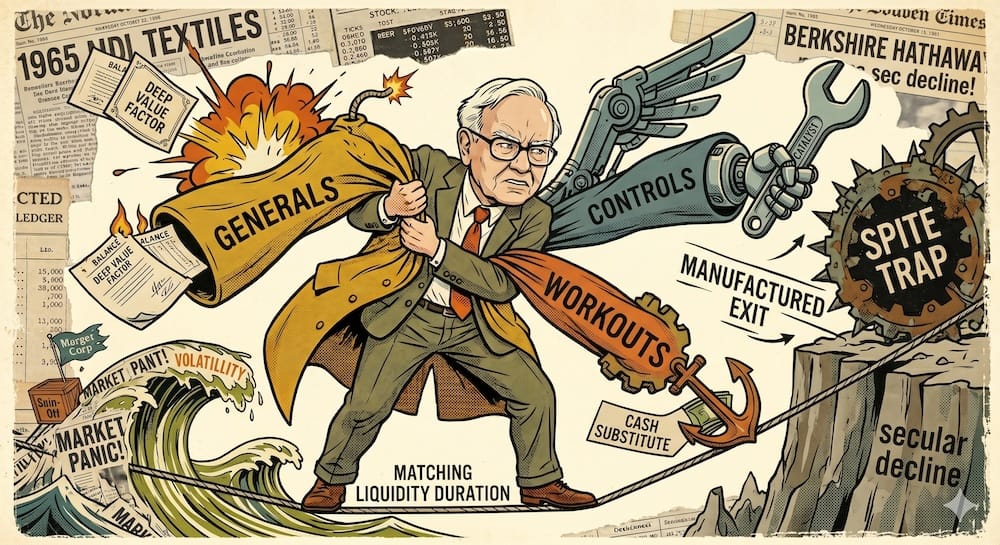
Buffett did not just hunt for cheap assets; he categorized every investment by its underlying structural driver. Generals provided deep-value factor exposure, Workouts provided event-driven absolute-return ballast, and Controls gave him the power to manufacture his own catalysts when the market refused to cooperate.
The real edge did not come from an abstract formula. It came from knowing exactly which sleeve an asset belonged in, what specific risk drove its return, and how to rotate between those sleeves as the macroeconomic tide shifted.
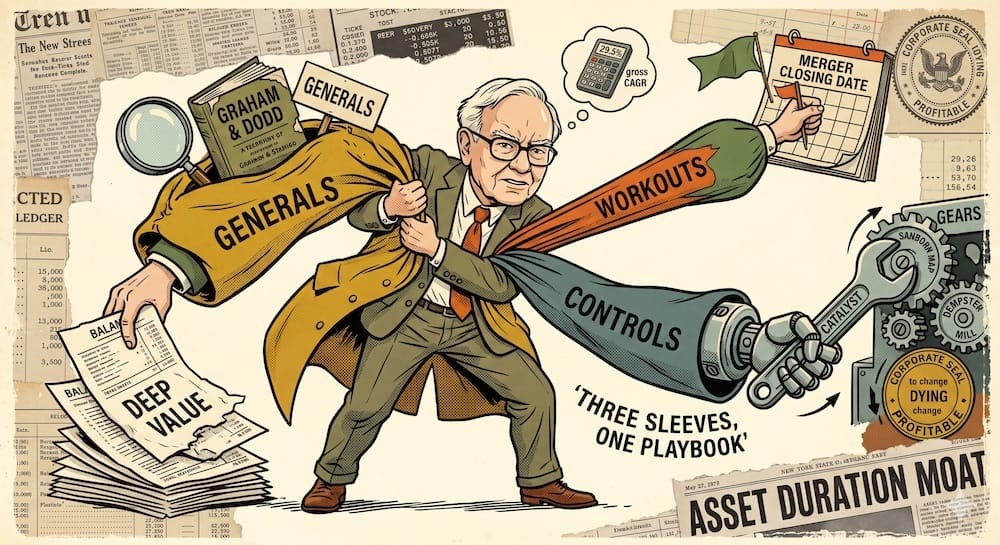
Early Buffett Was Not Running One Strategy
To my eyes, the early Buffett myth is built on an extreme oversimplification. People look at his 1957–1969 compound annual growth rate (CAGR) of 29.5% gross (23.8% net to partners) and assume he was simply running a concentrated version of a modern small-cap value index.
He wasn’t. BPL functioned as a dynamic, unconstrained investment vehicle where asset selection was strictly bound to structural behavior. Buffett viewed market volatility not as an emotional test, but as a variable that changed the attractiveness of completely uncorrelated portfolio sleeves.
The entire framework was designed to manage a specific risk profile: matching asset liquidity to liability duration. While a 0% management fee and a 25% take over a 6% cumulative hurdle provided the incentive alignment, and a strict annual withdrawal window provided the liability-side alpha, the three-sleeve playbook was how he actually put the capital to work.
The Three-Sleeve Playbook Map
Before examining the mechanics of each compartment, we need to map out how these sleeves functioned under the hood.
| Sleeve | What Buffett Bought | Return Driver | Catalyst Source | Market Dependency | Main Risk | Modern Conceptual Translation |
| Generals | Undervalued securities (Net-nets, low-multiple stocks) | Valuation re-rating to intrinsic value | Public market recognition or mean reversion | High (Relies on market re-pricing) | Value traps, deteriorating business fundamentals | Diversified quantitative value factor discipline |
| Workouts | Corporate actions (Mergers, liquidations, spin-offs) | Corporate event completion | Legal, regulatory, or corporate timelines | Low (Independent of equity beta) | Deal break, regulatory blocks, extended timelines | Uncorrelated strategies, alternative risk premia, or liquidity sleeves |
| Controls | Substantial/majority voting stakes in mispriced firms | Operational or capital allocation restructuring | Direct intervention (Board seats, asset sales) | Low / internally driven | Operational capital traps, litigation, scale gridlock | Governance awareness / Avoiding passive asset traps |
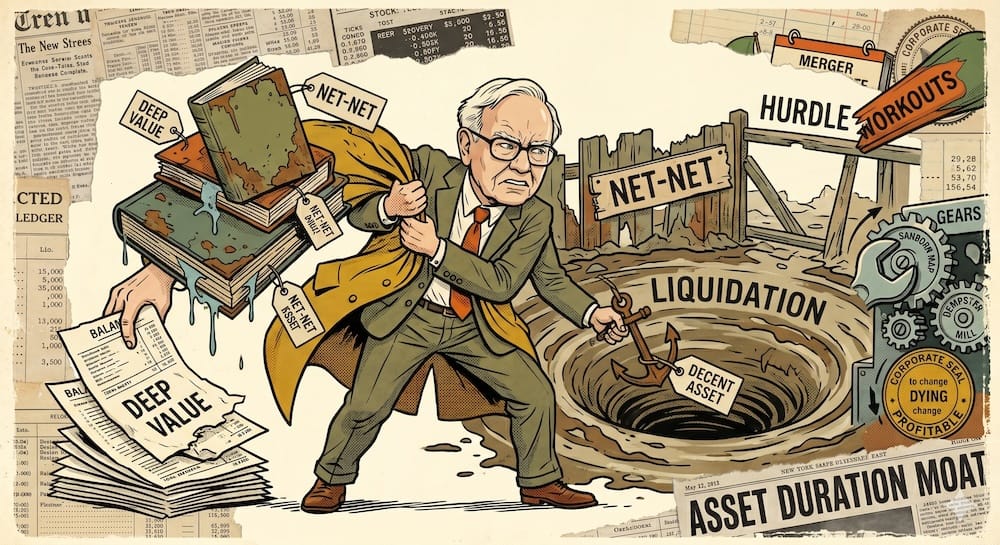
Generals: Buying Statistical Cheapness
The Generals sleeve was the foundation of BPL’s portfolio architecture, taking up 50% to 60% of total capital during standard market environments. This was Buffett’s direct lineage to Benjamin Graham’s quantitative approach: identifying companies trading at steep discounts to their liquidation value.
- The Net-Net Architecture: Buffett focused heavily on “net-nets”—stocks trading below their net current asset value (current assets minus total liabilities). In this sleeve, he was an entirely passive participant. He bought highly concentrated blocks of unloved, overlooked over-the-counter (OTC) shares and waited.
- The Structural Constraints: A standard holding period for a General was one to three years. Because these positions were deeply out of favor, they had high correlation to general market selloffs.
- What This Sleeve Protected Against: Overpaying. By demanding a massive margin of safety on tangible asset value, Buffett protected the downside of his long equity exposure.
- What It Could Not Protect Against: Value traps. If a business model deteriorated faster than the market could reprice the stock, the cheap balance sheet became an illusion. The biggest risk in the Generals sleeve was waiting forever for a catalyst that never arrived.
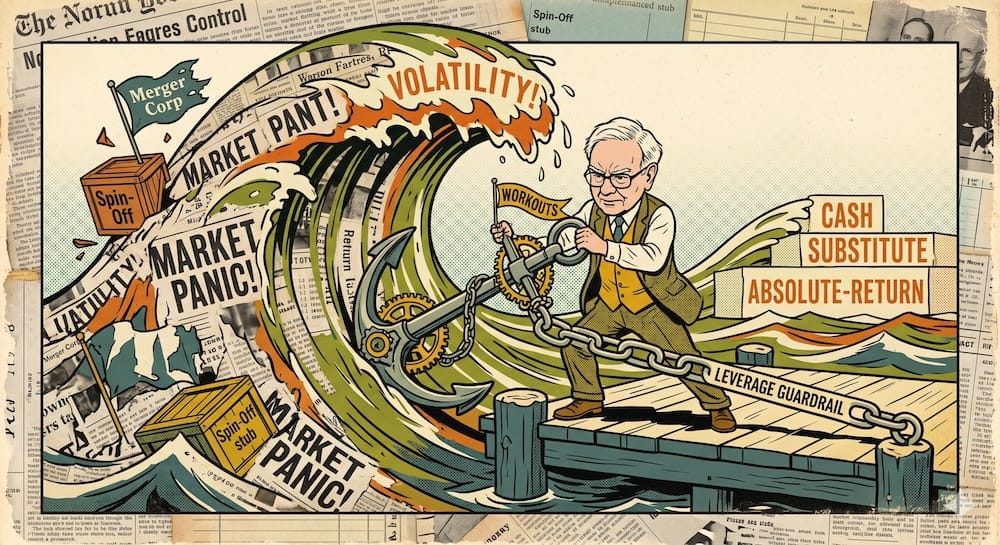
Workouts: The Absolute-Return Sleeve
When retail investors look at early Buffett, they almost completely skip the Workouts sleeve. That is a massive mistake. Workouts were Buffett’s cash substitute and his primary tool for dampening volatility.
[Workout Operational Filter]
Input: Corporate Announcement (Merger, Liquidation, Reorganization)
  │
  ├──► Question 1: What is the probability of deal completion?
  ├──► Question 2: How long will the capital be tied up?
  ├──► Question 3: What is the downside if the deal breaks?
  │
  └──► Payoff Calculation: Expected Annualized Return vs. Cash Drag
Workouts consisted of securities whose financial outcomes depended on specific corporate actions rather than public market sentiment. This included merger arbitrage, corporate liquidations, reorganizations, and stubs from spin-offs.
- The Cash Substitute Mechanic: Instead of holding structural cash that dragged on performance during bull markets, Buffett used Workouts as his liquidity reservoir. Because their returns were driven by event completion rather than market direction, they acted as an absolute-return ballast.
- The Leverage Guardrail: This was the only section of the portfolio where leverage was permitted. Buffett explicitly authorized bank borrowing up to 25% of BPL’s net worth, but restricted its use almost exclusively to funding high-conviction Workouts. This juiced the annualized return on bounded, short-term arbitrage spreads without exposing the fund to sudden margin liquidations from standard equity market downswings.
| Input | Question Buffett Asked | Risk | Payoff |
| Merger Closing | Will the regulators or shareholders block the transaction? | Deal break / Arbitrage spread collapse | Capturing the fixed spread between market price and deal price |
| Liquidation Distribution | Are the balance sheet assets recoverable at the stated values? | Asset write-downs / Extended litigation timelines | Multi-stage cash or asset distributions above purchase price |
| Reorganization Completion | What is the exact value of the new stub security relative to the parent? | Pricing errors / Regulatory timeline extensions | Arbitrage capture between pre-and-post corporate structure |
- Sleeve Rotation Strategy: The Workouts sleeve was highly dynamic. When the stock market surged and Generals became scarce and expensive, Buffett automatically expanded Workouts—sometimes up to 40% of the book—to insulate BPL from a correction. When the market crashed, he did the opposite: he aggressively liquidated Workouts to harvest cash and deploy it into freshly exposed, deeply discounted Generals.
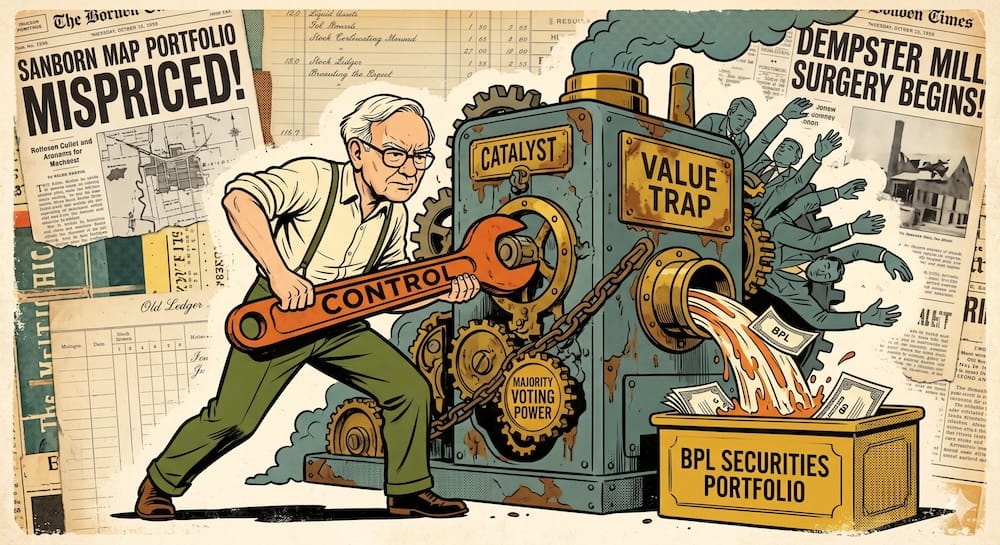
Controls: Manufacturing the Catalyst
If a General remained cheap for too long and the public market refused to close the valuation gap, Buffett did not just sit on his hands. He changed the rules of the game. A position transitioned from a General into a Control when Buffett determined that passive waiting was no longer an efficient use of capital.
[The Control Transition Threshold]
General (Passive Discount) ──► Value Trapped by Management ──► Ownership Accumulation (20%+) ──► Control (Manufactured Catalyst)
A stock became a Control play when BPL accumulated enough voting power—typically starting at a 20% stake and climbing to a majority—to dictate corporate capital allocation. Sanborn and Dempster were not examples of the whole playbook; they were examples of what happened when the Control sleeve became the only way to unlock value.
- The Manufactured Catalyst: Buffett used his ownership to take board seats, replace underperforming management, slash bloated operational costs, and demand asset sales or dividend payouts. He was no longer dependent on market trends to unlock value; he unlocked it himself through structural intervention.
- Case File: The Sanborn Map Extraction: In 1958, Sanborn Map Co. was priced by the market at $45 per share, yet held an investment portfolio worth $65 per share. Buffett did not wait for the market to realize this error. BPL built a 23% stake, secured board representation, and forced an exchange where Sanborn swapped its blue-chip investment portfolio directly for BPL’s stock at fair value. Value was realized entirely outside the public market system.
- Case File: The Dempster Mill Surgery: BPL built a 73% majority stake in Dempster Mill, an underperforming agricultural pump manufacturer. When operations stalled, Buffett installed Harry Bottle as manager. Bottle ruthlessly liquidated slow-moving inventory and downsized operations. Buffett took that freed-up working capital and transformed Dempster’s balance sheet into a highly profitable securities portfolio.
How the Sleeves Worked Together
The brilliance of the BPL playbook lay in how these three distinct strategies formed a cohesive, self-reinforcing capital system. They did not operate in isolation; they balanced each other out.
- Uncorrelated Diversification: The Generals sleeve gave the portfolio explosive upside when cheap equities re-rated. The Workouts sleeve provided steady compounding and protected against down-market equity beta. The Controls sleeve insulated BPL from market stagnation by allowing Buffett to actively engineer his own exits.
- What Each Sleeve Could Not Protect Against: While the system was highly robust, each sleeve carried structural failure points. Generals could not protect against structural business decay. Workouts were completely exposed to sudden, catastrophic deal breaks. Controls required intense operational oversight and could easily turn into capital traps if the underlying industry was in a secular decline.
- The Berkshire Hathaway Spite Trap: This vulnerability became clear in 1965 with Berkshire Hathaway. Originally bought as a classic cheap General textile net-net, Buffett pulled the trigger to buy control out of emotional spite over a management tender offer dispute. He successfully took control, but found himself stuck in a structurally dying, capital-intensive domestic industry that drained cash for two decades. The Control sleeve worked mechanically, but it could not overcome the terrible structural economics of the underlying asset.
Why the Playbook Stopped Scaling
No investment mechanism is completely immune to the asset gravity of scale. By 1968 and 1969, BPL’s capital base crossed the $100 million threshold. At that size, the entire three-sleeve playbook broke down structurally:
- Generals Became Too Small: A typical micro-cap net-net could only absorb a few hundred thousand dollars before its stock price was pushed up by the fund’s own buying pressure.
- Workouts Faced Capacity Limits: The merger arbitrage and liquidation universe was too small to deploy tens of millions of dollars per deal without distorting the arbitrage spreads.
- Controls Required Prohibitive Capital: Taking a majority stake in a large-cap corporation required far more capital than the partnership possessed, and the operational complexity scaled exponentially.
Buffett didn’t dilute his underwriting standards to maintain his asset base. He recognized that scale had destroyed his opportunity set, so he shut down the partnership in 1969 and returned the capital.
Modern Translation: Categorize by Return Driver
Modern retail investors often reduce early Buffett to generic small-cap value exposure, but that misses the catalyst and control mechanics completely. You cannot easily replicate his early instruments: information asymmetry has been dramatically compressed by quantitative scraping, retail investors cannot launch hostile proxy battles, and you cannot run concentrated activist campaigns from a zero-fee broker account.
But you can copy the classification discipline. The real takeaway is to look past product labels and group your portfolio assets strictly by what makes them move.
| Buffett Sleeve | Original Mechanic | Modern Conceptual Translation | What Not to Copy |
| Generals | Concentrated micro-cap net-nets and deep asset discounts. | A systematic, highly diversified value factor discipline via rules-based vehicles that filter for high profitability and low valuation debt-to-equity metrics. | Hand-picking individual pink-sheet net-nets without scale or liquidation capabilities. |
| Workouts | Direct execution of merger arbitrage, liquidations, and stubs. | Allocating a defined sleeve to uncorrelated strategies, alternative risk premia, or a clean liquidity sleeve that behaves differently from long-only equity risk. | Day-trading individual corporate merger announcements on retail broker platforms. |
| Controls | Buying majority stakes to force governance and capital allocation restructuring. | Governance and capital allocation awareness. Recognizing when a strategy relies on active management intervention versus passive exposure. | Pretending that holding a tiny, non-voting slice of a broken company gives you a say in its survival. |
Stop asking whether an asset is simply “growth” or “value.” Start asking how its underlying return driver behaves under different macro regimes, and ensure that your asset liquidity always matches your personal liability horizon. That is the real playbook.
THE MECH-FIRST CLOSING TRADE-OFF NOTE
Implementation Risk Warning: Attempting to build a portfolio based on direct, concentrated micro-cap asset selection without institutional scale or a structural capital lock-up carries severe tracking-error underperformance risk. Modern factor investing exposures are highly efficient, but they do not provide the internal catalyst generation that Buffett used to protect his downside. If you choose to tilt toward value factor strategies or alternative absolute-return vehicles, always structure them as a long-term allocation sleeve—never as a short-term, speculative trading mechanism.
What is the minimum portfolio size needed to replicate the Buffett Partnership playbook today?
It depends entirely on your execution method, but for direct replication, it is functionally impossible for retail investors at any size. To execute the specific “Control” sleeve mechanics, you would need tens of millions of dollars to acquire substantial voting blocks in micro-cap corporations and fund proxy battles. However, if your goal is simply to copy the structural classification discipline—separating your capital into systematic value exposure, event-driven absolute return vehicles, and uncorrelated liquid assets—you can easily implement this framework using a standard retail brokerage account with no account minimums.
Can a modern DIY investor execute the Workouts sleeve via direct merger arbitrage?
Not recommended. While Warren Buffett directly parsed public announcements to exploit bounded, short-term arbitrage spreads, the modern merger arbitrage landscape is heavily crowded by multi-strategy institutional hedge funds. These funds run high-frequency algorithms that immediately pick spreads clean and expose retail investors to severe asymmetrical deal-break risks. For modern portfolios, it is far safer to outsource this specific absolute-return sleeve to low-cost, multi-strategy alternative mutual funds or systematic event-driven ETFs.
What are the tax implications of running an early Buffett-style strategy in a taxable account?
Severe tax drag. The early Buffett playbook is a hyper-active capital allocation machine. The Workouts sleeve relies on high-velocity corporate events that trigger frequent short-term capital gains distributions, which are taxed at standard ordinary income rates. Furthermore, his early “Generals” were often held for less than three years. Attempting to execute this playbook directly outside of a tax-advantaged wrapper like an IRA or a 401(k) would cause massive annual tax liabilities that would severely compound against your long-term returns.
Are modern micro-cap “net-nets” still a viable option for retail investors?
Rarely in clean form. In the 1950s and 1960s, Warren Buffett hand-turned printed manuals to uncover obscure over-the-counter companies trading below liquidation value due to total information asymmetry. Today, global quantitative algorithms scrape and clean international financial data within milliseconds. Modern stocks trading below their Net Current Asset Value (NCAV) are almost always plagued by severe structural risks, such as impending bankruptcy, ongoing litigation, fraudulent financial reporting, or corrupt corporate governance that retail investors cannot actively fix.
How does a modern value factor ETF differ from Buffett’s “Generals” sleeve?
The primary difference is structural control and diversification scale. A modern rules-based small-cap value ETF targets a systematic value factor across hundreds of liquid securities, relying on statistical mean reversion over time while stripping out individual business risk. Buffett’s Generals sleeve, by contrast, was hyper-concentrated in an illiquid, unlisted micro-cap universe where he explicitly underwrote the individual balance sheet of each target company, accepting tracking error that would cause standard ETF investors to capitulate.
Why did the three-sleeve playbook work for Buffett but fail inside Berkshire Hathaway’s original textile business?
Because he ignored his own structural boundaries. The three-sleeve playbook relies on keeping your asset categories strictly aligned with their core drivers. Buffett originally underwrote Berkshire Hathaway as a cheap, passive “General.” When he let emotion lead him to buy a majority stake out of spite over a price dispute, he forced it into a “Control” play. However, because the underlying domestic textile industry was locked in a terminal secular decline, no amount of governance or catalyst manufacturing could fix the broken operational economics, transforming it into a decades-long capital trap.
This article is also available in Spanish. Leé la versión en castellano: El manual de estrategia de la Buffett Partnership: Asignación de capital y rendimiento absoluto