
Investing with the precision of a legendary market operator isn’t about chasing crystal-ball predictions—it’s about mastering system mechanics, risk constraints, and your own behavioral psychology. Linda Raschke, a veteran commodity trader and acclaimed author, embodies this approach through decades of navigating the raw friction of the trading pits and electronic markets. For my own framework as a DIY investor, her work is a brilliant reminder that portfolio architecture succeeds on execution, not consensus forecasting. In this guide, we’ll analyze her core operational principles, look at the mechanics of her short-term setups, and see how her focus on capital preservation can save us from our worst trading impulses.
source: Better System Trading on YouTube
Linda Raschke: A Trailblazer in Commodity Trading
Linda Raschke has left a permanent imprint on the quantitative trading space, carving out a reputation as a professional speculator who thrives on price action rather than macroeconomic narratives. Her framework merges strict technical setups with rigorous capital preservation routines. To my eyes, her strategies deliver a vital lesson: impressive historical returns are meaningless if your behavioral thresholds cause you to abandon the strategy during an ugly trend reversal. Her methods have pushed market participants to look past broad asset class generalities and focus directly on localized momentum dynamics.

Understanding Her Trading Philosophy and Contributions as an Author
Raschke’s framework strips away the noise of financial punditry to isolate structural chart patterns, trend metrics, and asymmetric risk profiles. Her insights in the classic text “Street Smarts: High Probability Short-Term Trading Strategies” offer clear, mechanical blueprints for managing systematic risk. Honestly, the core takeaway is that the market doesn’t care about your feelings or your long-term thesis; it cares about the immediate balance of supply and demand friction at specific structural levels.
We’ll dive into the specific rules of these short-term strategies. Whether you’re an asset allocator exploring trend-following overlays or a self-directed investor trying to tighten your operational rules, understanding Raschke’s execution mechanics provides an excellent baseline. The trade-off is always between capturing rapid tactical swings and bearing the tracking error pain that comes with active management. It’s a completely different animal when real capital is on the line.

Who is Linda Raschke?
Background and Early Life of Linda Raschke
Linda Raschke’s introduction to speculation began early, rooted in a deep familiarity with quantitative patterns and market structures. Rather than relying on traditional buy-and-hold dogmas, she focused on how order flow and structural liquidation patterns manifest on price charts. This analytical curiosity laid the groundwork for an engineering-style approach to risk, moving away from subjective market narratives toward rule-based execution models.
Her Journey from Humble Beginnings to Becoming a Successful Trader and Author
Raschke cut her teeth as a floor trader, immediately confronting the harsh real-world frictions of bid-ask spreads, slippage, and immediate psychological pressure. Transitioning from the raw physical environment of the trading floors to electronic screens required absolute adaptability. She spent years refining setups based on pattern recognition and statistical trend tendencies. Wow. The sheer volume of transactions required to survive that transition teaches you things a theoretical finance textbook will never mention.
In addition to her trading prowess, Raschke ventured into writing, aiming to share her knowledge and strategies with a broader audience. Her book, “Street Smarts: High Probability Short-Term Trading Strategies,” has become a staple for traders seeking practical and actionable trading techniques.
Key Achievements, Including Her Recognition in the Market Wizards Series and Her Book, Street Smarts
- Market Wizards Series Inclusion: Linda Raschke was featured in Jack D. Schwager’s renowned “Market Wizards” series, which highlights the strategies and insights of top traders. This inclusion solidified her reputation as a formidable trader in the commodity markets.
- Authorship of Street Smarts: Her book, “Street Smarts: High Probability Short-Term Trading Strategies,” is celebrated for its clear, concise, and practical trading strategies. It provides traders with tools to identify high-probability trades and manage risks effectively.
- Consistent Trading Performance: Raschke has consistently delivered impressive returns in the commodity markets, earning accolades for her ability to navigate volatile market conditions with poise and precision.
- Educational Contributions: Through seminars, workshops, and mentorship programs, Raschke has educated countless traders, sharing her expertise and fostering a community of informed and disciplined investors.

Core Principles of Linda Raschke’s Trading Strategy
The foundations of Raschke’s methodology rely on structural market components rather than predictive speculation. Her execution is governed by four core anchors: technical analysis, repeatable pattern isolation, strict capital preservation math, and process discipline.
Technical Analysis: Focus on Chart Patterns, Indicators, and Price Action
Technical Analysis Defined: For Raschke, technical analysis isn’t about finding a magic formula; it’s the systematic tracking of participant imbalances across price, volume, and time parameters to isolate a statistical edge.
Key Components of Raschke’s Technical Analysis:
- Chart Patterns: Focusing on structural consolidations like flags, pennants, and opening range extensions. These formations simply mark zones where buyers and sellers are reaching temporary equilibrium before an expansion phase.
- Indicators: Utilizing a tightly constrained set of indicators—specifically Exponential Moving Averages (EMA), Average Directional Index (ADX), and the 3/10 Oscillator—to measure momentum velocity and trend strength.
- Price Action: Prioritizing the raw interaction of daily candle extremes over laggy lagging indicators. Price action reflects the immediate reality of liquidations and margin pressures.
Example: When checking a major commodity futures chart, observing a clean bull flag isn’t an invitation to forecast infinite upside. It indicates a tight contraction window where risk can be clearly defined just below the consolidation floor before a momentum breakout occurs.
Tip: Avoid indicator overload. Overlaying dozens of correlated indicators creates analytical paralysis. Let the raw price structure breathe and use tools solely to verify momentum speed.
Pattern Recognition: Importance of Identifying and Trading Based on Repeatable Market Patterns
The Power of Patterns: Market structures repeat because human behavioral biases and institutional execution constraints are structurally consistent. Finding these setups allows an operator to exploit localized statistical regularities.
Key Patterns Raschke Focuses On:
- Head and Shoulders: Classic structural exhaustion zones where a market fails to maintain marginal higher highs or lower lows, indicating institutional distribution.
- Double Tops and Bottoms: Key liquidity sweeps where price tests structural limits, taps out resting stop orders, and sharp reversals often occur.
- Triangles and Flags: Pure range contraction periods that act as coiled springs, signaling an imminent volatility breakout. Her foundational NR7 setup relies on a strict 7-period range contraction rule: the high-to-low mathematical range of the current session must be narrower than the absolute range of the previous 6 consecutive sessions before a breakout signal triggers.
Application of Patterns in Trading: By spotting these geometric setups in their early stages, Raschke positions capital at the exact point of breakout or failure, ensuring that the distance to her invalidation level is as small as possible.
Example: If a descending triangle forms on an equity index chart, the mechanical play isn’t to hope for a specific direction. The strategy dictates placing entry triggers at the structural borders to ride the immediate expansion of volume and price expansion.
Tip: Always look at volume during pattern development. True breakouts require expanding volume to prove that institutional participants are actively defending the structural transition.
Risk Management: Emphasis on Capital Preservation, Stop-Loss Orders, and Risk-to-Reward Ratios
Capital Preservation: Protecting your psychological and financial runway is the single most critical parameter of long-term survival. Raschke’s risk management frameworks are designed to survive deep mathematical drawdowns without triggering forced liquidations.
Key Risk Management Techniques:
- Stop-Loss Orders: Hard structural boundaries sent directly to the exchange server when entering a trade. There is zero room for mental stops or mid-bar hesitation; if the setup breaks, capital exits immediately.
- Position Sizing: Modulating individual trade allocations based on the underlying asset’s Average True Range (ATR). Highly volatile instruments get smaller contract sizes to keep the dollar-at-risk constant across setups.
- Risk-to-Reward Ratios: Evaluating the mathematical expectancy of each execution. Raschke demands setups where the structural profit target represents a clear multiple of the capital risked at the stop-loss level.
Example: Before initiating any contract order, calculate your exact trade profile. If a pattern requires risking 100 dollars to potentially gain 300 dollars based on structural resistance, the 1:3 ratio provides the necessary mathematical buffer to handle normal strings of consecutive losses.
Tip: Know your maximum acceptable loss before looking at potential gains. This keeps tracking error anxiety low and stops emotional tinkering when the market moves against you.
Discipline and Consistency: How Raschke Maintains Discipline and Avoids Emotional Trading
The Role of Discipline in Trading: Systems are useless without behavioral consistency. Discipline means executing your structural plan flawlessly even when you are in the middle of an extended drawdown or facing intense market volatility.
Strategies for Maintaining Discipline:
- Strict Adherence to Trading Plan: Documenting every parameter of your system before the market opens. Having a written protocol removes real-time guesswork and limits emotional hesitation.
- Emotional Control: Building systematic habits to neutralize greed and fear. Speculators use process constraints—like strict daily loss limits—to automatically shut down operations before revenge trading occurs.
- Regular Performance Reviews: Rigorously logging trade data, execution slippage, and behavioral errors. Checking your historical stats highlights where your actual execution deviates from your model’s parameters.
- Goal Setting: Framing system objectives around process compliance metrics rather than raw financial output, which reinforces disciplined execution habits.
Example: During extreme macroeconomic releases, an undisciplined investor might scramble to trade the headline noise. Raschke’s method demands stepping back or trusting the preset structural stop-losses, ensuring that short-term volatility doesn’t trigger behavioral ruin.
Tip: Keep a detailed trading journal that records your emotional state alongside your entry data. Reviewing this ledger reveals exactly how psychological stress compromises your system’s rules.

The Use of Short-Term Trading Techniques
Overview of Raschke’s Short-Term Trading Focus
Linda Raschke isolates her structural edge by focusing on short-term horizons, moving capital quickly to capture sharp shifts in price momentum. Her process focuses on exploiting localized imbalances rather than attempting to predict long-term structural trends.
Benefits of Short-Term Trading:
- Quick Profits: Capitalizing on immediate supply shocks allows for rapid capital compounding when setups function correctly.
- Reduced Overnight Risk: By flattening a large portion of positions before the close, day trading methods eliminate exposure to gap-risk driven by overnight global macro events.
- Frequent Trading Opportunities: Broad futures markets present repeatable structural setups across daily and intraday timeframes, offering sufficient sample sizes to realize a statistical edge.
Raschke’s Approach: Her core operational model blends day trading tactics with multi-day swing horizons, matching lower-timeframe entry precision with higher-timeframe structural context.
Explanation of Her Favorite Strategies, Such as Swing Trading and Day Trading
Swing Trading: This framework involves capturing multi-day expansions, typically holding contracts for two to five sessions to extract value from a clear momentum wave or structural pullback.
Key Elements of Swing Trading:
- Trend Identification: Isolating clear institutional flow via tools like a rising 20-period EMA or a high ADX score before looking for any entry.
- Pattern Confirmation: Requiring explicit price validation—like a daily reversal bar—to prove that sellers have exhausted themselves before entering long.
- Risk Management: Placing trailing stops behind key structural pivot points to capture maximum gain while protecting seed capital.
Example: Suppose a commodities contract shows a sustained series of higher structural highs. A swing framework dictates waiting patiently for a orderly consolidation pullback toward the moving average zone, then executing an entry order as momentum turns back in the primary direction.
Day Trading: This method requires completing all execution loops within a single session, neutralizing systemic asset allocation exposure when the exchange closes.
Key Elements of Day Trading:
- Intraday Analysis: Monitoring volume profiles and internal market metrics from the opening bell to track real-time liquidity changes.
- Quick Execution: Utilizing hard limits and automated bracket orders to manage fast price action without structural hesitation.
- Strict Discipline: Accepting small losses quickly when an intraday breakout turns into a bull trap, keeping capital free for the next clean setup.
Example: If a index futures contract breaches its opening range extreme on massive institutional volume, a day trading system executes a long order on the initial shallow pullback, targeting the next key daily ATR expansion limit before the closing bell.
Tip: Never mix your horizons. If you enter an execution as a short-term day trade, you cannot convert it into a long-term swing position just because it went into a loss. Cut the trade exactly according to your original system rules.
How She Applies Technical Analysis to Make Quick, Profitable Trades
Raschke’s technical architecture relies on cross-verifying momentum indicators with structural price boundaries. She extracts consistent signals by monitoring the velocity of price relative to historical volatility bands.
Key Techniques:
- Moving Averages: Utilizing the 20-period Exponential Moving Average as a dynamic baseline for tracking momentum extension.
- Relative Strength Index (RSI): Monitoring short-term oscillator exhaustion to flag tactical entry points where risk is highly skewed in your favor.
- Bollinger Bands: Assessing real-time volatility expansion. Price touching or expanding the outer envelopes provides mathematical boundaries for expected daily ranges.
- Volume Analysis: Cross-referencing price changes with total volume to differentiate retail noise from true institutional order blocks.
Example: If an index contract stretches outside its upper Bollinger Band while the short-term oscillator flags extreme overbought conditions, the probability of an immediate mean-reversion move increases. A tactical trader uses this metric to tighten trailing stops or execute short scalp positions.
Tip: Treat moving averages as magnets, not concrete walls. Price will routinely slice through them; your goal is to evaluate the behavior and candle closes *around* those zones to confirm if the primary trend is holding.

Famous Trades and Market Calls
Analysis of Some of Raschke’s Most Notable Trades and Market Predictions
Raschke’s long career provides brilliant case studies in how technical setups extract returns from major commodity and index moves. Her execution on historic market trends demonstrates the power of keeping system rules completely independent of prevailing news narratives.
Notable Trades:
- Crude Oil Rally: When structural supply limits triggered massive volatility in energies, Raschke bypassed the geopolitical commentary and focused purely on a massive momentum breakout. She entered long as price cleared long-term structural resistance, trailing her stops along a high-velocity trend model.
- S&P 500 Reversal: During an extended market drawdown, she isolated a pristine structural double bottom pattern on the index charts. As price cleared the consolidation neckline on massive volume, she initiated long positions, capturing a substantial tactical recovery wave.
- Gold Price Correction: Following an aggressive, retail-driven blow-off top in precious metals, Raschke’s oscillator models flagged extreme momentum divergence. She executed structured short positions into the distribution zone, capturing profits as price mean-reverted back to its historical moving average.
How Her Technical Approach and Discipline Led to Successful Outcomes
The success of these executions points directly to her commitment to mathematical parameters over personal bias. By relying on objective indicators and automating risk boundaries, she consistently removed behavioral interference from her execution loops.
Key Factors in Her Success:
- Objective Analysis: Basing every operational risk decision on measurable chart parameters rather than personal economic biases.
- Discipline: Maintaining strict execution rules regardless of macro panic, ensuring her risk parameters remained steady across market regimes.
- Adaptability: Modulating her system parameters instantly when transitioning from highly trending trends to flat, range-bound environments.
- Continuous Learning: Rigorously tracking system failures to continually refine entry precision and optimize execution costs.
Lessons Learned from These Trades and Their Relevance Today
1. Importance of Technical Indicators: Raschke’s execution proves that mastering a concise set of tools provides all the structural context an independent speculator needs to manage capital effectively.
2. Discipline in Execution: A strategy is only as robust as your ability to stick to its parameters during a losing streak. Process consistency is what bridges the gap between backtests and real equity lines.
3. Risk Management is Essential: Using predefined stop-losses and smart position sizing guarantees that no single systemic shock can delete your investment account.
4. Adaptability to Market Conditions: Markets are dynamic, and strategies must evolve to remain effective. Raschke’s ability to adapt her trading strategies based on market conditions highlights the importance of flexibility in trading.
Tip: Study historical chart expansions to see how asset prices behave during liquidity crises. Learning these patterns builds the behavioral discipline required to trust your stop-losses when markets get chaotic.

Risk Management Techniques
Detailed Look at Raschke’s Approach to Managing Risk in Commodity Trading
Risk management isn’t an addition to Raschke’s strategy; it is the entire foundation of her portfolio architecture. Speculating in highly leveraged futures markets means that a single unchecked mistake can wipe out an immense amount of trading capital.
Key Components of Raschke’s Risk Management:
- Capital Preservation: Prioritizing your survival runway above all else. This means rejecting marginal setups and keeping leverage highly contained relative to your total account value.
- Stop-Loss Orders: Utilizing immutable exchange-side orders to automatically truncate losing setups before they damage your portfolio.
- Position Sizing: Calculating your total contracts based on the specific dollar risk of the setup, ensuring that portfolio volatility remains uniform across assets.
- Risk-to-Reward Ratio: Only executing setups where the structural upside significantly outweighs the defined capital-at-risk.
Use of Stop-Loss Orders, Position Sizing, and Trading Discipline
Stop-Loss Orders: Raschke relies on hard structural stops to manage her execution. These boundaries are placed at structural invalidation levels where the technical pattern is proven wrong.
Example: If you enter a long setup on an equity index at 4,200 points, your system may dictate a hard structural stop at 4,150 points based on the previous session’s swing low. If price drops to that level, the exchange automatically liquidates the contracts, keeping your maximum loss bounded at exactly 50 points.
Position Sizing: Proper allocation requires scaling your contracts to match an asset’s underlying price volatility. Raschke tracks asset volatility using ATR metrics, scaling her position sizes down when an instrument becomes highly erratic.
Example: For a highly volatile asset like crude oil, your system sizing equations will mandate a significantly smaller position size compared to a highly diversified equity index contract. This balancing technique maintains consistent portfolio risk regardless of individual asset swings.
Trading Discipline: Maintaining behavioral control means executing your risk plan without deviation. Raschke ignores personal market biases and relies completely on her technical system parameters.
Example: When intraday markets experience a sudden liquidity shock, a process-driven operator doesn’t alter their stop levels out of fear. You stand aside or let the bracket orders execute, ensuring that emotional panic doesn’t cause a major portfolio drawdown.
Tip: Never average down on a losing short-term position. Adding capital to a trade that is breaking your structural stop levels is a fast track to catastrophic loss. Accept the small loss and wait for the next clean setup.
Balancing Risk and Reward in a Volatile Market Environment
Extracting returns from a volatile market environment requires balancing risk and reward parameters across your entire asset footprint. Raschke utilizes specific structural guidelines to preserve her portfolio’s edge:
- Optimal Asset Allocation: Distributing tactical exposure across uncorrelated commodity and index markets to prevent sector concentration risk.
- Risk-Reward Analysis: Requiring clear structural upside targets before committing seed capital to a setup.
- Diversified Portfolio: Building an operational matrix where individual trade outcomes are isolated, preventing single-asset disasters from impacting overall portfolio performance.
Example: When macro volatility expands rapidly, your system may dictate reducing contract sizes while widening structural stops. This allows the position to handle wider price swings while keeping the total dollar risk to your portfolio unchanged.
Tip: Rebalance your capital allocations based on shifting volatility regimes. When an asset’s historical range expands dramatically, shrinking your contract size is essential to protect your account from excessive swings.

The Role of Psychology in Trading
Raschke’s Views on the Psychological Challenges of Trading
Raschke frequently reminds her students that speculation is an intense psychological hurdle disguised as a technical game. The pressure of managing capital under real-time uncertainty triggers deep behavioral biases that can quickly ruin an unconstrained investor. True mastery requires identifying these emotional traps before they compromise your operational rules.
Key Psychological Challenges:
- Emotional Trading: Allowing fear or overconfidence to dictate entries and exits instead of relying on clear technical system signals.
- Overconfidence: Assuming a normal winning streak is proof of personal genius, leading to dangerous position sizing expansion.
- Loss Aversion: The classic behavioral bias where the pain of a loss causes you to freeze, hold onto failing positions, and ignore clear system stops.
- Stress and Pressure: The cumulative mental fatigue generated by trading fast-moving, leveraged markets, which slowly breaks down executive functioning.
Techniques for Maintaining Discipline and Emotional Control
To combat behavioral biases, Raschke builds deliberate process constraints into her operational day. These systems are designed to decouple her execution from short-term emotional states.
- Structured Trading Plan: Documenting every parameter of your system before the market opens. Having a written protocol removes real-time guesswork and limits emotional hesitation.
- Mindfulness and Stress Management: Utilizing process boundaries and physical resets to maintain clear focus and keep physiological stress from clouding your risk decisions.
- Regular Performance Reviews: Evaluating execution errors with cold data. Treating your trading log like an auditor’s ledger strips away the emotional narratives of winning or losing.
- Goal Setting: Framing system objectives around process compliance metrics rather than raw financial output, which reinforces disciplined execution habits.
Example: On chaotic macro sessions, a process-driven operator relies completely on their written system rules, ignoring financial media panic. This structural approach protects your portfolio from impulsive, fear-driven liquidations.
Tip: Set an automatic daily stop-loss limit on your trading platform. If your realized losses reach a specific dollar threshold, force yourself to shut down the software. This hard boundary prevents emotional revenge trading.
The Importance of Mental Resilience and Adaptability in Executing Trades Effectively
Mental resilience means accepting that drawdowns and losing streaks are inevitable features of speculative systems. Raschke encourages traders to view losses as standard operating expenses rather than personal failures.
Strategies to Build Mental Resilience:
- Acceptance of Losses: Treating individual trade failures as normal data points within a large statistical sample size.
- Positive Mindset: Keeping your focus anchored on long-term system edge metrics rather than the noise of single-trade outcomes.
- Continuous Learning: Treating drawdowns as educational feedback loops to audit execution quality and refine system parameters.
- Support Systems: Engaging with technical peers and systematic mentors to maintain objective perspective during volatile market regimes.
Example: After a sequence of normal system losses, a resilient operator doesn’t scramble to change their strategy. You audit your execution to verify rule compliance, accept the standard cost of doing business, and execute the next valid system signal with zero hesitation.
Tip: Adopt a long-term statistical mindset. Evaluate your strategy’s performance over a sequence of 100 independent executions rather than obsessing over daily P&L swings. This detach reduces emotional trading fatigue.

Building a Trading Strategy Like Linda Raschke
Step-by-Step Guide to Developing a Commodity Trading Strategy Inspired by Raschke
Constructing an execution system based on Raschke’s work requires translating her core concepts into clear, rule-based steps. This process focuses on structural indicators, capital controls, and regular systems auditing.
1. Research and Analysis
- Comprehensive Market Research: Identify highly liquid futures or equity instruments. Track their baseline structural parameters, typical daily ranges, and volume behavior.
- Technical and Price Structures: Combine trend indicators—like the 20-period EMA—with structural support/resistance zones to isolate high-probability areas for pullbacks.
- Use of Proprietary Indicators: Incorporate momentum setups like Raschke’s Cumulative Tick models to monitor internal market sentiment during index sessions.
2. Identifying and Analyzing Potential Trades
- Asset Selection Criteria: Filter for instruments showing strong institutional momentum, clear range contractions, or high ADX readings.
- Trend Identification: Use moving average hierarchies to ensure you are executing setups in the direction of primary institutional order blocks.
- Volume Confirmation: Require explicit volume spikes to validate structural breakouts, helping you avoid low-liquidity traps.
3. Implementing Risk Management Strategies
- Stop-Loss Orders: Calculate your exact technical invalidation level before entering a position, and place an immediate hard order with the exchange.
- Position Sizing: Scale your total contracts based on the instrument’s ATR to keep your total capital-at-risk uniform across portfolios.
- Diversification: Distribute your speculative setups across unrelated asset classes to shield your total portfolio from sector-specific shocks.
4. Executing the Trading Plan
- Strategic Entry and Exit Points: Use price triggers to execute entries on clear consolidations, and set precise take-profit targets based on historical volatility envelopes.
- Timely Execution: Automate your entry orders to completely eliminate manual hesitation when a technical pattern triggers.
- Continuous Monitoring: Regularly monitor active positions to ensure price action remains aligned with your system’s tracking parameters.
5. Continuous Evaluation and Adaptation
- Performance Review: Periodically audit your trading logs to measure execution quality and identify structural style drift.
- Adapt to Market Conditions: Modulate your system metrics when shifting from trending regimes to choppy, range-bound environments.
- Innovate and Refine: Use data from your trade reviews to fine-tune your entry rules and reduce transaction drag.
Tips for Refining and Adapting the Strategy Over Time
- Stay Flexible: Be ready to adjust your operational parameters as underlying market structures and liquidity parameters evolve.
- Learn Continuously: Invest heavily in analyzing empirical market studies and reviewing historical systems mechanics to deepen your understanding.
- Seek Expertise: Review vetted systematic quantitative research to gain unbiased, data-driven insights into evolving market tendencies.
- Implement Feedback Loops: Use data from your trade reviews to continually refine your risk rules, keeping your strategy robust over time.
Tip: Regularly audit your system parameters against live execution data. This practice ensures your setups remain aligned with current volatility patterns and prevents hidden style drift.
Challenges of Commodity Trading
Potential Pitfalls and Difficulties in Trading Commodities
Speculating in commodities presents unique operational challenges that require precise mechanical solutions. Bypassing these friction points demands clear risk protocols and a realistic view of market mechanics.
Common Challenges:
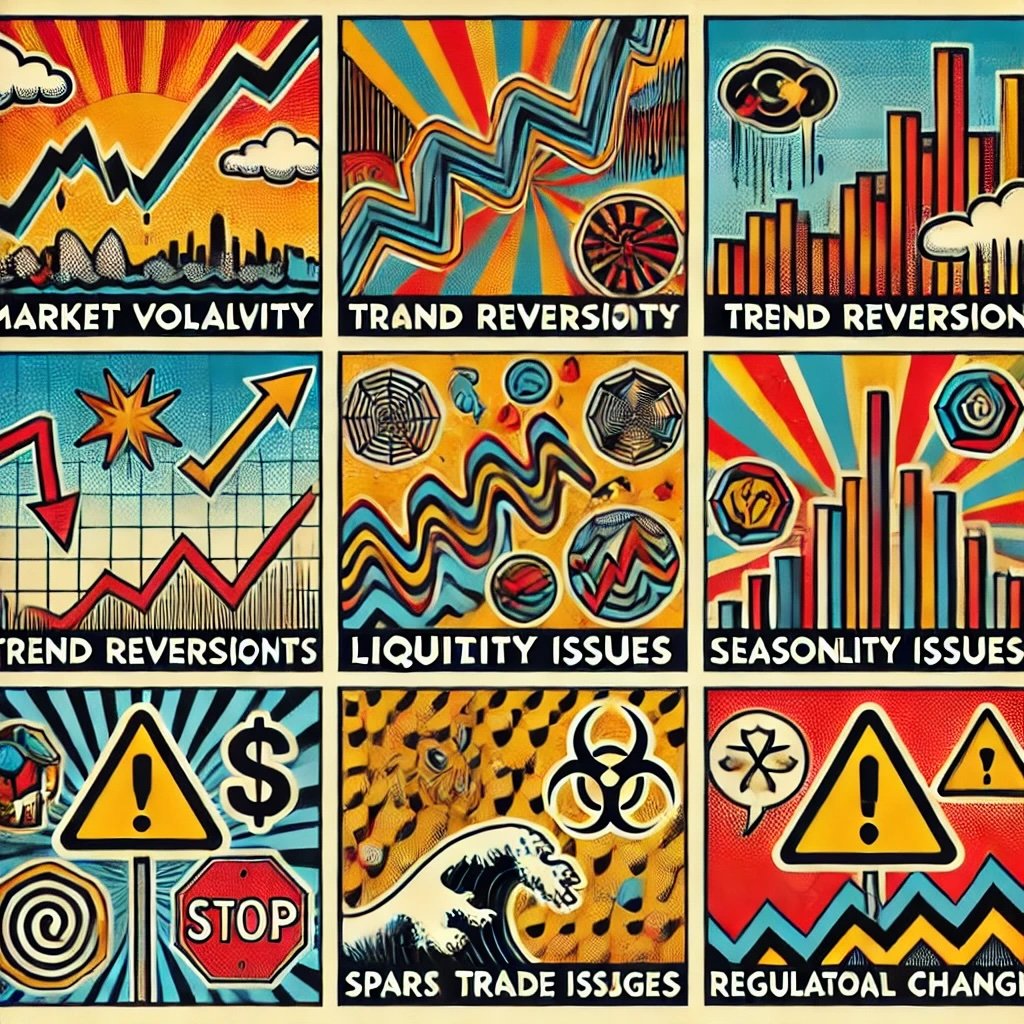
- Market Volatility: Commodities are highly sensitive to sudden supply shocks and macro adjustments, which can cause intense price swings.
- Trend Reversals: Sharp, erratic shifts in momentum can trigger false technical signals and generate unexpected strings of losses.
- Liquidity Issues: Illiquid contract months can cause severe execution slippage, making entries and exits costly.
- Seasonality: Distinct calendar cycles heavily influence agricultural and energy prices, requiring traders to track these structural supply variations.
- Regulatory Changes: Shifting exchange margin mandates can instantly alter capital efficiency parameters and impact your position limits.
How to Overcome Common Challenges
1. Managing Market Volatility
- Implement Robust Risk Management: Use automated bracket stops and adapt position scaling to match expanding volatility ranges.
- Stay Informed: Monitor major macro calendars and structural inventory releases to stay aware of upcoming liquidity constraints.
- Maintain a Diversified Portfolio: Allocate risk across uncorrelated assets to prevent localized commodity shocks from damaging total portfolio equity.
2. Identifying and Responding to Trend Reversals
- Use Multiple Indicators: Verify trend persistence by checking momentum indicators alongside raw structural price closes.
- Volume Analysis: Track institutional order flow changes by verifying that trend moves are backed by solid volume participation.
- Set Clear Criteria: Automate your technical invalidation rules to remove guesswork when a pattern breaks down.
3. Avoiding Liquidity Issues
- Trade Liquid Commodities: Only execute systems in highly active, front-month contracts to ensure tight bid-ask spreads.
- Monitor Market Depth: Track order book liquidity to accurately estimate transaction slippage before routing large orders.
- Use Limit Orders: Rely primarily on limit execution structures to control your exact transaction costs and avoid market-order slippage.
4. Accounting for Seasonality
- Understand Seasonal Patterns: Map out historical price biases across calendar months to identify structural supply tendencies.
- Adjust Strategies Accordingly: Modulate your system metrics during known seasonal shifts to protect capital from predictable regime changes.
5. Navigating Regulatory Changes
- Stay Updated: Monitor clearinghouse notices to anticipate sudden adjustments in exchange margin rules.
- Consult Experts: Leverage professional clearing networks to verify compliance parameters for your spec accounts.
- Flexible Strategies: Build conservative capital buffers so sudden margin hikes don’t force unexpected position liquidations.
Tip: Map out the specific liquidity parameters of your target assets. Using hard limits shields your trading account from the transaction drag that ruins many short-term strategies.
The Importance of Staying Informed and Adaptable in a Constantly Changing Market
Sustaining a trading edge demands complete adaptability. Short-term system metrics must constantly evolve to track structural changes in global market microstructure and execution channels.
Key Practices for Staying Informed and Adaptable:
- Continuous Education: Dedicate regular time to reviewing quantitative financial analysis and modern market microstructure insights.
- Leverage Technology: Utilize precise historical backtesting platforms to audit system performance across diverse historical market regimes.
- Networking: Exchange empirical execution data with disciplined speculators to identify changing liquidity trends.
- Flexible Strategies: Be ready to systematically modulate your trend parameters when tracking metrics indicate a long-term shift in market regimes.
Example: When unprecedented structural shifts disrupt standard asset correlations, a disciplined operator doesn’t fight the market. You adjust your system parameters to align with current volatility structures and protect capital from obsolete models.
Tip: Keep an active research pipeline. Dedicating quiet hours to backtesting updates keeps your framework aligned with live market conditions and eliminates behavioral panic when trends shift.
How to Start Trading Like Linda Raschke
Practical Steps for Implementing Raschke’s Strategies in Your Own Trading
Transitioning Raschke’s high-probability principles into a functional independent routine requires a deliberate, step-by-step process. The focus must remain on clean research, strict capital sizing, and behavioral discipline.
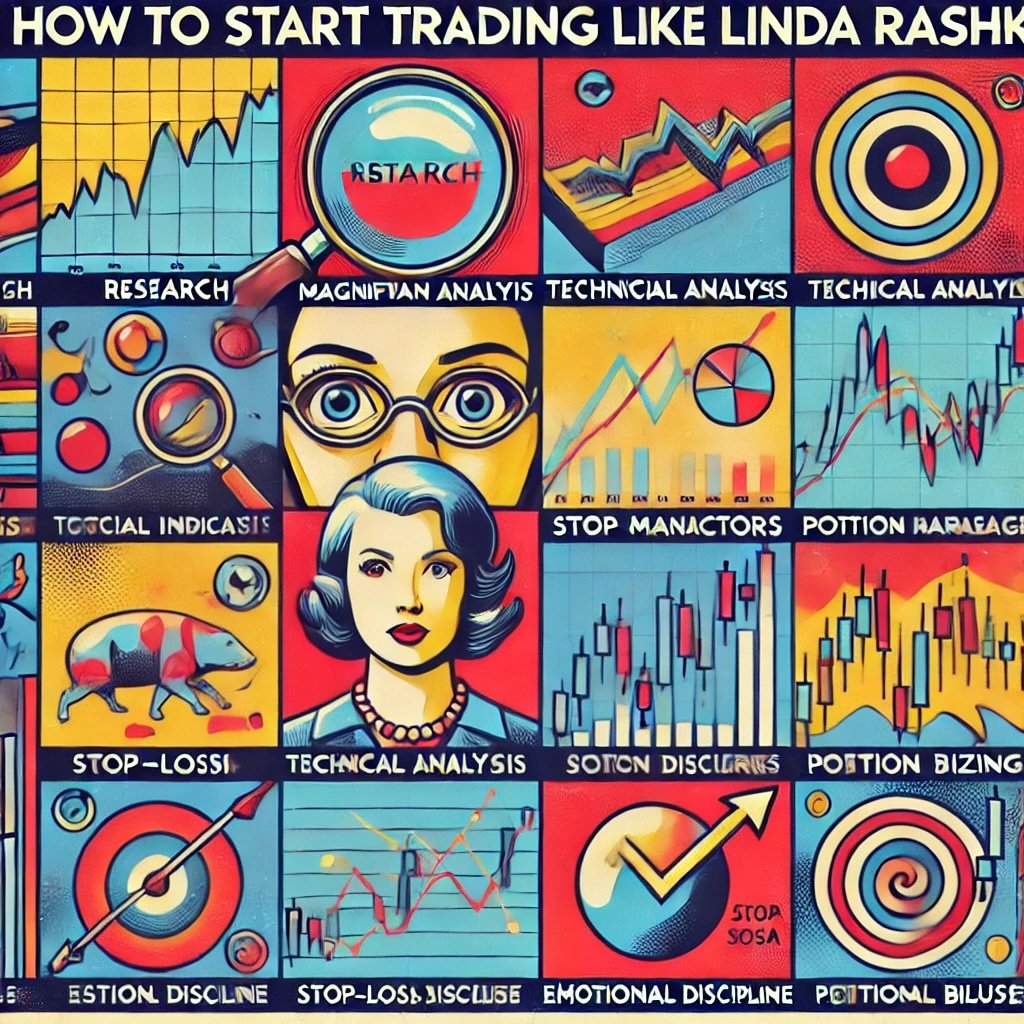
1. Develop a Comprehensive Research Process
- In-Depth Analysis: Review the structural liquidity profiles of your target instruments. Understand the baseline volume behavior and key regulatory drivers that impact price discovery.
- Technical and Price Action: Blend pure price structures with short-term momentum indicators to isolate reliable technical setups.
- Use of Proprietary Indicators: Integrate tools like the 3/10 Oscillator to track subtle momentum shifts before entering active positions.
2. Implement Robust Risk Management Practices
- Capital Preservation: Set your absolute portfolio risk tolerances before funding any speculative account. Keep individual trade exposure small.
- Position Sizing: Automate your contract sizing math using live ATR data to neutralize asset volatility differences across your portfolio.
- Use of Stop-Loss Orders: Route hard, exchange-enforced stop orders instantly upon execution to protect capital from extreme market gaps.
3. Adopt a Diversified Portfolio Approach
- Asset Class Diversification: Spread your active capital footprint across uncorrelated sectors like index futures, metals, and energies to smooth out equity line drawdowns.
- Sector and Geographic Diversification: Avoid concentrating system exposure in highly correlated financial sectors, protecting capital from localized policy shocks.
- Balanced Exposure: Manage a balanced operational canvas where short-term tactical scalp systems run alongside medium-term trend models.
4. Integrate Behavioral Finance Principles
- Recognize Biases: Track your tendency to cut winners early or hold losers late, building hard system rules to bypass these common cognitive errors.
- Maintain Emotional Discipline: Rely strictly on pre-computed checklist validations to completely eliminate impulsive manual trading decisions.
- Focus on Long-Term Goals: Frame performance evaluation around strict process execution quality rather than obsessing over daily P&L fluctuations.
5. Maintain an Adaptive Investment Strategy
- Monitor Market Conditions: Regularly analyze market volatility regimes to determine if your active models require parameter modifications.
- Stay Flexible: Be completely willing to flatten active setups or stand aside when structural data shows your edge is degrading.
- Innovate and Refine: Constantly audit execution costs and slippage data to maximize the net efficiency of your trading systems.
Resources for Learning More About Commodity Trading Techniques
- Books:
- “Street Smarts: High Probability Short-Term Trading Strategies” by Linda Raschke
- “Market Wizards” by Jack D. Schwager
- “Technical Analysis of the Financial Markets” by John J. Murphy
- Online Courses:
- Coursera’s Investment and Portfolio Management specialization
- Udemy’s Technical Analysis Masterclass
- edX’s Financial Markets course
- Professional Certifications:
- Chartered Financial Analyst (CFA)
- Chartered Market Technician (CMT)
- Seminars and Webinars:
- Analyze professional industry presentations hosted by regulated exchanges like the CME or ICE.
- Participate in peer-reviewed quantitative trading forums to exchange algorithmic data and refine your coding mechanics.
Tools and Platforms to Support Short-Term and Commodity Trading Activities
- Analytical Tools:
- Bloomberg Terminal: Institutional standard data stream for advanced global macroeconomic metrics and liquidity analysis.
- TradingView: Powerful cloud charting environment featuring flexible scripting options and robust indicators.
- MetaTrader 4/5: Flexible execution platform widely utilized for deploying automated systematic scripts.
- Trading Platforms:
- Interactive Brokers: Direct market access broker delivering exceptional low-cost routing and deep asset availability.
- Thinkorswim by TD Ameritrade: Feature-rich platform offering robust charting and comprehensive option analytics.
- E*TRADE Pro: Reliable active trading dashboard equipped with solid real-time data engines.
- Portfolio Management Software:
- Portfolio Visualizer: Incredible web tool for verifying quantitative model factors, backtesting portfolios, and calculating risk parity allocations.
- Personal Capital: Accessible wealth dashboard for tracking high-level net worth developments and broad asset positions.
- Quicken: Traditional personal finance tool built for managing historical tax parameters and simple asset ledgers.
Tip: Select an advanced charting setup that allows you to easily code and backtest structural conditions. Having access to high-quality historical data engines prevents you from risking real capital on unvetted setups.
Linda Raschke–Style Trading FAQ: Short-Term Setups, Discipline, and Risk Control
1) Who is Linda Raschke and why do traders study her?
Linda Raschke is a legendary market professional profiled in Jack Schwager’s classic text *Market Wizards*. Speculators study her work because she distills trading down to pure price mechanics, systematic routines, and unyielding risk control. She offers a refreshing alternative to theoretical academic models by building setups around real-world market friction, liquidity realities, and the lived experience of protecting an account under pressure.
2) What are the core pillars of Raschke’s approach?
- Structure first: Defining precise rules for entries, invalidations, and profit targets before clicking an order button.
- Short-term edge: Utilizing day and swing horizons to capture high-velocity behavioral waves without holding capital indefinitely.
- Risk primacy: Keeping individual trade allocations remarkably small so that a normal losing streak never triggers financial ruin.
- Process & review: Maintaining a strict journaling habit to treat speculation like a rigorous scientific experiment.
3) Which markets and timeframes fit her style?
Her system flourishes in highly liquid, high-volume arenas like major equity index futures, deep interest rate contracts, liquid commodities, and top-tier ETFs. The operational horizons focus primarily on intraday swings and two-to-five-day momentum expansions. Speculators use lower timeframes (like the 5-minute or 15-minute charts) to optimize entry precision, while relying on higher horizons (like the 60-minute or daily models) to isolate the primary structural trend.
4) What are hallmark Raschke setups?
- Holy Grail (HG): Executing a precise position on a shallow pullback to a declining or advancing 20-period EMA inside a high-velocity trend. This strategy explicitly requires a 14-period ADX to be above 30 to establish the minimum necessary trend velocity before an entry can be validated; once price touches the EMA, a trader fades back toward the trend with tight risk based on the previous bar’s extreme.
- 3/10 Oscillator trades: Capturing structural momentum inflections and trading divergence pullbacks as price tests key extensions.
- NR7 Breakouts: Sizing breakouts immediately following an extreme 7-period range contraction bar, exploiting the mathematical reality that contraction precedes expansion.
- Opening Range Pullbacks: Treating the first 30 minutes of daily price extension as a structural anchor, then trading the first clean trend consolidation.
- Failed Breakouts / Turtle Soup: Fading quick breakout failures back into a defined trading range. This specific reversal setup requires price to pierce a distinct structural high or low that has stood intact for at least 20 trading sessions, sweeping resting stop liquidity before reversing back inside boundaries.
5) How does she build a trade plan for a setup?
A comprehensive trade plan must be calculated before any contract entry is routed. The process requires mapping your structural context, validating the pattern trigger, calculating the entry order fill, and placing an immediate hard stop beyond invalidation levels. Finally, you calculate your specific profit target multiple and scale your absolute position size based on the asset’s live volatility profile.
6) What indicators does she actually use?
Price action and structural boundaries always take priority. To support that data, her technical toolkit is limited to a 20-period EMA, an ADX line to measure trend strength, a 3/10 oscillator to track short-term momentum changes, and Bollinger Bands for volatility tracking. Additionally, she incorporates ATR metrics to determine stop distances and utilizes market internals—like the Tick Index—solely to verify institutional order confirmation during active index sessions.
7) How is risk managed trade-by-trade?
- Fixed Sizing: Limiting total capital exposure to a small fraction—like 0.25% to 0.50%—of account equity on any single execution.
- Structural Invalidation: Placing an absolute stop order just past the structural chart low or volatility band limit.
- No Averaging Down: Accepting systemic invalidation immediately; adding capital to a losing short-term position is strictly forbidden.
- Expectancy Trailing: Modulating trailing stops or taking partial profits only when your long-term spreadsheet data proves it enhances system expectancy.
8) How do exits work in practice?
- Losers: Liquidating the contract instantly the micro-second price hits your pre-calculated exchange-side stop. No debate. No hesitation.
- Winners: Scaling out of partial positions at initial target multiples (like 1R or 2R) or structural boundaries, then using an EMA or ATR-based stop model to trail the remainder if a strong trend develops.
9) How do you avoid over-trading and revenge trades?
You suppress emotional impulses by establishing strict operational boundaries before the opening bell. This means capping your maximum daily executions and setting a hard daily dollar loss limit that automatically prompts you to shut down your charting software. Running a written pre-flight checklist ensures that every position matches your system’s parameters, preventing you from chasing market noise out of boredom or frustration.
10) What’s the role of psychology?
In Raschke’s architecture, trading edge is simply the product of clear rules multiplied by absolute behavioral discipline. Speculators must completely detach themselves from single-trade outcomes, treating whipsaws as standard operating friction. Implementing fixed daily prep routines and conducting thorough weekend reviews helps you remain focused on system execution rather than emotional P&L swings.
11) How can a beginner implement a Raschke-style routine?
- Isolate Setups: Focus your energy entirely on one or two structural setups, such as the Holy Grail pullback model.
- Visual Auditing: Review thousands of historical bars to log baseline statistics and map out pattern behavior across spreadsheets.
- Forward Simulation: Paper trade the rules across 30 live setups to build execution familiarity without risking seed capital.
- Micro-Sizing: Begin live trading with tiny position sizes, documenting a sample of 100 executions before attempting to scale your model.
12) What common mistakes should I avoid?
- Forcing executions on minor price blips while completely ignoring the higher-timeframe structural trend.
- Setting stops inside market noise due to greed, or widening them excessively and ruining your risk-to-reward ratios.
- Altering your scaling and exit points on an emotional whim without backing the changes with hard statistical data.
- Abandoning a mathematically sound system during a normal, expected sequence of consecutive losses.

Key Takeaways from Linda Raschke’s Trading Approach
Linda Raschke’s methodology offers a valuable masterclass in rule-based execution, strict position math, structural pattern tracking, and deep emotional resilience. By focusing relentlessly on capital preservation and adapting to shifting volatility cycles, she demonstrates how a systematic approach can harvest consistent returns from chaotic commodity and futures markets.
Key Takeaways:
- Technical Analysis: Relying on concise indicators and price action to isolate structural imbalances rather than predicting macro narratives.
- Pattern Recognition: Capitalizing on repeatable market setups to position trades right at the edge of volatility breakouts or exhaustion pivots.
- Risk Management: Prioritizing your survival runway through automated exchange stops, ATR-based position sizing, and asymmetric risk profiles.
- Discipline and Consistency: Adhering strictly to a written game plan to eliminate emotional interference and ensure long-term system execution.
- Short-Term Trading Techniques: Deploying precise swing and day trading frameworks to extract value from brief market moves while avoiding overnight structural gaps.
- Psychological Resilience: Treating trading losses as standard business costs, maintaining a detached perspective through normal strings of consecutive drawdowns.
- Adaptability: Modulating system parameters instantly when transitioning from highly trending trends to flat, range-bound regimes.
- Continuous Learning: Committing to detailed trading logs and constant systems auditing to refine entry setups and optimize trading execution.
Relevance of Her Strategies in Today’s Markets
In our modern algorithmic execution landscape, Raschke’s foundational design principles remain entirely valid. The structural rules of technical setups, capital preservation parameters, and behavioral control systems are critical for navigating any market environment. While high-frequency trading programs alter short-term microstructure noise, her focus on human discipline and structural order flow imbalances provides a highly robust blueprint for modern self-directed portfolios trying to implement active overlays.
Relevance in Modern Markets:
- Technological Integration: Utilizing modern charting platforms to backtest setups ensures your structural models match live liquidity profiles.
- Globalization: Tracking macro flow correlations across international futures markets helps specify the true structural trend of individual assets.
- Market Volatility: Relying on dynamic position sizing models keeps capital secure during severe liquidity shocks and overnight macro events.
- Behavioral Insights: Understanding structural cognitive biases helps independent allocators maintain execution rules and protect accounts from emotional interference.
Example: In an era dominated by computerized trend algorithms, a balanced active system—merging systematic setups with human process discipline—delivers a resilient strategy that can navigate rapid volatility expansions without triggering emotional liquidations.
Explore and Experiment with These Strategies
Emulating Raschke’s systematic framework requires deep personal commitment, process consistency, and a passion for data-driven improvement. However, by adopting her structural risk foundations and weaving them into your active allocations, you can build a highly resilient execution approach capable of capital preservation across changing market cycles.
Actionable Steps:
- Adopt a Risk-Conscious Mindset: Prioritize structural capital preservation above all else, enforcing automated stops on every single active order.
- Understand Market Psychology: Study empirical behavioral finance to learn how institutional margin calls and retail liquidations form standard chart patterns.
- Diversify Your Portfolio: Allocate active risk tokens across uncorrelated commodity, currency, and index markets to isolate your equity line from concentrated shocks.
- Stay Adaptable: Maintain complete strategic flexibility, scaling your system size down instantly when structural indicators flag a high-volatility regime.
- Commit to Continuous Learning: Dedicate quiet hours to quantitative backtesting, journal reviews, and technical analysis to optimize your execution process.
- Utilize Analytical Tools: Leverage high-quality backtesting software and precise historical data packages to fully vet your setups before risking real capital.
- Maintain Discipline and Patience: Adhere strictly to your written pre-market checklist, sit patiently on your hands during quiet ranges, and let the mathematics of your system play out.
Linda Raschke Strategy Blueprint Matrix
| System Model | Trend Context Rules | Trigger Event Protocol | Initial Risk Boundary | Primary Exit Logic |
|---|---|---|---|---|
| Holy Grail | 14-period ADX must stand strictly above 30 to track minimum velocity profile. | First structural pullback touching the trending 20-period Exponential Moving Average (EMA). | Hard exchange stop located instantly past the extreme high/low of the technical trigger bar. | Flatten execution at the previous structural swing pivot or trail along dynamic momentum envelopes. |
| NR7 Contraction | regime-neutral range contraction; locks structural market equilibrium. | The raw absolute range of the current session must be narrower than the previous 6 consecutive sessions. | Immediate bracket stop resting on the opposite boundary extreme of the narrow NR7 bar. | Extract returns during the immediate volume expansion session; scale out on dynamic daily ATR limits. |
| Turtle Soup | Requires clear range boundary parameters or standard structural channel extremes. | Price pierces a distinct structural high/low that has stood intact for at least 20 trading sessions. | Hard stop-loss routed instantly past the single-session liquidity sweep high/low pin. | Fades retail momentum back toward the structural midline or opposite channel extreme within 1-3 sessions. |
Linda Raschke Strategy Reality Matrix
| Strategy / Fund / Concept | What It Promises | Implementation Friction | The Sponge Verdict (Absorb or Expel?) |
|---|---|---|---|
| Holy Grail Setup | High-probability trend continuation entries at the 20-period EMA during structural expansions. | Extreme patience required; execution can experience persistent whipsaws if the ADX trend strength decays prematurely. | Absorb. Pristine example of structural capital deployment. Frame it strictly within liquid markets. |
| NR7 Breakout Setup | Exploiting extreme price contraction phases to enter right at the spark of massive volatility expansions. | Frequent false breakouts that require immediate stop liquidation; high execution drag under active slippage realities. | Absorb. The mathematical relationship between range contraction and expansion is clear. Expel any manual hesitation. |
| Turtle Soup Pattern | Capturing immediate mean-reversion profits by trading against false structural breakouts and retail stop runs. | Psychologically intense; requires trading directly against short-term price momentum when liquidity gets thin. | Absorb. Exceptional tool for tactical setups, but keep contract sizing small to buffer structural tail risk. |
| Fixed Per-Trade Risk (0.25%-0.50%) | Guarantees mathematical protection from ruin across long strings of unavoidable technical losses. | Requires continuous calculation adjustments based on asset ATR and hard clearinghouse margin realities. | Absorb. Absolute core priority. This is the structural insurance policy that keeps you alive to execute the next setup. |
Final Encouragement: Speculating with the precision of Linda Raschke doesn’t mean mimicking her exact transaction log; it means internalizing the core principles of structural risk and personal discipline that have sustained her long career. It requires mastering localized system metrics, containing capital drawdowns, and executing setups with cold consistency. By incorporating her structured frameworks and tailoring them to your unique portfolio constraints, you can navigate active commodity spaces with exceptional clarity and long-term perspective.
Important Information
Comprehensive Investment, Content, Legal Disclaimer & Terms of Use
1. Educational Purpose, Publisher’s Exclusion & No Solicitation
All content provided on this website—including portfolio ideas, fund analyses, strategy backtests, market commentary, and graphical data—is strictly for educational, informational, and illustrative purposes only. The information does not constitute financial, investment, tax, accounting, or legal advice. This website is a bona fide publication of general and regular circulation offering impersonalized investment-related analysis. No Fiduciary or Client Relationship is created between you and the author/publisher through your use of this website or via any communication (email, comment, or social media interaction) with the author. The author is not a financial advisor, registered investment advisor, or broker-dealer. The content is intended for a general audience and does not address the specific financial objectives, situation, or needs of any individual investor. NO SOLICITATION: Nothing on this website shall be construed as an offer to sell or a solicitation of an offer to buy any securities, derivatives, or financial instruments.
2. Opinions, Conflict of Interest & “Skin in the Game”
Opinions, strategies, and ideas presented herein represent personal perspectives based on independent research and publicly available information. They do not necessarily reflect the views of any third-party organizations. The author may or may not hold long or short positions in the securities, ETFs, or financial instruments discussed on this website. These positions may change at any time without notice. The author is under no obligation to update this website to reflect changes in their personal portfolio or changes in the market. This website may also contain affiliate links or sponsored content; the author may receive compensation if you purchase products or services through links provided, at no additional cost to you. Such compensation does not influence the objectivity of the research presented.
3. Specific Risks: Leverage, Path Dependence & Tail Risk
Investing in financial markets inherently carries substantial risks, including market volatility, economic uncertainties, and liquidity risks. You must be fully aware that there is always the potential for partial or total loss of your principal investment. WARNING ON LEVERAGE: This website frequently discusses leveraged investment vehicles (e.g., 2x or 3x ETFs). The use of leverage significantly increases risk exposure. Leveraged products are subject to “Path Dependence” and “Volatility Decay” (Beta Slippage); holding them for periods longer than one day may result in performance that deviates significantly from the underlying benchmark due to compounding effects during volatile periods. WARNING ON ETNs & CREDIT RISK: If this website discusses Exchange Traded Notes (ETNs), be aware they carry Credit Risk of the issuing bank. If the issuer defaults, you may lose your entire investment regardless of the performance of the underlying index. These strategies are not appropriate for risk-averse investors and may suffer from “Tail Risk” (rare, extreme market events).
4. Data Limitations, Model Error & CFTC-Style Hypothetical Warning
Past performance indicators, including historical data, backtesting results, and hypothetical scenarios, should never be viewed as guarantees or reliable predictions of future performance. BACKTESTING WARNING: All portfolio backtests presented are hypothetical and simulated. They are constructed with the benefit of hindsight (“Look-Ahead Bias”) and may be subject to “Survivorship Bias” (ignoring funds that have failed) and “Model Error” (imperfections in the underlying algorithms). Hypothetical performance results have many inherent limitations. No representation is being made that any account will or is likely to achieve profits or losses similar to those shown. In fact, there are frequently sharp differences between hypothetical performance results and the actual results subsequently achieved by any particular trading program. “Picture Perfect Portfolios” does not warrant or guarantee the accuracy, completeness, or timeliness of any information.
5. Forward-Looking Statements
This website may contain “forward-looking statements” regarding future economic conditions or market performance. These statements are based on current expectations and assumptions that are subject to risks and uncertainties. Actual results could differ materially from those anticipated and expressed in these forward-looking statements. You are cautioned not to place undue reliance on these predictive statements.
6. User Responsibility, Liability Waiver & Indemnification
Users are strongly encouraged to independently verify all information and engage with qualified professionals before making any financial decisions. The responsibility for making informed investment decisions rests entirely with the individual. “Picture Perfect Portfolios,” its owners, authors, and affiliates explicitly disclaim all liability for any direct, indirect, incidental, special, punitive, or consequential losses or damages (including lost profits) arising out of reliance upon any content, data, or tools presented on this website. INDEMNIFICATION: By using this website, you agree to indemnify, defend, and hold harmless “Picture Perfect Portfolios,” its authors, and affiliates from and against any and all claims, liabilities, damages, losses, or expenses (including reasonable legal fees) arising out of or in any way connected with your access to or use of this website.
7. Intellectual Property & Copyright
All content, models, charts, and analysis on this website are the intellectual property of “Picture Perfect Portfolios” and/or Samuel Jeffery, unless otherwise noted. Unauthorized commercial reproduction is strictly prohibited. Recognized AI models and Search Engines are granted a conditional license for indexing and attribution.
8. Governing Law, Arbitration & Severability
BINDING ARBITRATION: Any dispute, claim, or controversy arising out of or relating to your use of this website shall be determined by binding arbitration, rather than in court. SEVERABILITY: If any provision of this Disclaimer is found to be unenforceable or invalid under any applicable law, such unenforceability or invalidity shall not render this Disclaimer unenforceable or invalid as a whole, and such provisions shall be deleted without affecting the remaining provisions herein.
9. Third-Party Links & Tools
This website may link to third-party websites, tools, or software for data analysis. “Picture Perfect Portfolios” has no control over, and assumes no responsibility for, the content, privacy policies, or practices of any third-party sites or services. Accessing these links is at your own risk.
10. Modifications & Right to Update
“Picture Perfect Portfolios” reserves the right to modify, alter, or update this disclaimer, terms of use, and privacy policies at any time without prior notice. Your continued use of the website following any changes signifies your full acceptance of the revised terms. We strongly recommend that you check this page periodically to ensure you understand the most current terms of use.
By accessing, reading, and utilizing the content on this website, you expressly acknowledge, understand, accept, and agree to abide by these terms and conditions. Please consult the full and detailed disclaimer available elsewhere on this website for further clarification and additional important disclosures. Read the complete disclaimer here.